There’s a clear blue sky and an icy north wind but if you can get yourself organised to be in a sheltered spot the sunshine is strong enough to feel warm.
I look up at the three geranium cuttings sitting hydroponically in small medicine bottles of water. It’s hard to see if they are beginning to sprout roots and in the absence of rooting hormone it’s hard to tell whether they will.
Yesterday Vicky made a chick out of a polystyrene egg supplied by Emily and I made a ‘Lady Posh-Totty’ out of mine. That was Task 3 done. In this family we extend occasions to weeks. So a birthday becomes a birthday week, Christmas becomes Christmas week, and it follows that Easter becomes Easter week. There are still two more tasks to do! One’s an egg hunt (or a creative alternative), the other a colouring-in Easter card, which I think we’ll pass on.
Today was also the day I believe I finally closed the door to Montmorency. The crafty, easy access point has been filled. Access denied! The battle with this mouse has been a bit like the relationship between Peter Rabbit and Mister McGregor. Will Monty and his crew find another route to bring irritation to an otherwise calm Victorian terrace? Time will tell. The mouse-catcher told me that mice are neophobic – they have a fear of the new, and that all too often far more than compensates for the yummiest of baits and diabolical (if you’re a mouse, that is) of traps.
Emily rang, thinking for some reason it was Wednesday, about the shopping list. We chat about preferred purchases, stopping spuds from going green and other grocery small talk. Tom comes in from the garden where he’s been reading. We have a chat about this diary and he tells me that he’s working for Dominic Raab, who’s deputising for the PM at the moment. It’s been hard work, but he feels a great sense of satisfaction about “doing his bit.” Wow, I tell him, we have a Whitehall Mandarin in the family. Next birthday we’ll buy him a shirt with dragons and big sleeves.
I mean really, really, really big sleeves!
Meanwhile, in the living room, Vicky is singing along to a DVD of ‘Phantom of the Opera.’
She has a lovely voice.
The Bigger Picture: A Clash of Titans
Donald Trump and Anthony Fauci were both born New Yorkers. Neighbours, in fact, from Queens and Brooklyn.
Both are also Titans.
Trump, because of his larger than life persona – love him or loathe him, and there seems no inbetween, no-one can ignore him, his inseparability from big money – whether he owns it or owes it seems to follow different rules from mere mortals, and his presidential power which he exercises with such unpredictability it evokes an awe and wonder about it, as it would a Marvel comic supervillain.
Fauci’s titanic superpower is his reputation, experience and expertise with infectious diseases. There are many who say that he is among the most trusted medical figures in America, having served public health for more than 50 years, advising every president since Ronald Reagan. He became director of the NIAID in 1984 and has made contributions to HIV/AIDS research and other immunodeficiency diseases. From 1983 to 2002, Fauci was one of the world’s most frequently-cited scientists across all scientific journals and was awarded the Presidential Medal of Freedom, the highest civilian award in the United States, in 2008.
Fauci was put on the spot two days ago in an interview with CNN’s Jake Tapper. Despite being as diplomatic as anyone is likely to have been he said “I mean, obviously, you could logically say that if you had a process that was ongoing and you started mitigation earlier, you could have saved lives,” continuing, “”What goes into those kinds of decisions is – is complicated. But you’re right. I mean, obviously, if we had, right from the very beginning, shut everything down, it may have been a little bit different. But there was a lot of pushback about shutting things down back then.”
Trump, who on Sunday re-tweeted a supporters’ statement that Fauci should be fired, was furious, calling the epidemic expert to the podium early in a presidential coronavirus briefing.
Fauci, ever the diplomat, stepped back from the brink. It was a poor choice of words, he said.
Also, “Hypothetical questions sometimes can get you into some difficulty.”
It was a realisation of how thin-skinned Trump was, Supervillains do have their equivalent of Achilles Heels.
But Fauci was right. Trump could have seen what was coming. The president had been warned about the potential for a pandemic but internal divisions, lack of planning, and his faith in his own instincts led to the slow Federal response.
“Nobody knew there would be a pandemic or epidemic of this proportion,” President Trump has repeatedly stated.
Wrongly.
The president told Watergate veteran Bob Woodward in a taped interviews on February 7th and March 19th that he had known about the deadly nature of the Covid-19 outbreak and its potential to become a pandemic since a presidential briefing on 28th January, and he set out to play it down because he did not want the people to panic. It would be almost five months before this entered the mainstream media arena, but it throws light on what are a set of erratic decisions and a declaration from Tom Frieden, a former director of the United States Centres for Disease Control and Prevention (CDC) that the country is less safe from Covid-19 when the channels of communication between the agency and the American public are erratic.
Behind the scenes Trump was torn between his business friends including Michael Corbut of Citigroup, Brian Moynihan of Bank of America, Steve Schwarzman of Blackstone and the investors Paul Tudor Jones and Nelson Peltz, who wanted a quick reopening of the economy and medical experts who were pushing back against the move. His natural instinct, from a lifetime of immersion, was with the business community. In truth, in his ramblings about ventilators and off the wall medications, he had trouble engaging with the science.
By the time it came to today’s presidential briefing he rolled back on that. But the briefing itself, where he rambled on for over an hour, was off the rails, bizarre and troubling. He pulled the US out of the World Health Organisation amid a tapestry of half-truths and conspiracy theories, made some totally weird and often factually incorrect statements about ventilators, lashed out at China and Democrats in roughly equal measure and was rude and abrupt to a number of journalists who had gathered in the Rose Garden.
It isn’t necessarily the first time that President Trump had displayed his inability to manage the pandemic, but it was a turning point in how observers saw the helplessness of a flailing Titan in the face of a rising pandemic and the human toll it was exacting.
And time will show that Fauci would outlast his president.
Other American news:
Back in Blighty:
Dominic Raab says, “Our plan is working,” but it’s too early to relax lockdown rules. The lockdown is set for a three week extension as worldwide cases of Covid-19 near 2 million. There’s also a call to scrap ‘triple lock’ on UK pensions after the coronavirus crisis. It’s expected to raise £20 billion.
But it will be some time before the situation improves significantly. There have been 777 deaths in the UK in the last 24 hours, leading to an overall death toll of 12,107. Hospitals are still under enormous pressure. At least 38 NHS workers have died from Covid-19, ranging from a 23 year old nurse to a 79 year old professor. There are many accounts of medics who find themselves treating their own colleagues critically ill for Covid-19.
Pressure on the NHS over admissions and transfers to ICUs is such that it issues the Covid-19 Decision Support Tool to help triage which patients go into intensive care. With about 5,000 coronavirus cases presenting every day and some intensive care wards already approaching capacity, doctors will score patients on three metrics — their age, frailty and underlying conditions — according to a chart circulated to clinicians.
It is recommended that patients with a combined score of more than eight points across the three categories should probably not be admitted to intensive care, although clinical discretion could override that decision.
Some deaths from the virus don’t even make it to hospital. About half are in care homes and to give a sense of scale of the problem, coronavirus outbreaks have been detected in 92 care homes in the last 24 hours. The Covid-19 death toll at a care home in Stanley, County Durham, hits 13.
Care workers are not as well protected by PPE and staff recruitment has always been a problem, even in pre-pandemic times. In Scotland, care workers are given a 3.3 per cent pay rise in view of the problem. It doesn’t happen elsewhere in the UK.
When it comes to PPE there is a deadly combination of the care sector being the poor relation to medicine in Health and Social Care and a desperate overall shortage. Even in the medical sector unions are warning that the UK stock of protective gowns is critically low.
Some of that shortage is political. The British government, deep in its Brexit mindset, decided not to participate in the EU purchasing consortium. It is going it alone, and as time will tell, muddling its way through.
Testing and tracing, abandoned in the early stages of the outbreak when, as Germany has shown, it could have been most effective in controlling Covid-19 creaks along in the UK, run by private contractors with little real experience in terms of rapidly creating an effective system. I looks very much that those in government simply haven’t got their head around the task at hand.
“We need an army,” said an expert in contact tracing, who had deal with outbreaks of Ebola, HIV and tuberculosis, as he observed the rise of Covid-19.
We currently have a privately hired militia.
And a fad in what’s fashionable among a smartphone obsessed population. Government orders NHS Bluetooth technology app after tech giants give the green light. The NHS is now working with Apple and Google to develop an app that will track how close users get to those with Covid-19.
The only time I will ever come to use this app, when it finally arrives, when I am in an indoor venue with other people in six months’ time, I find I appear to be the only customer using it.
Tech isn’t tech unless it can solve a problem. That’s what tech means. Most, even those in high places, with power and control over all our lives, forget it.
Vaccination still remains a hope rather than a reality. Much of the science behind developments that have been quietly underway since January has been repurposing existing vaccines to the new Covid-19 genome. The concept of general immunity has also been raised as negative correlations are reported between systematic BCG vaccinations as a national public health enterprise and the impact of Covid-19. But desperate times breed wishful thinking and critics are quick to point out the myriad of other variables such as socioeconomic status, demographic structure, rural versus urban settings, time of arrival of the pandemic, number of diagnostic tests and criteria for testing, and national control strategies to limit the spread of COVID-19.
What is known and worrying, however, is that according to UN agencies 117 million children may miss their measles shots due to Covid-19.
And for all our ability to gather knowledge, wisdom is harder to come by, exemplified by a deadly Covid-19 cluster in North West Tasmania may have been sparked by an ‘illegal dinner party’ of healthcare workers, and a premier drug company became a ‘virus super-spreader’ as a conference among Biogen employees unwittingly spread the coronavirus from Massachusetts to Indiana, Tennessee and North Carolina.
“Don’t bet on a quick global resurrection. The speed of economic recovery will be more tortoise than hare.” Professor Neil Ferguson, an epidemiologist and Covid-19 modeller predicts.
The coronavirus’s economic effects are hitting ethnic minorities and the young hardest. It’s a universal problem, the more vulnerable the group, the harder hit it is by Covid-19 and it’s indicative of human societies, whatever they claim, that governments, and even the rest of more advantaged citizens simply don’t do enough.
Globally, there are now 1.9 million cases of Covid-19 and more than 120,000 deaths. It’s a number that will rise into millions. Worldwide institutions become necessary to prevent an outbreak of economic disasters as the IMF provides debt relief to help 25 countries deal with the pandemic. But the slump in economic activity looks like it may lead to the biggest fall in carbon emissions since World War II. But experts warn that without structural change emissions declines caused by Covid-19 could be short-lived as economies get back to normal.
That will involve burning oil. The bitter price war between major oil producers has come to a truce – for now. Production will be cut by nearly 10 million barrels a day from May for the coming two months. It’s the largest cut ever and a reduced supply for up to two years.
It’s a time that oil markets have become erratic and as non-carbon-based energy alternatives lie at the heart of planning post-covid recovery it could mark the beginning of the end.
You could be forgiven for thinking about coronavirus as an agent of positive environmental change, particularly with respect to climate change, but don’t be fooled – the pandemic is far from environmentally friendly as opportunists take advantage of the crisis and deforestation spikes in the Amazon.
In Europe:
és and restaurants) has had to give way to more disciplined and structured meetings via Zoom and similar social media platforms.
Further afield:
While, step by step, daily reality is mutating:
Two things touch me on a personal level. The first is, were this not the height of a pandemic, this message from the local police congratulating the public for good behaviour would seem Orwellian, Now, it doesn’t shock.
“Over the weekend we have been all over #Bexley, #Lewisham and #Greenwich keeping you safe. We are really pleased to say that the majority of people we spoke with were exercising responsibly and others understood and walked on when asked, #StayHomeSaveLives.”
The second is someone declaring they have gone the full Bridget Jones and started a lockdown diary. Up to ten pages a day when they didn’t shower, leave the flat or see another living person.
Yesterday Vicky and I met two of Emily’s Easter challenges. The first was to make an Easter chick out of a yellow balloon, bits of laminated card and felt. A pair of googly eyes was included for good measure. Then we were to photograph it and share our achievements on WhatsApp. Unfortunately, Vicky’s balloon exploded early in the proceedings, but we sent a picture of that nonetheless. My chick fared a bit better – that is, it survived long enough to be photographed and WhatsApped. Emily responded with her own – a chick with really long legs. Maybe it was a hen-harrier chick!
So far, so good.
Then on to the mask. Vicky goes to town on hers, starting with half a paper plate and turning it into an Aztec-come-shaman creation. I thought of leaving it blank, so it looked like a PPE mask. Bit of a cheat. But I couldn’t resist putting a big toothy grin on it with a black marker pen and produced something deeply disturbing and certainly not Easter-like.
We chat about our endeavours on WhatsApp video and say hello to Tom, who’s resting after a hard-pressed week in Whitehall as one of the civil servants addressing the crisis. We make a point of not talking about his work, but he has been busy and we worry. He’s the most front-line of all of us, taking the train up to London, now largely empty, and entering ‘hostile territory’ a number of times a week.
The weather’s turned. There’s a strong northerly wind and it’s ten degrees cooler than it was a couple of days ago. The common has only the hardiest of outdoor venturers – mostly joggers and dog-walkers. Certainly not the sunbathers. There has been a police request on Nextdoor to stop gatherings near the Slade pond nearby, but today doesn’t look much like a gathering day.
I’ve lost a stone over lockdown. Maybe it’s the rowing machine. Maybe it’s being restrained in what we eat. Maybe the bathroom scales are kaput. Who knows?
The Bigger Picture: de Pfeffel’s Progress
Alexander Boris de Pfeffel Johnson has been discharged from St Thomas’ Hospital and is recovering at Chequers, his prime ministerial convalescent home in the Buckinghamshire countryside, ahead of a review into social distancing. He’s thanked the NHS for saving his life, especially Jenny and Luis, the nurses from New Zealand and Portugal for staying at his “ICU bedside for 48 hours, when things could have gone either way,”and implores the British to stay at home to beat Covid-19.
He has good reason to as the UK becomes the worst-hit country in Europe, the death toll from Covid-19 passing ten thousand.
Flirtation with herd immunity, slowness to respond and the negligent abandoning of testing when it could have been so effective in the early stages of the outbreak, in the same way a fire extinguisher can prevent a flare up turning into a full-blown conflagration, something more comprehensive like a sprinkler system even more so.
By contrast Germany’s early success, leading to less than a third of the deaths, owes much to 1.3 million tests followed up with a thorough programme of contact tracing. The UK has tested less than a quarter of that and has all but abandoned attempts to aggressively trace contacts. As Johnson saw this as his opportunity to revive his Churchillian wartime bombast, the messaging in Germany was much more sombre and down to earth.
“The pandemic is not a war,” German president Frank-Walter Steinmeier said at an Easter Sunday address. “It does not pit nations against nations, or soldiers against soldiers. Rather, it is a test of our humanity.”
Dealing with the pandemic is about empathy. Understanding at a deep level about what is meant by the common good and engaging with it. It’s not about the Johnson show with human suffering as a backdrop, or at best a chorus-line.
At the moment, he has suffered with countless others and his personal approval ratings rise to an all-time high of plus 38 as the populace identifies with his very human journey.
Don’t be fooled. It won’t last and any passing parallels with Evita Peron are ephemeral. Madonna won’t be playing Bojo any time soon.
And don’t think there has been any far-reaching consideration of who will make the sacrifices. Even the bailout will make the rich richer still and ordinary people will have to pay.
Structurally, British society hasn’t travelled far since the Great Crash of 2008. Virtually no sacrifices have been demanded of banks, landlords or profitable corporations, such as utility companies. The only people in society not being asked to share the burden are ‘rentiers:’ those who own assets they can charge others to use.
Down the line Covid-19 will make this ever clearer, as it will BAME people, who are still being disproportionately affected by the pandemic. They currently make up more than a third of patients in critical care, yet are only 16 per cent of the British population. It’s the British Medical Association who raise the alarm.
It’s the haves and have-nots. The powerful and powerless and the underlying selfishness that has, in some massive con, been made respectable.
The lack of PPE does arise from a government that failed to create a stockpile. A government that sleepwalked into a pandemic, and as will be revealed in the future, a government whose cronies will profit enormously through untendered multimillion pound contracts.
The price is paid by those in the front line. The carers in residential homes. Immigration workers who are forced to move asylum seekers without PPE, despite deportation flights being grounded. And nurses who have reached an unthinkable point of desperation that the Royal College of Nursing has issued guidelines telling nurses they can refuse to work if they aren’t protected from the coronavirus.
Those inequities are by no means limited to Britain. In his Easter message, Pope Francis calls for debt relief and an end to sanctions.
Across many countries leaders seize powers to fight Covid-19, and fear grows for democracy. France and Bolivia have postponed elections. Peru handed its president new legislative authority. Israel sharply ramped up the reach of its surveillance state.
Countries are facing pressures to loosen Covid-19 restrictions. Money is the new global deity (was it ever so new?) and when it can’t flow so easily It becomes an angry god, demanding human lives to appease It. So much so that Donald Trump, arch-priest of Money, lashes out at Dr Anthony Fauci after the good doctor said more lives could have been saved from the novel coronavirus if the country had been shut down earlier.
Covid and Money are at odds with each other.
Except for the price-gougers and profiteers from the pandemic. But that’s another story.
Other stories from across the world:
A Danish journalist watching Sweden’s more relaxed reaction to Covid-19 was like “watching a horror movie.” The exponential rise in Sweden contrasts strongly with other Scandinavian countries.
Spain has 619 new deaths from Covid-19, up from 510 reported on Saturday, yet it is to lift some of its lockdown rules.
Polish MPs are set to debate an abortion ban, while the lockdown prevents (an otherwise inevitable) protest. A similar bid to ban abortions in 2016 was defeated in parliament after thousands of women demonstrated in the streets. It’s not just Poland, from childbirth to the economy, women’s rights are endangered by the pandemic, particularly with regard to childbirth, abortion, fertility treatment, a parallel pandemic of domestic abuse and carrying the lion’s share of responsibility for children at home under lockdown
China’s Covid-19 cases rise to a six-week high, claimed to be primarily down to Chinese people returning home from other countries.
Which is also the case in South Africa has a number of stark contrasts with the empty street images we’ve become used to in western cities under quarantine. Poverty and inequality limit safe and distanced space, and unlike Ebola elsewhere in Africa this disease has been imported into the country not by the poor, but by those wealthy enough to have free access to the globalised superhighways of the twenty first century world. The first confirmed case was a South African returning from Italy on March 5th and a key hotspot in Johannesburg has been the financial centre, people who had travelled to other cities around the world, come back and gone to parties. The poor, in their impossible to pandemic-proof townships simply picked up the tab. Some even got to shouting, ‘Corona! Corona!’ at westerners passing through, because they thought it was a disease of rich white people.
In the United Kingdom:
Covid-19 lockdown sees Northern Ireland house fires increase by 50 per cent.
According to headteachers, schools in England could reopen in June after the summer half term.
Lord Sugar says the next series of ‘The Apprentice’ could be delayed until 2021.
Tesco introduces changes to adapt to Covid-19. These are one-way aisles, increase to contactless payments, new delivery slots, especially for vulnerable customers, with more on the way, encouraging customers to come at quiet times to avoid queuing, and protective screens. A number of product restrictions removed, as they encouraged stockpiling – the pandemic will long be remembered for the mass hoarding of toilet rolls!
There’s a local request on Nextdoor:
“Is there anyone who can recommend someone who does washing machine repairs please? Due to Covid, just some advice would be great if a visit cannot be arranged.”
We’re grateful it was our dishwasher and not our washer-dryer that went on the fritz early in lockdown. It is what under normal circumstances would be a minor domestic emergency turning into something much more ominous.
And a cautionary request from the neighbourhood police:
“While we would like to wish you all a Happy Easter, it’s disappointing that PC Teresa had to follow up reports of people still congregating at Slade Pond. Please #StayHome. Enjoy your chocolate, it can’t be made any clearer to help. #ProtectThe NHS, #Save lives.”
We see them out on the common. Always calm, patient and forbearing. It’s not a job I’d want to be doing at the moment.
On Thursday Emily left an Easter bag with the shopping. Because we cannot go to the shops, Emily is being our angel of mercy doing our weekly shopping run for us. Inside one of the bags she has composed an Easter booklet, which says the following:
Front Cover:
Easter box
Open on Easter Sunday
(cartoons of a rabbit, a chick, a chick coming out of an egg and a daffodil.)
Inside:
Happy Easter Sunday
So I thought (cartoon Emily with a thought bubble):
What do we do at Easter?
see each other
eat chocolate eggs
decorate eggs together
Then I thought (cartoon Emily with an idea lightbulb):
If I get some activities together, I could send you these in a box to you, and by joining in the activities we will be having fun, united together.
So, Ta Dah!! Here is the Easter box. (cartoon of box)
The box contains:
5 envelopes
Bag of chocolate eggs
Each envelope contains an activity with all the materials you will need, including glue. So no excuses! (smiley emoji)
You can do all the activities in any order. I will (if I haven’t already) set up a WhatsApp group called ‘Easter fun time’ where we can share photos and video clips of each other.
Note on Safety:
With all of our health and safety very prominent in my mind, rest assured that every item (including the delivery box) has been carefully prepared.
Items that could have been cleaned have been wiped down with my favourite bleach and water solution.
Every item (including this paper and pen) has been handled with clean Marigold gloves and I even wore a face mask (cartoon of Emily wearing a mask)
For items that could not be wiped, e.g. feathers, the original outer packaging has been cleaned and dried, then the item removed and placed in a paper envelope.
Every item was prepared well over 72 hours before being sent.
Right! That’s the health and safety bit! Now it’s time for fun!
Enjoy yourselves, have fun and we are looking forward to sharing the photos xx
Back Cover
(large cartoon of rear view of Easter Bunny)
I put a couple of beers in the fridge, pour today’s whisky ration into the decanter and set my alarm for 5 pm, when we take on the challenge.
Meanwhile there’s a cold front coming in to end all the fine weather we’ve been having. The clouds are starting to tower and look dark underneath and from time to time we can hear the rumblings of thunder from the static caused by mixing air.
The Bigger Picture: A Perfect Storm
And on the seventh day was Boris Johnson discharged from hospital. Not only is it the wrong number of days to come back from the dead for Easter but Boris Johnson is no Messiah. Jesus spent his handful of years of ministry encouraging the common good, self-restraint and selflessness. Boris Johnson spent his years in a different kind of ministry promoting libertarianism, the ideology of self-interest and the indulgences it allows to those who succeed through it.
It was that ideology that was always balanced against the advice of scientists in a false equivalence, so he could say he was following the science, while actually doing the opposite. It was also that ideology that led to Brexit, which in turn led to a wilful distancing, illustrated by Britain missing a total of eight conference calls or meetings about Covid-19 between EU states or health ministers – meetings Britain was still entitled to join.
It seemed to some at first that his relaxed manner and refusal to panic was reassuring. Those who had not yet learned that the core feature of Johnsonism – to promise the Earth but deliver nothing more than a kid’s plastic bucketful of earth – but the reality was that in a country that led the world in medical and bioscience, the leader did not engage, did not listen, followed his faith in those instincts he always felt served him well, and in the midst of an alarming public death rate, fell ill himself.
Now he’s out and recuperating at Chequers.
As another, older, both historically and actually, leader, the Queen reassures the nation in her first Easter message about “New Hopes.”
It is formal and formulaic, even though she has never given an Easter speech before. But it projects a strange stability that echoes royal speeches going back ninety years and has a quality of ritual that so many Brits buy into. It’s irrational. But then Brits are, as we applaud the NHS, clapping and banging kitchenware, despite routinely, while voting for a whole decade for a political party with a track record of trying to cripple it.
For now the NHS is heroic – deservedly so – as it battles the rising viral tide. British Covid-19 hospital deaths pass 10,000 after 657 die in England in the last 24 hours. Sir Jeremy Farrar, director of the Wellcome Trust and an expert on infectious diseases who’s published over 600 papers, warns that the signs are there that the UK coronavirus death toll could end up being the highest in Europe.
Time will prove him right.
Britain faces a perfect storm. It’s not just lackadaisical leadership and ideological and political instincts that obstruct dealing with the virus. Nor is it an accident of geography that the country finds itself being a hub on the northwest of Europe, actively reaching out to the far corners of the globe. Much of it is what Britain has set out to be for the last forty years – a country that had decided to be a land of individual opportunity. A share-holding, property-owning democracy, as Margaret Thatcher had once egged on the country to be.
There is a school of thought that all political ideas, when put into practice continue down a particular road until they pass the point of usefulness or benefit, and steamroller on, like a giant behemoth until they become counterproductive ay best, and destructive or even absurd at worst. People bought shares in newly privatised industries, sold them to financial institutions to make a nominal profit, and the shares drift from private to corporate ownership. Same with the selling of council houses. Properties become major assets to cash in on and the rental market passes from public housing programmes whose primary purpose is to meet the changing needs of both individuals and communities, to private landlords and a free market that makes homes unaffordable.
“Blessed are the wealthmakers,” Saint Margaret of Thatcher might have said.
“Blessed are the professionals, the organisers,” other noteworthies might well have added. “The players of keys, movers and shakers of software files.”
Most will not get us all out of the fix we’re in.
Much has been said in praise of health and care workers. Rightly so. But it’s also the underpaid, hitherto overlooked and undervalued to meet our needs and make the machinery behind our lives continue to function – the drivers of trains, buses and taxis, the deliverers of groceries and takeaways, the supermarket checkout staff.
It seems that those we have most taken for granted are those who we need most. Our definition of essential has changed.
For the rest of us it’s working from home where possible, furlough on 80% income where it’s not and redundancies for the unlucky who have been caught out by the wrong pandemic, in the wrong place at the wrong time. I count myself lucky – and a little guilty – to be retired on a pension. The whole world of employment has been tipped on its head.
Those who can do their best to hide from harm’s way. The virus isn’t magical. It can’t travel through walls and closed doors.
Italy and Spain have passed the peaks of their epidemics; UK, early in its epidemic, faces an accelerating death toll, as does America whose total number of Covid-19 deaths in the US has overtaken Italy, although the per-capita death rate is lower. But all that’s for now as America’s far-flung geography and relatively sparse population density have helped cushion the country so far.
The exact epidemiology is still unclear. It is much more harmful to some than others and in cases such as the outbreak on the Diamond Princess, the residents of Vò in Italy where all 3,300 people were tested twice and Japanese citizens evacuated from Wuhan at the start of its outbreak half of people who tested positive were asymptomatic.
Covid-19 is looking increasingly like a virus that can spread silently. By being silent it has spread faster than official data suggest. In America just 0.1% of the population have been tested positive. In Italy it’s 0.2%. That’s because testing has happened sparingly, concentrating on the sick. In Vò the rate was fifteen times higher at 3%.
But for most testing for the virus is not part of the course, and certainly not systematic testing. Instead proxies are being used, from smart thermometers to checking out whether there are other symptoms of influenza-like illness (ILI) like a dry and persistent cough to a loss of taste and smell. The spread of the disease throughout most of the countries the virus has reached is still relying on nineteenth century diagnostics, with clinicians reporting the frequency of ILIs as a broad indication of how widely Covid-19 has spread. Germany, one of very few countries to move beyond this, increases its Covid-19 tests to 500,000 per week, so It’s not the fact that testing technology hasn’t been developed – it has. It’s just the fact that in most countries the systems to make that technology work for the common good aren’t in place.
The principle is called test, trace and isolate. Apple and Google have announced they will allow users to share location data to trace the spread of Covid-19. Development is rapid and there are opportunities for the UK to become part of worldwide app schemes, but post-Brexit glorious isolationism looks very much like the reason why the government decides that the NHS, through NHSX, its technology arm, will develop its own app which would trace those who have been in contact with infected people and alert them to get tested.
According to press releases the NHSX system is being developed ‘at breakneck speed,’ and hopes are being lifted by the prospect that tech will be the magic bullet to end the nightmare, by a government desperate to raise hopes during a time of darkness.
There’s also much hope too invested in the new Covid-19 antibody test. Will it allow us to go back to school or work? Will there be Covid-19 ‘immunity certificates’? To some extent the antigen and antibody tests become mixed up and muddled in people’s heads, in the same way that other complex issues like the ozone layer and global warming become confused. Even a number of politicians give garbled responses on this one, unless they’ve been well-briefed beforehand.
Add to that the emerging fact that half of all cases express no symptoms at all and there’s a deeply troubling picture of how out of control most of humanity is at the moment.
And how much in the dark we all are in the face of a lethal threat – at least for some.
Like a tortoise facing a threat, we pull in our heads and feet and go nowhere.
We lock down.
Not even Singapore has been able to avoid a lockdown. The affluent city-state has learned that contact tracing won’t stop the virus on its own. Italy extends its lockdown to May in a signal to European business. The Moscow lockdown is extended as the mayor warns that things are getting worse.
But lockdown is a far from ideal state of play. There is evidence that domestic abuse has risen under lockdown, and this is a global phenomenon. There are worries about lockdowns colliding with natural disasters like tornadoes, floods and earthquakes that displace people from their homes. How do hundreds of people get shelter?
And of course, people don’t behave themselves as yesterday hundreds flock to London’s parks to be in the sun. It resulted in the following message from the Metropolitan Police in my Nextdoor social media inbox:
“So with the sun shining on us this weekend the team would like to wish you all a Happy Easter, and the only thing we ask of you is please stay at home to enjoy it. We are aware of the temptation to be out in the parks having egg hunts, but please stay at home and let’s be honest, the chocolates would melt out there anyway ….. #StayHomeSaveLives
We used to take painted hard-boiled eggs to Greenwich Park and roll them down the slopes near the observatory. I guess that would be frowned upon too.
But friends of our environment see upsides. Country Living magazine lists seven ways the planet is healing, thanks to global lockdown:
Air pollution levels have plummeted.
People have taken less airline flights.
Venice’s canals have cleared up.
Animals have reclaimed land.
Charities are continuing to fight for the planet.
People are reconnecting with nature.
Cows are returning to the Giant’s Causeway.
I know it’s woolly and I’m sure there are many more ecological imperatives than the return of cattle to the Giant’s Causeway, or at least the grassy bits near the rocks, but the sentiment’s good and it has raised the whole issue about the relationship between all our activities and the state of the Earth and citing pollution decrease, it has encouraged scientists to take the opportunity to call for permanent changes post-covid.
Covid-19, the product of zoonosis – the crossing of the barrier between the natural and human worlds – returns back to the natural world as orangutan conservationists protect their critically endangered species from the coronavirus.
Today was no different from any other lockdown day in the countless woven tales that made it what it is. Here are a few:
Tim Brooke-Taylor, Goodies star, dies from Covid-19.
Tatiana Datolla and Armanda De Rosa were married on Saturday by a City Hall official in Rome, all of them wearing masks in a ceremony they had booked a year ago. They lowered their masks for a kiss.
My new normal: I ditched my day job to become a supermarket key worker.
Julian Assange’s partner, Stella Morris, reveals that they had two children and urges bail in the light of the Covid-19 risk at HMP Belmarsh. “I can’t believe there are people today protesting outside Belmarsh prison,” a local
“Don’t Stop Me Now.” Lyon choir sings for lockdown.
ICE detainees fail to refuse working, despite a lack of basic coronavirus protection. The program pays just $1 a day. There have been reports from some facilities where if detainees refuse to participate in the programme they are threatened with solitary confinement. Detainees from the Bristol House of Correction and Jail went on strike to make sure their demands were heard.
Virtual zoo trips are added to the entertainment arsenal for bored children: San Diego Zoo with its live cams, Chester Zoo its additional learning materials and Cincinnati Zoo winning the prize with its feeding time, home safari and the Fiona the Hippo Show.
Globally:
Human rights groups warn that some regimes are taking advantage of the pandemic to control civil liberties. This has been, almost unsurprisingly, the case with Viktor Orban of Hungary, Benjamin Netanyahu in Israel (suspending the courts) and Duterte of the Philippines. On a wider scale, emergency measures have left more than 500 million people unrepresented and another 1.7 billion with parliamentary activity postponed or reduced.
It’s devastating for hospitals. Across Europe there are real fears that hospitals could run out of the drugs needed to treat critically ill Covid-19 patients within a week. In America there has been a marked decrease in organ transplants, while military helicopters are deployed across the country to carry Covid-19 patients to hospital as part of a new 300-strong task force.
Cracks appear in the Belgian Easter egg market as the Covid-19 lockdown bites.
Germany flies in seasonal workers with strict Covid-19 precautions.
While Spain continues to battle a dire coronavirus outbreak, the situation is vastly better in neighbouring Portugal.
China muzzles its Bat Woman, so named after having spent years in dank caves researching coronaviruses and their hosts. Beijing authorities hushed up the findings of scientist Shi Zengli, who unlocked the genetic makeup of SARS CoV-2, vital for tests and vaccines, within days of the outbreak.
Turkey’s last-minute two-day curfew brings thousands to the streets. Maybe, just maybe, giving two hours’ notice before imposing a weekend curfew in a city of 16 million might not be the brightest idea.
Finally:
An eleven month old girl becomes the second to die of Ebola in the Congo amid fears of a new wave. Reminding us all of the worry that more than one pandemic can be a real possibility.
You know you’ve been in lockdown too long when your high point of the day is discovering at long last how that pesky mouse is getting into the house. Coming downstairs I see the wee beastie scuttle across the room into the corner. I have a pair of trainers there and I’ve often wondered if the wee beastie uses them for cover. It hasn’t. It’s vanished. So I investigate and find out that where the central heating pipes rise from the floor there’s a hole. In humanworld it’s hard to see and easy to overlook, but in mouseworld it’s a wide open door.
Access denied! Hah! I have a plan to block it up in a non-mousechompable way. So far I have denied it access to the cupboard under the sink, stinking the house out with toxic fumes as I fibreglassed it off limits to all miniature mammals.
There’s another hole too that I have covered with a steel blanking plate. Chew your way through that, Montmorency!
I think the solution this time is to block it up with scrunched up foil, or perhaps iron wool, and put a centimetre’s depth of rapid-setting cement over it.
But I get the feeling that, despite the virtues of pest control, there is something mildly unhinged about triumphing over a mouse. We’ve tried pretty much everything, including traps with every mouse’s favourite bait. Allegedly. Including the distasteful business of laying poison bait. Rentokil did that for £200, then wanted to burn us out of £700 more to ‘proof’ the house. No way are we going to pay £700, but then again we don’t want to continue to be harassed by one or more small rodents.
The solution is to get a cat. The man from Rentokil told me that city mice have evolved to be ultra-cautious, as the bolder beasties having met their doom nibbling bait of one life-threatening sort or another. You can have the fanciest trap in the world – there is one that zaps them for £30 – but if they won’t taste the bait it’s a waste of time and money.
We decided to get a cat from the Battersea Home after we had returned from our European tour – to Annecy, Bavaria, Berlin, then Dordrecht in Holland. But of course, the tour is off for the time being. And we still don’t have a cat. When we did have cats we never had mice and the nice man from Rentokil said, coming to think of it, he had never been called to a house where there was one.
To make matters a little trickier, cats can catch Covid-19. A roaming cat could, at least in theory, bring it into the house. Zoonosis is a two-way street.
We think the mouse problem began with our next door neighbour Peggy sadly passing away recently in her late nineties. She missed the scourge of the coronavirus by a matter of days. Peggy had been invalided, bed-bound for many years, watching telly 24/7, a substantial part of which was the QVC shopping channel, but that’s another story.
After passing away, her daughter Claire set about clearing out the house and the Great Period of Peace and Serenity for housemice ended. Disrupted like refugees from a warzone, they fled, crossing borders between Victorian terraced houses in search of a new habitat, and not unlike the southernmost states in Europe we were the first port of call.
But mousies, the border’s closing! Begone on your journey to pastures new!
Outside it is balmy and warm. The sky is blue and free from clouds. A pleasant breeze blows. My phone tells me that the local temperature is twenty two degrees Celsius. It was forecast to rise to twenty six.
I’m going to attack the weeds with the strimmer after this. Today it’s me versus nature and I intend to win …… in a small, acceptably woke way of course.
Perhaps the one thing that’s niggled me most has been the government’s response to a petition I and forty six thousand others have signed, asking for the transition period to be extended. The response was somewhere on the spectrum between stupid wooden-headedness and dangerous lunacy. Even strident arch-Brexit journalist, Isabel Oakeshott, tweeted it was crazy to cut all our ties in the middle of a coronavirus crisis. Frankly, it’s suicidal.
The other observation has been the number of suggestions online about how to fill your lockdown hours. Exercise, baking, arts and crafts, making silly videos and all sorts of other creative hobbies and activities. But for me, this journal is keeping me more than busy.
I am aware that it might be quiet in here. Quiet enough for a mouse. But I’m still looking out at a world where there is a lot of stuff happening.
Outside, the common is strangely quiet.
Postscript: I’ve subsequently learned from trial and error that sprays that deter cats and dogs from scratching furniture also deter mice. Mice have a very keen sense of smell and are neophobic by nature, so a change in how something smells makes them suspicious and hesitant. But be prudent in its use and wear a mask when spraying, as such a spray can irritate human nostrils too.
The Bigger Picture: Six Breaths of Separation
There are over 1.5 million Covid-19 cases worldwide. Human civilisation has seen nothing like this before. It is the first event that has affected every nation on the planet, reached into every corner. There are, it’s widely maintained, no more than six degrees of separation. Some call it the six handshakes rule. You could equally say the coronavirus is no more than six breaths away from the most remote person from you on the planet.
Previous global catastrophes have been world wars, but huge tracts of the globe escaped the harm they caused. They were significantly partial. Covid-19 is total.
The damage the virus is causing is staggering. Its future damage even more so. The human population seen as a whole is not ready for it. A billion people live in slums worldwide. Half a billion more could be pushed into poverty, a UN report says, while the IMF warns that the economic hit from Covid-19 will be the worst since the Great Depression.
Each country’s economy is like the metabolism of an individual cell and failed economies all but synonymous with failed states. The sickness reaches way beyond individuals into the systems and mechanisms that keep civilisation turning. The world is sick. Richer countries become absorbed in their own problems as the greater movement of people within and between them spreads the viruses.
One breath.
Two breaths.
Three.
But it’s clear that in a global catastrophe the rich, sick as they might be, need to help out the poor, for the well-being of humanity as a whole. To preserve civilisation.
Failed economies are synonymous with failed states. Failed states are by nature corrupt. So what emergency financial relief packages go to countries need to have transparency and anti-corruption measures. Global rights groups have raised this alarm with the IMF executive board.
The United Nations High Commissioner for Refugees (UNHCR) warns that the social and economic consequences of the pandemic may prove to be worse than its health impact and the UN Secretary General warns that the pandemic is threatening international peace, while the WHO warns of a ‘deadly resurgence’ if coronavirus controls are lifted too soon.
Pope Francis said he believes the pandemic is “certainly nature’s response” to humanity’s failure to respond to “partial catastrophes” wrought by human-induced climate change.
It’s more than that. Climate change has become common currency for describing human civilisation’s dysfunctional relationship with the biosphere.
Dr Fazlun Khalid, UN Advisor on environmental ethics, takes it a step further and hits the nail more squarely on the head:
“Scientists have long warned of the inevitability of a pandemic, due to our civilisation’s relentless encroachment on to natural ecosystems and wildlife, resulting in the repeated breaking of ecological boundaries.”
All too often, environmental destruction has been local affair. So the world might well have looked on and gasped in horror, but stayed as members of a global television audience looking in from the outside, but local actions thousands of miles away can impact in depth our everyday lives. While nothing happened we remained complacent. Even the Great Cassandras among us, like Greta Thunberg, are listened to by most in passing and with maybe a little fascination, before returning to the easy comfort and complacency millennia of human progress, if that is the right word, has created for us.
Who would have thought that an animal market in the Far East could well have set off a pandemic that would kill millions? Who would have considered the countless meat markets across the world were able to amplify a pandemic? And how do we set about co-ordinated global action over animal markets to help prevent the next one?
And what kind of post-pandemic world do we need to have to make that so?
What got me to start this project was the awareness that, despite the fact that I knew next to nothing about it, the pandemic would trigger paradigm shifts, and it would be an interesting exercise to not only compare ‘big history’ with the ordinariness, even banality of my everyday life as it became constrained by lockdown, but also to try to seek out what those paradigm shifts were, and how and when they might appear.
This early in lockdown images begin to appear about what kind of world will follow. Some suggest that our personal lives will be changed forever.
It’s hard to predict but there will be changes in our behaviour. Will there be long-lasting adaptations we make, like my parents’ generation did after the Second World War, like ‘waste not, want not’ and ‘mend and make do’? Will we develop the ultra-hygiene we’d associate with germophobes and sufferers of OCDs? Will our social and interpersonal behaviour become more distanced?
Already the parting words in phone calls, SMS and emails are often, “Stay safe.”
Are they simply trends of the moment, or are these behaviours that will enter our culture defining our era?
For white-collar employees, remote working is likely to be here to stay, with all the knock on effects for office space, public transport and even the nature and economics of cities. There may well consequences for property investment and its importance as a reservoir of wealth. The consequences of online shopping range from the decline of the high street as a focus for retail, but maybe its re-emergence in a different form.
What the world will seek, post-pandemic, is stability, and in some respects it will succeed. There will be greater awareness of the massive devastation a pandemic can bring and how far and fast it can spread, along with care along our frontiers with the rest of nature, the human food chain, how we travel – immunity passports are likely to be a feature of all international air travel, and how well prepared our public health services happen to be. The pandemic is likely to affect the balance between the common good and self-interest towards the former.
We are, when all is said and done, all no more than six breaths away from each other.
If the pandemic has done anything, it has revealed how vulnerable humanity is. It’s been a long time coming. From when the early astronauts came back with photographs of a planet with the thinnest of skins of an atmosphere travelling through the hostile blackness of space we had a sense of fragility. The most recent witnesses of that thin blue skin on the International Space Station are, incidentally, preparing to return to a planet that wasn’t pandemic-stricken when they set out.
But for the vast majority of us, in the day to day, it was something we could put to the back of our minds. Not so with a pandemic. The virus is out there and any of us could catch it.
There is a feeling that once all of this is over all will be well. But it won’t. Other threats to global stability are out there, threatening to end the rise of civilisation and throw us all into a dystopian dark age.
For a start there’s the relentless march of climate change. It’s believed that carbon dioxide emissions are likely to drop because of Covid-19, but there’s no evidence to suggest it will be enough. In the EU there are pressures from Hungary, Poland and the Czech Republic to reboot their economies with coal. German politicians have been calling for industry to be shielded from too much environmental protection during the coronavirus crisis, even though most corporations are distancing themselves, having managed to turn carbon dioxide reduction into a competitive advantage a long time ago.
Multiply those interests across the world and you can see it’s a problem that’s far from having gone away.
Access to fresh water is another growing problem, along with the loss of biodiversity, soil depletion, the destruction of our oceans, our inability to efficiently manage our waste and many other impacts on the environment. Coupled with the problems we present to each other such as religious and political extremism, tides of migrants from the most afflicted parts of our world, and with that the frictions of xenophobia, and a volatile financial system driven as much by the erratic foibles of human behaviour as it is by material circumstances and needs.
In business there are both disasters and, for some, opportunities. Existing smaller companies are already much more vulnerable. A survey in the United States by an insurance company, along with the US Chamber of commerce found that over half of non-sole proprietor companies with less than 500 employees had either closed already, or were expected to close in the coming weeks. If a government supports too few there is the catastrophe of the heart a country’s economy being torn out. Support to too great an extent and you get a zombie economy. The big will survive, like large mammals surviving severe winters, but they too will change.
The global supply chain has also evolved into becoming a Chinese supply chain and other countries’ dependence on China, having outsourced production there, has made them starkly vulnerable, as is the case with PPE. The move has already started to seek other supply chains independent of Beijing. In some cases, returning production locally.
Getting medics protective gear is a “Herculean effort,” Hancock admits.
And with it a realisation that getting something cheaper means something very different from something costing less. A realisation of where we had sleep-walked for decades, and in that realisation comes a paradigm shift that global business will never be the same again in a parallel way to the impact of tech on the workplace – users of Zoom have grown from 10 million to 200 million almost overnight – and the shrinking need for premises.
From all of this come ideas about how economies will change after the watershed of the Covid-19 pandemic ends, as is the case with all other plagues throughout history it will do so. Plagues like the Black Death in the middle ages also changed economic systems. One such idea, gaining traction and being adopted by the Dutch city of Amsterdam is based on the Oxford University economist, Kate Raworth, called the doughnut model. It starts on the inner ring with a commitment to meet citizen’s needs to lead a good life – food, clean water, sanitation, affordable housing, energy, education, healthcare, income and societal freedoms. It is bounded on the outer ring with the boundaries we must not cross to avoid environmental degradation.
Between the two are all the activities that humans enjoy, where human and planetary needs are being met.
Not only are we capable of imagining futures but we are already to test those imaginings. What matters is Covid-19 has stopped us sleepwalking because we’ve been forced to stop doing things the same old way.
Back in the present the pandemic rolls on relentlessly.
We’re in the thick of it, nearing the peak at 5233 cases and 917 deaths over the past 24 hours in the UK. The Deputy Chief Medical Officer, Jonathan van Tam tries to make something positive out of the continuing bad news by saying Covid-19 curve “beginning to bend” as UK’s hard work “pays off.” It’s partly true, but it’s more to reassure those who think the nightmare has no end to it.
And Covid has that ability to dash hopes and breed uncertainties. In South Korea dozens of recovered coronavirus patients test positive again. No one quite knows why and it’s a blow to immunity hopes. In the Democratic Republic of Congo, where hopes were that the two year Ebola outbreak was over, a new case appears, reminding us of the persistence deadly viruses can have.
It’s not “a little flu,” as Brazil’s leader Jair Bolsonaro would have it as he shrugs off Covid-19 and flouts distancing rules, while a teenager from an indigenous tribe had died after contracting Covid-19 , raising fears about the spread of the virus in protected lands.
Nor is it, as BBC presenter, Emily Maitliss, declared a great leveller, the consequences of which everyone – rich or poor – suffers the same
“You do not survive the illness through fortitude and strength of character, whatever the prime minister’s colleagues will tell us,” she said as she opened Wednesday Newsnight show.
“This is a myth which needs debunking. Those on the front line right now – bus drivers and shelf stackers, nurses, care home workers, hospital staff and shop keepers – are disproportionately the lowest paid members of our workforce. They are more likely to catch the disease because they are more exposed.”
“Those who live in tower blocks and small flats will find the lockdown a lot tougher. Those who work in manual jobs will be unable to work from home.”
Low wages are often accompanied by the kind of work most would not want to do. A poultry worker’s death illustrates this as coronavirus spreads in meat plants.
There’s a huge cognitive dissonance when it comes to the stark fact that the better-off, the keyboard bashers of society are utterly dependent on those who have no choice but confront the dangers of a pandemic to pay the rent and feed the cat. It comes out at moments like when the US Surgeon General exhorts the BAME community to stay at home moments after admitting that their jobs don’t enable them to.
“Do it for your big momma,” he says, paying lip service, and nothing more.
Those even worse off are faced with even starker realities. In the biggest outbreak at a homeless shelter in California to date, San Francisco’s mayor announced on Friday that 70 people have tested positive for Covid-19, creating anger those who had sought more aggressive action to protect the homeless.
As Americans record their deadliest day from the coronavirus pandemic, becoming the first country to reach 2,000 deaths in 24 hours, as the number of infections reaches half a million, President Trump says about nationwide testing being necessary to reopen the country, “I don’t think it’s needed.”
It causes a rapid loss of faith in his handling of the outbreak, while Democrats scramble to turn the 2020 election into a referendum on Trump’s Covid-19 response.
The White House has put its faith in a model put forward by the Institute for Health Metrics and Evaluation (IMHE) at the University of Washington, that predicts there will be zero deaths by June 14th and it seems that it’s been treated as a prediction by Gypsy Rose Lee. It’s magical thinking. So why test? Why do anything to curtail liberty? The virus will go away all of its own accord.
Dr Anthony Fauci knows that can’t be true:
“You need to make sure it doesn’t resurge and that will require the ability to test, to identify, to isolate and to do contact tracing,” he said in Saturday’s White House Coronavirus Task Force press conference.
But Trump thinks he knows better.
And what Trump thinks, he believes.
There will be a total of 115,586 deaths by June 14th. But that lies in the future. Variety Magazine predicted that Rock ‘n Roll would be gone by June way back in 1955. It was just as wrong, only less grisly.
In the meantime the virus wreaks havoc:
But there are some signs of progress. Governor Cuomo says there’s been “dramatic decline” in the rate of New York hospitalisations.
Some insights too.
Treating severe Covid-19 still remains in what will be looked back at as in the early stages. There are many stories of resourceful light engineering companies and laboratories improvising ventilators. In California ventilators are being fashioned from diving gear and plumbing supplies. Ventilators from the set of BBC drama ‘Holby City’ have been donated to the new NHS Nightingale Hospital in London. There’s a ‘mend and make-do’ spirit. Some recall wartime years, whether they’ve lived them or heard them from their parents and grandparents.
What can broadly be described as medicines are still limited. There is no Covid-19 specific medication; only age-old practices like plasma therapy that had been used in treating the Spanish flu pandemic a century ago and repurposed drugs such as hydroxychloroquine and remdesivir, neither of which were ideal, both of which had harmful side-effects. Hydroxychloroquine will be later abandoned, but current choices are desperate ones and recovery is much more about nursing care and good luck than it is to do with medication,
History will mark and enter into our collective memory not only the progress of a disease throughout the world’s population, nor humanity’s eventual response to it, with all its twists and turns but also how people come to understand it. Some, like Vietnam, Taiwan and Rwanda came to understand it from recent experience of other epidemics. Others, like New Zealand, Australia, Iceland and Cyprus had observed the current and past experience and actions of others, for good or ill. Others yet again, like Britain, the United States and Brazil had neither learned from their own experience nor that of others. The virus gets a hold quickly and the response has to be hard and fast. Nothing less will do.
Britain’s coronavirus history to date is a sorry example of what happens when that doesn’t happen. The first meeting of a number of expert advisers on respiratory diseases was on the 13th January. The story of a highly infectious SARS had leaked out on to the internet, first within China, then within hours globally two weeks previously on 30th December. Chinese authorities, now the cat was out of the bag, confirmed it a day later. SARS was well understood to have pandemic potential from the 2004 outbreak and Britain’s global interconnectedness, particularly in terms of being an airline hub, had been long known, if only that the airspace around South East England is among the busiest in the world, something that has given me headaches as a paraglider pilot on a number of occasions. Nevertheless, they were united in their belief that the risk to Britain from the “novel coronavirus” appearing in Wuhan was “very low”.
There had been just one reported death, but it was equally well known from the previous outbreak that China had form for cover ups and misinformation. There was a political mindset of pre-Brexit boosterism and no such thing as negative news. The climate was not right for any precautionary principle applying here.
A week later it was upgraded to “low.”
Wuhan was locked down on 23rd January. The UK’s first confirmed cases came on 31 January, both in York, the same day a planeload of Britons flew home from Wuhan and were placed in a two-week quarantine in Merseyside. The NHS declared a Level 4 critical emergency.
The experts continued to meet regularly. Outbreaks of coronavirus started appearing elsewhere – in Iran, Italy and on cruise ships. Estimates that, if unchecked, the virus could infect 45 million people and lead to 500,000 deaths. Medics and scientists knew trouble was on its way and the UK started setting up clinical trials for possible Covid-19 treatments, as well as developing tests to track the spread of the illness around the country.
Boris Johnson missed five Cobra emergency meetings about Covid-19, finally attending on March 2nd. Four days later the first Brit dies of Covid-19.
Still, not enough gets done. MPs still pack in to the Commons, restaurants, bars, schools remain open and football matches and the Cheltenham races continue to take place. The contrast between the UK’s response and that elsewhere grew ever more stark.
At that point, the only official advice on offer to the vast majority of Britons, except those who had already fallen ill, was to wash their hands for 20 seconds. Other countries were already taking much more dramatic measures. They had banned mass gatherings, shut down restaurants and bars, closed schools and cancelled events such as football matches.
There were two definite examples of cognitive dissonance.
The first can be illustrated by a scientific pre-print from Professor Tom Pike of Imperial College, London simply extrapolated what had happened in China to other countries populations and assumed that the UK could expect 7,000 deaths, as if policy decisions and human behaviour had nothing to do with it. The BBC reported it widely.
The second was a failure to grasp non-linear growth – that consequences accelerate as time passes.
We were set up to learn the hard way.
Lockdown came late, on March 23rd.
Boris Johnson, incapacitated, arguably, by his own carelessness and complacency, is taken into hospital shortly afterwards. He’s now out of intensive care and is reported as having taken short walks, played computer games and watched movies as he starts on the road to recovery. It’s an echo of Lloyd George’s Spanish Flu experience just over a century ago. Both were 55. Both infected, went through a period of ‘touch and go’ then recovered.
Johnson’s hero, Winston Churchill, escaped the Spanish flu completely, but had some very strange ideas about it.
“Man is a gregarious animal,” he wrote in ‘Their Finest Hour’ in 1949, “and apparently the mischievous microbes he exhales fight and neutralise each other. They go out and devour each other, and Man walks off unharmed. If this is not scientifically correct, it ought to be.”
Perhaps there is an echo there too.
It seems though that Johnson’s carelessness and complacency is infectious too as Communities Secretary Robert Jenrick, someone who has been instructing the public to stay at home is caught out travelling forty miles, despite travel restrictions, to visit his mother and father, aged 69 and 79 respectively. He claims he is delivering essentials, including food and medicine and that he’s been maintaining social distancing.
Not everyone’s convinced and that begins to sow the seeds of mistrust and cynicism among many.
It comes in the light of a tightening lockdown as we enter the Easter holiday with a spring heatwave reaching 26 degrees Celsius.
“We have to take the pain now,” says Professor Jonathan Van Tam, England’s deputy CMO, adding “Signs that UK lockdown are beginning to pay off,” although it’s hard to see that from the data, which shows the UK is far from being out of the woods and the government is being less than candid about where the edge of the woods is or how long it’s likely to take us to get there. The devolved governments in Scotland and Wales are at least trying to be clearer and over time that will generate a view that they know what they are doing more than Westminster does.
Lift lockdown too soon and, as projections have indicated in the US, all you’ll get in thanks is a fresh spike of cases and deaths in the summer.
The police are doing their best. They don’t get the same plaudits as NHS workers but they have to enforce the rules without going over the top about them. They’re the ones making sure that people stay at home and don’t make unnecessary journeys, including to second homes. That the guidelines aren’t optional.
A policewoman gets bitten on the arm while explaining Covid-19 lockdown rules.
Also largely unsung are the care home workers. Alex Crawford, reporting for Sky sums it up:
“What’s happening in UK care homes right now is a scandal our grandchildren will ask about.”
More stories piece together within the wider narrative:
But finishing on a more positive note from my local Nextdoor group:
“Well done Wickham Street!” for Thursday’s pots and pans and cheering.
Even though in our street only one other person came out.
I’ve always wondered what was so good about Good Friday, and I certainly don’t want to figure out what’s good about it today, other than the fact that it’s a beautiful spring day with a soft breeze, a slightly hazy sky and warm enough to be comfortable in a t-shirt. It seems a very small sacrifice to be under lockdown in such near-perfect conditions. The police have announced that they will be out over the Easter weekend, stopping those who can’t resist temptation.
I’m minded that ‘quarantine’ comes from the French for forty days and this is the end of Lent, where Jesus was tempted over and over again by Satan, Prince of Darkness. Succumbing to temptation is the very weakness within ourselves that the coronavirus is seeking out.
That one moment of weakness.
I’m one to talk! I had to learn the hard way. Just over a couple of years ago Vicky and I were flying back from Nepal. I had already learned in Pokhara, where I’d gone to paraglide, to avoid meat. A night of the screaming shits followed by a day of raw bowels and dehydration taught me that. At the restaurant I learned that the Nepalese version of a vegetable biriani made for a really appetising meal and omelettes for breakfast were a must. I’d learned about Nepalese omelettes from my flying friend Deepak Purna Thapa who I’d go out flying with around the hills of England and Wales. They were cold and in a polythene container, but still tasty. But a freshly prepared Nepalese omelette was something special, and it seemed wherever you ate it. The hotel we stayed at in Kathmandu, The Moonlight, was a really nice hotel that did good food, but on the morning we were due to depart I made a mistake.
Breakfast was slow that morning, especially the omelettes. I think the small stove they used to prepare them had broken down. I settled for a chicken sausage instead.
I broke my own rule.
Within a couple of hours I wasn’t feeling well and from then on the journey back to London became one of survival, dealing with a fever all the way. Kathmandu Airport’s ageing and not fit for purpose departure lounge was crammed full of people. Its toilets were utterly foul. It was a relief to make the short walk across the tarmac to embark on the Etihad A320 to Abu Dhabi. On the plane the cabin crew were brilliant, but it was a tough journey, including weathering a five hour stopover at Abu Dhabi. Despite the never ending buffet in the business class lounge I couldn’t eat. I couldn’t even abide the sight of food. The most I could manage was sipping a little water. The A380 to Heathrow was more luxurious, which meant I could stretch out and weather it out, arriving at Heathrow at the height of the ‘Beast from the East’ blizzard. It was bitterly cold. There was a long and worrisome delay for a taxi from Addison Lee, but our lift arrived, having struggled through infernal road conditions to get to us. Our taxi driver was an older, well-educated Jewish gentleman, who raised spirits and sang Jewish songs along with Vicky, while I curled up pathetically. All I could think was getting home and being warm again.
A moment’s weakness. That’s all it took. The memory of the far-reaching consequences of a trivial mistake makes me cautious. Vicky and I talk about it between – and sometimes over – movies on Netflix and Amazon Prime. There is no such thing as one hundred per cent safety. All we can do is keep our risks down to a minimum.
There is a Home Office leak that is truly frightening. According to Byline Times, Home Office Rupert Shute stated that we will all get Covid-19 eventually. I’m torn between the shallowness and stupidity of the remark. I’m not sure whether it is the absence of a duty of care or something far more serious. Unlike New Zealand, who have nipped the problem in the bud, our own government have faffed around for weeks, fiddling while the virus burns its way through human lungs. I’m left with the conclusion that these guys are no wiser than I am and are just bodging and blagging as they go along.
Something I’ve long noticed is that institutions invariably become extensions of their leaders. The projection of Johnsonism – winging it as you go along – makes sense, as the muddle kills people day after day.
In lockdown niggles become bigger. Perhaps there is more time to become absorbed by them. Perhaps in a little world everything becomes bigger. Who knows? I tried last night to pay Emily online, but couldn’t. The bank had put an extra layer of security to prevent fraud. Now it’s PIN then password plus a texted code to your mobile that confirms it’s you. Only my phone network has an alpha block on codes being sent by text, also a security measure. So it means that between them, the two the security systems preventing fraud work so well that they are stopping me from spending any money from my own account! So I try the card reader, only to find that the battery is low, so it doesn’t work either.
I feel somewhat vulnerable about this. I’m in a technology trap. I prefer at the moment to avoid cash – it’s haram – and although the chap from the bank was really helpful in my plight and got things sorted, what was a small problem had grown into something so much bigger with the lockdown.
As for the ongoing Covid-19 saga, it’s both incessant and far-reaching. I can no longer catch all of it in a day. I feel like a barnacle, a creature that has begun its life free swimming and ends up glued to a rock, waving its modified limbs, its cirri to catch its food. A lot of stuff drifts by but the little barnacle catches enough to get by.
That’s how I feel at the moment.
Barnacles, by the way, are cute. Watch them feed, why don’t you? I’m sure there’s a clip on You Tube.
The Bigger Picture: Eliminate or mitigate? That is the question.
I’m pretty obsessed with flying. These days it’s foot-launched flight, the nearest thing to flying like a bird and it’s the sheer physicality of being in the sky, using the sky to stay up and maybe go places. But I think that desire for flight came from an army childhood, flying out to postings, and after the age of eleven flying out on holiday to Malaysia and then Berlin.
Those were remarkable days for a little boy who loved aeroplanes. If you belonged to the airline’s junior jet-club you could go up to the cockpit, and on an internal flight in Malaya I could even sit at the controls and supervised by the pilot do a basic manoeuvre or two. Whether the thirty odd passengers in the cabin of the Fokker F-27 knew what was going on is a different matter.
It left me with a ‘what if’ scenario. What if, for some mysterious reason, the pilot and co-pilot were no longer flying the aircraft? A double heart attack, or abducted by a passing UFO with a passing whim to cause havoc in the local transportation system? And it fell to me to fly the aircraft?
I’d have to do a lot of learning as I went along, with the worrisome load of three dozen other lives in my hand.
That’s the problem dealing with the pandemic. Both scientists and doctors struggle to understand the virus and the disease while in a state of flux. Our knowledge is constantly changing and it’s often disseminated as hundreds of preliminary scientific reports that doctors on the ground might not have time to scan, busy as they are saving lives.
There are some mighty big questions, not least because Covid-19 is so unequal in the harm it causes:
Why is a fifty year old a couple of hundred times more likely to be hospitalised and die from Covid-19 than a twelve year old? Someone in their seventies is around a thousand times more likely?
Why are men around the world up to twice as likely to die from the disease than women? Is it to do with social norms and gender behaviours, and do these in themselves confuse our ability to understand what’s happening? Or is it primarily a matter of biology, bearing in mind that the human immune system is closely associated with the X chromosome.
Why are minorities most at risk from Covid-19 and to what degree does societal racism and inequality play a part? This is a question that is not going anywhere and it’s one with far-reaching implications.
For governments there is a much more basic question about how their countries should respond to Covid-19. Should they do everything possible to eliminate Covid-19 from their population or do they manage the disease within it, a process that’s become known as mitigation.
Almost all “western” nations have chosen the mitigation option, “flattening the curve” so that their healthcare systems can cope with the load. The exception is New Zealand, which has adopted an articulated elimination strategy with the goal of completely ending transmission of Covid-19 within its borders, and even though it only took up that strategy as late as March it appears to be working, with new case numbers falling. Most cases are now returning travellers, who are safely quarantined at the borders, and the few remaining case clusters in the community are being traced and further spread stamped out.
New Zealand exercised rigorous quarantine at the borders and locked down heavily for a month. They made robust interventions, expanding testing, surveillance and contact tracing to interrupt and then eliminate the chains of viral transmission. Unlike a number of Asian countries around the Pacific rim, New Zealand has never experienced a major pandemic and had been barely affected by Sars.
For PM Jacinda Ardern’s government it was a politically brave commitment. They had rightly figured from the evidence it was the least bad option but there would be massive social and economic costs in the short term, and would require a range of measures to protect those with the least resources, namely Māori and Pacific populations and low-income New Zealanders.
It works. Compared to Britain’s rapidly rising Covid-19 death toll of 7,978 (over a thousand have been in residential care and they may not be included in the official totals) there has only one death in the months ahead. It will only rise in single digits over the months ahead.
There’s nothing like the bold decisiveness of New Zealand’s government. By contrast, we’re in a mess.
Leaked recordings of a Home Office conference call on Tuesday reveal that the government has all but given up its fight against the coronavirus, and is intent on simply finding a way of ‘managing it within the population.’ The recordings show Home Office Deputy Science Adviser Rupert Shute stating repeatedly that the government believes the ‘we will all get’ Covid-19 eventually. The call further implied that the government will now consider hundreds of thousands of deaths unavoidable over a long term period consisting of multiple peaks of the disease.
It’s bleak. There should be a public outrage, but there isn’t.
The only consolation is a twisted variant of schadenfreude that things are possibly more chaotic the other side of the Atlantic. In New York State, epicentre of the disease in America, the outbreak is reaching its peak, hospital admissions and deaths still rising but the numbers are levelling.
While New York subway people struggle to distance themselves.
“Everybody is very scared,” a subway traveller admits.
In the White House the Trump administration wilfully ignores scientists and public health experts and downplays the severity of the disease, helping to stoke the spread of misinformation. State governors are either playing the party line, or fearful that annoying the president will result in less support to their jurisdiction, which is engaged in a free-for-all in terms of obtaining the resources needed for their citizens. For many it paralyses them from acting in a timely fashion.
There is an animus by the Trump administration towards the Centres for Disease Control and Prevention. It paralyses them too, hindering testing and stopping the distribution of masks nationwide.
“We’re being put at risk unnecessarily,” is a common complaint from medics.
It’s not clear where exactly President Trump is coming from when he plays these games, or what exactly he is trying to achieve, but it’s ordinary people who are suffering as a result.
The following is from a petition and it sums up the pain, frustration and betrayal:
“Debra is a patient with breast cancer who made the unbearable decision of delaying vital chemotherapy treatment for fear of going to the hospital during the Civid-19 outbreak. But instead of facts and reassurances Debra is frustrated by the lies, misinformation and lack of decisive action coming from Trump. We need your help in letting Americans know that it’s our President’s job to keep Americans, like Debra, safe.”
It’s a matter of degree as to whether mitigation is mismanagement. There’s a number of politicians in the US and Western Europe who are seeking to divert attention away from their lacklustre performance. China has become the convenient scapegoat. It’s not that China is without a lot to answer for? Why is patient zero so unknown, especially since it’s been possible to track the Spanish flu outbreak to a Kansas poultry farmer a hundred years ago? Why was China so secretive through late November and the whole of December 2020? They are valid questions and a resentment about a country that has been at the epicentre of the original outbreak is understandable, although disease outbreaks historically can happen anywhere.
Part of the resentment comes from seeing China get back on its feet again. In Wuhan the lockdown is being eased and citizens are returning to their normal lives, supported by Covid testing.
Another source of resentment is the way China has started to exploit the pandemic to cement domestic support internally and the political dependency of other nations. Now China is sending aid packages to the West, this time in the form of facemasks and breathing equipment. Its propaganda machine has gone into overdrive, enlisting China’s loyal captains of industry such as Jack Ma of Alibaba into the cause.
Along with China being an inexorably rising superpower, the dark side of a surveillance autocracy and ethnic cleansing of Uighur Muslims in Xinjiang Province, a disease-ridden West is deeply insecure.
A disease-free rising power is something to be concerned about. But that concern should not transform into xenophobic hatred. But it is and there are consequences, as new data shows that US companies are definitely leaving China.
There’s news from Brussels that after weeks of wrangling, EU finance ministers strike a €500 billion relief deal for countries hit hardest by the pandemic.
The European Parliament buildings in Brussels and Strasbourg also address matters more directly, opening up to the homeless and vulnerable. In the case of Brussels, two spaces will be created inside one of its buildings. One for the homeless, and another for those who leave the hospital but still cannot return home. The kitchens will also work at full capacity, making more than 1,000 meals a day, for those in need, but also local hospital health workers. In the French city of Strasbourg, another European Parliament building will accept patients, but thoughts are already turning to exit strategies.
Economically, the hardest hit country in the eurozone is Greece, just as it looked as though things were going to improve.
While in the case of healthcare, in Spain the elderly suffer disproportionately. They aren’t usually being tested for COVID-19, nor are they being admitted to hospital intensive care units, which are prioritized for younger patients with a better chance of survival. Nationwide, only 3.4% of Spain’s ICU patients are over 80. It’s a similar situation in Italy. So the elderly suffer at home, alone, more isolated than ever and anxious about catching the virus, even from the medical teams they need.
In France fact echoes fiction, echoes fact. More than 1.2 million people left Greater Paris – or nearly a fifth of its population – during the week of the Covid-19 lockdown, according to an estimate by Orange, the mobile phone operator, based on aggregate data. Echoing the flight of Parisians from the city in ‘The Plague,’ by the French writer Albert Camus, in turn echoing the flight of wealthy Parisians from Nazi occupation in 1940. Coastal and rural villages alike have swelled as if it were August. The population on the Île de Ré, a chic holiday spot on the Atlantic coast, has jumped by thirty per cent.
It’s an exodus of the better off in cities across the globe.
Brits urged to stay at home over the Easter weekend as Boris Johnson fights the virus in hospital.
“Too early to lift lockdown,” says Dominic Raab – the Covid-19 peak is not expected for another two weeks.
Bogota police bid to arrest boredom of Colombians amid lockdown. Police in Colombia have been leading stretching and dance exercises as a new way of keeping people’s spirits up during the lockdown.
Good Friday is observed at home as in Japan a divide over the virus surfaces.
Turks try to ward off Covid-19 with eau de cologne. Soap is cheaper, but kolonya is a national obsession.
While in America there are queues outside methadone clinic lines and packed waiting rooms inside, leaving clients vulnerable to Covid-19. Problems have a tendency to layer on each other.
The pandemic weaves a tapestry of woeful human experiences. It’s in their retelling that it reveals itself:
Twin sisters, Eileen and Eleanor Andrews, aged 66, who did everything together died within days of each other after they contracted Covid-19. They are believed to have contracted the virus at the home they shared together in South Wales.
A Grimsby primary teacher has been hailed as a local hero for walking five miles each day to deliver lunches to children who need them during the lockdown. Zane Powles, assistant headteacher at Western Primary School, delivers 78 packed lunches every morning to children who qualify for free school meals. Each lunch contains a sandwich, a packet of crisps, a biscuit and an apple.
Kay, a wedding dress seamstress has turned her skills to making NHS scrubs. With all the distractions and responsibilities that come with being a mother of four, she is still making about four sets of scrubs a day from home to help doctors, nurses and care workers.
Grandad, 101, becomes the oldest Brit to beat Covid-19 after two weeks in hospital. A Dutch woman of 107 was reported as Europe’s oldest survivor yesterday.
From a chief nurse: “Patients are understandably frightened. Staff are frightened as well – frightened that they can’t make their patients better, they can’t make this better – and they’re frightened for themselves, their loved ones, and their colleagues.”
Every single person discharged from Croydon University Hospital is treated like a lottery winner, a special celebration that is mirrored by hospital staff, not just from around the country but also the world.
The big fear at the moment is having to go to hospital and it’s easy to be side-tracked into believing that they are places of last resort when suffering from coronavirus. But health conditions haven’t gone on to hold. For some it might be a broken bone, for others a stroke or cardiac arrest, others yet again the consequences of deferring treatment for cancer the list is endless.
If only we could stop ourselves from getting poorly.
But it doesn’t end there.
The beginning of life has always been precarious, with risks and complications. During a pandemic those risks are both extended and magnified and As COVID-19 continues to spread, home births have become a compelling option to many pregnant women who’d previously planned to give birth in a hospital, and in the UK numbers of homebirths, always a minority choice (one in fifty in 2017) are starting to rise.
But it’s an option that presents its own problems. Two midwives are needed to attend a homebirth, pregnant women can contract Covid-19, although it’s believed it’s not likely to be transferred to the unborn child, if anything goes wrong it then demands an immediate response from already overstretched paramedics. The home is not always the best of physical environments, even though they have much to offer emotionally and psychologically, with issues like poor ventilation, possible limits to cleanliness and pets. In general, the NHS still prefers hospital births in a more controlled setting and during the pandemic deters all but the lowest risks.
Certainly, where there are any risks, especially co-morbidities such as asthma, or the need for a c-section, hospital is the only option. It’s not ideal. Maternity wards especially have to be kept as covid-free as possible, so childbirth becomes a lonely experience, with a limited or no presence at all of partners.
One mother described her treatment after a caesarean:
“All the staff I dealt with were kind, lovely and professional. I was taken care of and reassured. I had a reasonably calm experience.”
Another said:
“All the NHS staff we’ve come into contact with during and since the birth were working so hard and trying their best under such difficult circumstances.”
For most the time spent in hospital is as short as possible, rarely more than a night. One new mother who experienced complications stayed a second.
“The second night on the ward was almost eerie – they were so busy yet so understaffed. The midwives and nurses were simply amazing but you could really sense the fear of what was coming and how stressed they were.”
Beyond the labour wards, the Covid-19 surge creates further pressures in district hospitals. A number close, with all births relocated to larger city hospitals, often making the experience more lonely, distant and isolating.
Once back home Covid-19 continues its insidious effect on new mums, adding to the difficulties at what is all too often a very challenging time. For most this is the new normal:
“Since leaving hospital the follow-up midwife appointments have been very different to usual, with them wearing masks and no home visits allowed.”
Even one very vulnerable new mother, who had to isolate once she got back home, described the exceptional situation where she was visited:
“We haven’t been able to have the initial midwife checks in the house and have to weigh Violet in the porch to decrease the risk of catching the virus. The midwives wear protective gear when they come to the house and they have been absolutely amazing. I feel for them immensely.”
It’s easy to be drawn into the covid wards, into the ICUs, but the reality is that the impact of the virus is so much more far reaching for those who have dedicated their lives to the rest of our health and wellbeing.
For the mums, family and friends can’t visit. For some it’s letting everyone know with photos and mini-movies on Facebook and the like. For others, it’s walking round to gran’s and holding their beautiful newcomer to the family up to the window. For some, their partner is home-working, as a backhanded benefit. For others not so. The covid lottery begins.
Some are born into the new reality.
Most of us have to put up with it.
For example:
The pandemic provides the English Dictionary with new words: Covid-19, self-isolation and elbow bumping.
Theatre performances and shows go increasingly online.
Video dating evolves its own etiquette.
Hull Aquarium faces closure if it can’t get help. Its daily food bill comes to £6,500 for its marine wildlife.
Across Britain funerals are given 20 minute time slots to cope with the spike of Covid-19 deaths.
An unprecedented plunge in oil demand starts to turn the industry upside down. Electricity usage in the has also fallen sharply. As a result seismologists have been able to hear the Earth’s natural vibrations more clearly as the everyday hum of human activity has grown quieter.
A scaremongering message about overwhelmed ambulance services is spreading on WhatsApp. PHE warn it is fake news
While the EU identifies ‘pro-Kremlin sources’ as architects of disinformation. They don’t take sides, per se. They just like putting the boot in when people are down. As if a pandemic isn’t enough.
Finally, a notice from the NHS, following features about Covid-19:
“Stay at home to stop coronavirus spreading – here is what you can and can’t do. If you think you have the virus, don’t go to the GP or hospital, stay indoors and get advice online. Only call NHS 111 if you cannot cope with your symptoms at home; your condition gets worse; or your symptoms do not get better after seven days. In parts of Wales where 111 isn’t available, call NHS Direct on 0845 46 47. In Scotland, anyone with symptoms is advised to self-isolate for seven days. In Northern Ireland, call your GP.”
We all look forward to a future day when it will be nothing more than a historical curiosity.
Daily Diary: Getting That Feeling Dystopia’s Creeping Up On You
I get up late, having slept soundly, and that sets me up for a day that is running late and I know how much I still have to do! The diary has become an obligation and I’m too cussed and stubborn to drop it now.
Shortly after I get up, the doorbell rings and I go through the ritual:
Rush downstairs in my dressing gown.
Fiddle with the front door lock.
Entering a sign language exchange with our postman. Neither of us is deaf.
Pick up parcel …. carefully.
Wipe parcel with methylated spirits
Leave to stand, while washing hands for 20 seconds
Open package
Wash hands again
It’s some massage oil for Vicky’s shoulder. Hopefully it will do what it said on the label, ‘for muscle relief.’ We’ll see. Ironically it comes with a number of offer slips, including one which says, ‘30% off your first grocery shop’ for Ocado.
FFS! I’ve been trying to get through to Ocado for weeks!
Emily’s due today on her weekly mission of mercy for the oldies. We had a great chat on WhatsApp yesterday and she is so careful about avoiding infection. Every action has to be seen as a risk and you must do everything in your power to limit that risk. Protective clothing. Sterile techniques. These are not absolutes in what they promise, but you can cut risks to a near zero chance. It has to be assumed that everything outside has the potential to be deadly, and we have to act as if it is so. Even if 99 per cent survive a corona attack, the fact is one per cent is still a lot of people and if I was going on an airline flight with a one percent chance of crashing, I’d have second thoughts. An airline with a one per cent chance of crashing would soon be out of business!
I also get an understanding of halal and haram, of kosher and whatever non-kosher is, along with cleanliness being next to godliness. Coronavirus’ habitat is our bodies, particularly our respiratory systems. But its niche is human behaviour.
On that score there is the discussion about masks. They prevent the entry and departure of viruses to a degree, and it’s to a degree that really matters. It’s all about getting those risks as low as possible. If you’re an antelope, get into the middle of the herd. If you’re a blenny, get yourself into that crevice. No absolute guarantees. Just loading the dice, counting the cards.
So here we are, snug in our lockdown bubble, sticking to our personal regimes and learning how to bring in variations to break the monotony of it all. There is a viral video of Russian ballet dancers improvising in their kitchen, of a comedian singing,” A mugful of vodka helps the lockdown go down.” Video conferencing becomes a way of life and I might just ‘attend ‘my friend Phil’s video-presentation on cross-country techniques to the Dunstable Hang Gliding Club. Emily and Tom meet ‘for a drink’ with their friends on Zoom. The times they are a-changing.
The seeming safety of the lockdown itself comes under threat. First the dishwasher breaks down. Not just a ‘must rinse the filter’ or ‘clean the seal’ breakdown, but a real breakdown, where the programme has gone awry and then it won’t switch off with an ominous working pump sound when there shouldn’t be one. Now I’ve got to say that I really like the dishwasher. It’s a magic box that stops washing up from being a never ending chore to steal precious time. Getting an engineer at the moment would be haram, a risk, a danger, a chink in the armour. So we put it to bed – well at least unplug it – and try to alter our mindset to accommodate the therapeutic benefits of hands in a sink. It’s not so bad. It becomes engrained in the daily routine, and thank our lucky stars it wasn’t the washing machine, cooker or, God forbid, fridge. But you do get that slightly unsettling feeling that dystopia’s creeping up on you.
Then, in the internet wanderings that create this diary I get a malware attack. That was even worse than the dishwasher. It’s all systems go on the computer’s security systems, bells and whistles. It works. The machine is safe, but not before I have a bit of a panic attack at first.
It’s a bit like a crab has snuck into the blenny’s crevice and nipped its arse.
The Bigger Picture: A Fragile Good Will
It looks like UK Prime Minister Boris Johnson is continuing to improve in intensive care. The leader story for the day in most papers is how much longer the lockdown will last, but the Mail headlines:
As daily death toll soars to nearly 1,000 and virus batters economy, the grim prediction…
GET SET FOR WEEKS MORE LOCKDOWN
Then adds:
…BUT BORIS IS GETTING BETTER
Two ‘domestic’ pictures show jolly royals Charles and Camilla and William and Kate.
And the Express reports that he’s sitting up in bed.
There’s something about the public mood at the moment that, despite having made so many mistakes at the outset, many are still behind the PM, and there has been a lot of sympathy with his personal journey though Covid-19.
Someone who claims she isn’t a fan of Boris Johnson claims he’s inspired confidence, has taken advice from experts and is respected by his ministers. He’s done a decent job of controlling the public without causing a full-on panic. If it had been Trump in charge she tells us she would have thrown herself off a roof by now.
There is relief within a shaky government. For much of the period of sickness the PR spin was that everything was under his control. That he was simply going into St Thomas Hospital for tests. There was only scant provision for a PM’s death or long term absence through illness. Foreign Secretary Dominic Raab was technically Number Two, but the reality is that all decisions are on ice. Ministers are not giving the same answer to the question, “When will the cabinet ease the lockdown” and the review has been pushed back. Health minister Vaughan Gethy has told BBC Breakfast that there is ‘zero prospect’ of the lockdown ending any time soon, and that people need to carry on for a while longer.
How the lockdown will be enforced is also unclear. There is talk of the police being days away from checking shopping trolleys and having roadside checks as lockdown rules are being flouted and ministers are under fresh pressure to shut down building sites over fears that construction workers could spread Covid-19. More than 50 MPs have signed a letter calling for more restrictive rules on building sites.
It’s all a bit muddy but for now, there is a fragile good will.
Some of that good will is being won by Chancellor Rishi Sunak as Britain makes a bold bet to protect jobs from Covid-19. It could cost £50 billion, but it matters in a world where one and a quarter billion workers are facing a major hit from Covid-19. Along with the job protection the Government also announces plans to release £750 million to charities helping people through the coronavirus crisis. By comparison with many other countries the move is decisive, thanks to the Bank of England financing UK government Covid-19 crisis spending. It has become the first central bank in the world to directly finance state spending during the coronavirus crisis, as the British government expands its ways and means account rather than borrow money from the market, with a view to boosting market stability.
It contrasts with the larger, more unwieldy and bureaucratic Eurozone. European finance ministers ponder coronabonds and once again, the Eurozone is consumed by rows over debt, with Italy’s prime minister warns that the coronavirus pandemic could break the EU. Brexit Britain needs that. It needs to demonstrate a certain agility as a state and it has been far from nimble in controlling the virus.
A sick prime minister has an upside to those who wish to cling on to power. Appealing to feeling is near the top of the list in the populist playbook.
But it is limited. A key reason why it works so well in campaigning and so badly in governing.
It’s becoming evident in America where President Trump’s approval ratings have begun to slide. The president never grasped the devastating potential of a pandemic; certainly nowhere near the depth of engagement that key influencers like Bill and Melinda Gates had. Plans for developing cheaper ventilators and millions of reusable face masks were scrapped back in 2017, shortly after he took office.
In what his government referred to as ‘streamlining’ he closed the Pandemic Preparedness Office in the White House National Security Council, made the Centres for Disease Prevention and Control (CDCs) less influential. They haven’t given a press briefing for over a month, even though at grassroots level they have been sending out teams of epidemiologists across the country. And removed an American representative from China’s CDC.
It’s not as though there weren’t opportunities to see the danger coming. Hedge fund billionaire Paul Singer foresaw it. In early February he warned employees of his Elliott Management hedge that they should prepare for a monthlong quarantine. By contrast, Trump was describing Covid-19 as being no worse than seasonal flu until the start of March.
When it came to dealing with the emerging crisis, it had to be done the Trump way, especially when it came to supply and distribution. The main source of imported medical supplies was China, via the Federal Emergency Management Agency (FEMA) operating as part of the Department of Homeland Security. When there were issues with quality a licencing system was introduced, creating another layer of bureaucracy or a trade in fake permits, depending on the scruples of the supplier and importer.
Getting supplies out to front lines across the United States was happening through private companies rather than the fed and it’s been a profitable time for a growing cohort of middle men and the grifter’s art of price-gouging. At a time when a country should be getting a grip on a direct threat to the biosecurity of the nation states are being encouraged to bid against each other and the federal government. It’s every state for itself, its ability to fight Covid-19 depending on how rich it is.
The competition extends all the way down to the hospitals.
“It’s a cage match,” one hospital describes the process.
Add to that Trump’s grace and favour approach, doling out scarce equipment to friendly governors. Playing politics with a dire situation that so much more demands statesmanship. Populism at its most raw. At its most toxic.
“If they don’t treat you right,” he told the White House Press Corps recently, referring to state governors. “I don’t call.”
The question we must all ask ourselves is would we treat a military threat in the same way?
Don’t answer, The question’s rhetorical.
Experts are not expected to contradict his decisions in public. Some do and end up at the receiving end of Trump’s verbal attacks, many on Twitter. Yet again he brings a family member, his son in law Jared Kushner, back from the Middle East where he has been generating high levels of PR about Israel’s relationships with Arab states in the Gulf, while side-stepping the Palestinians completely. It’s a story that leaves a nasty taste in the mouth, but it has little to do with Covid-19, so I’ll leave it there.
But never has there been a president so brazen about his nepotism. We’ve culturally adapted to (that doesn’t mean fully accepted) Mafia bosses acting this way, but running the world’s largest democracy? Again, I’ll leave the story there.
Finally, there’s all the noise. The obsession with the ‘great ratings’ of his press briefings. The rantings about China or the WHO, the debacle over a Covid-19 outbreak on an aircraft carrier, or his promotion of the anti-malarial drug Hydroxychloroquine, about which the US Poison Control Centres reports an increase in the drug’s misuse.
Covid-19 has infected a presidency and in time it will exact its toll.
Other news from America today:
More and more evidence is emerging for the consequences of people collecting in large groups. Called the cluster effect, social gatherings have become rocket fuel for superspreading Covid-19. Here are six examples from across the world:
An evangelical pray-in attended by over two thousand Christian worshippers from around the world in Mulhouse, France on February 18th. It triggered the biggest clusters in France and around 2,500 cases have since been linked to it as congregants took the illness home. Church officials said 17 members have died of complications linked to Covid-19
In Heinsberg, Germany, in mid-February, at least seven people pick up the virus at a 300 strong carnival party from one infected person and in turn create a regional epicentre for the disease. The district closes schools and kindergartens for a week.
A wealthy Vietnamese jet-setter who tested positive for coronavirus after a trip to Europe attended luxury catwalk shows at fashion weeks in Milan and Paris, is accused of bringing the virus back into Vietnam on a plane from Europe.
Leaked internal emails reveal that New Orleans city officials seriously and tragically underestimated the ability of Covid-19 to spread through a large gathering of people during the Mardi Gras carnival on February 25th. At the time of preparing for a possible outbreak there were only fifteen cases in the US and the virulence of Covid-19 in Wuhan, China, hadn’t been fully grasped. Following Mardi Gras, New Orleans became one of the largest hot spots in the country and sowed the seeds of other outbreaks. By Monday, April 6th state officials had reported more than 10,500 coronavirus cases in Orleans Parish and the adjacent suburb of Jefferson Parish. Across the state, at least 840 residents infected with the coronavirus have died.
In Puglia, Italy the funeral of a man who had been infected with coronavirus became a hotspot.
Australia, Bondi Beach: At least 30 people became infected at a beach party the night before restrictions came into force. Many of the hundreds party goers are foreign backpackers crowding and flouting already existing restrictions. It results in the beach being closed to the public.
Also in Australia, police are questioning crew members of the Ruby Princess after it dropped off without testing 2,600 passengers, despite widespread concerns over the outbreak on board and multiple previous outbreaks on cruise ships elsewhere. It was the country’s largest breach of biosecurity at its borders.
In Britain too, large gatherings and flouting restrictions are a problem. Deaths continue to climb – 928 in the last 24 hours – and the NHS under strain, with stories like Watford General Hospital turning away patients as its oxygen system reaches maximum capacity. Yet there have been 1,100 gatherings since March 25th, including over 500 house parties, of which 166 have been broken up by police.
There is a growing and unsettling awareness that ethnicity is a source of comorbidity with Covid-19 in both America and the UK.
In America two important pieces of coronavirus research came out yesterday. One showed that African Americans are getting infected and dying from Covid-19 at disproportionately high rates. The other finding is that countries with higher levels of pollution are seeing higher levels of coronavirus deaths than cleaner ones.
In Britain, research from the Intensive Care National Audit (ICNA) up to the beginning of April find that of nearly 2,000 critically ill patients, 33% were non-white. This was despite black, Asian and minority ethnic (BAME) people accounting for only 13% of the population in Britain.
It’s also a disturbing reality that BAME citizens in both countries are significantly more likely to be living in more highly polluted neighbourhoods.
Vaccines are still a little way away. Time is so pressing and Covid-19 so virulent that there’s a call from Dr Richard Hutchett, head of the Oslo-based Coalition for Epidemic Preparedness Innovations (CEPI) for pharma companies to start making Covid-19 vaccines before we know they work. Money up front from desperate governments in a £22 billion gamble.
With so many suffering from severe consequences of the disease the cost of medication comes to the forefront. The profit-based system of pharma within medicine is becoming increasingly questioned in the shadow of a major public health crisis, not just with respect to Covid-19 but for many widespread conditions, such as the cost of insulin for diabetes.
Roche partners with Arrakis Therapeutics to develop drugs that target RNA.
The search for an antiviral drug continues. There are three possible courses in which such a drug can act: to stop the virus entering the cell, to stop it replicating or to stop the immune system from going haywire. The journey to a Covid-specific medicine is every bit as long and tortuous as the quest for a vaccine. At best at the moment there is repurposing other medicines, the most promising being the corticosteroid dexamethasone.
In Britain ICUs find themselves running short of ventilators. Britain has ten thousand ventilators. Germany has 25-30 thousand. However, doctors say the machines are overused for Covid-19, especially with the invasive procedure of putting a patient on a ventilator, which can also involve an induced coma. There are concerns about the treatment itself causing harm to patients, especially the elderly. Many patients, including PM Johnson, recover equally as well on respirators supplying oxygen enriched air.
Perhaps the most chilling aspect of Covid-19 is silent transmission. Masks are becoming increasingly the physical manifestation of the pandemic, the very symbol of our New Reality. For some they come to represent state authority. It’s madness to do so, but it’s an understandable madness, especially in an era dominated by conspiracy theories.
The events of 9/11 led to surrendering privacy to enable security. It was inevitable. Terrorism brings fear to our everyday lives and society cannot function properly unless it feels safe to do so. But the surrendering of privacy in itself led to anxieties about a ‘deep state’ with dark intentions. In Britain government deceit about weapons of mass destruction sent a disturbing message that we lived in a country that was prepared to lie in order to put its servicemen and women in harm’s way. Other lies followed, not least in connection with the Brexit campaign.
So coronavirus entered societies, especially America and Britain where there was already distrust, both rational and irrational, but to large degree understandable.
So when tech companies, governments and international agencies announce measures to help contain the spread of the Covid-19 virus the concerns are genuine, and where there are unprecedented levels of surveillance, data exploitation and misinformation being tested around the world many worry. Especially when trust has been lost.
And when governments and their agencies turn to companies like Palantir Tech that are associated with security services and intelligence for surveillance some feel vindicated that it ‘dark choices’ have been made.
It’s only a small step then for conspiracy theorists to close the loop that incorporates masks, authority and trust in our institutions.
It will result in countless deaths yet to come.
Globally:
Singapore coronavirus surge raises fears of post-lockdown breakouts. City state reports 142 new infections as other countries eye ways out of the lockdown amid economic fears.
While the world spends on Covid-19 bailouts, China holds back, instead embarking on drive to reopen its factories.
A Hong Kong holiday camp has been turned into a quarantine facility. Life in quarantine with its regimented meals, temperature checks and PPE-wearing staff, feels like an odd mix of being in school, at camp and in prison.
Citing the pandemic, Saudi Arabia announced a ceasefire in the war in Yemen. Sadly It didn’t last long.
The pandemic has exposed fissures within religions. Across the world worshippers are suspending worshipping rites hitherto regarded as vital.
In my own neighbourhood there’s an appeal for donations to the local hospice and a warning from the police about antisocial behaviour.
Finally there is some advice about our own mental health through lockdown. To be ourselves. To accept what we are incapable of changing. That such an acceptance is an act of courage, and in being so empowers.
And to have faith in something bigger than ourselves.
There’s a beauty in the lime-green sprouting leaves on the trees on the common. It’s another pleasant spring day.
Vicky told me last night that she had a tooth beginning to play up. This was one of our fears. One of us would get toothache. Maybe even worse. At our age it seems that if a tooth goes wrong it is more likely to form an abscess, a scenario that could put either of us into hospital. There’s a chill feeling that the safety and security we’ve done our best to maintain could be broken by a single tooth.
We phone our local practice. There is a recorded message, saying the Government has given an instruction to stop all face-to-face dental treatment during the coronavirus crisis and to ring a mobile number for emergency dental advice during normal working hours, Monday to Friday. There is a feeling of abandonment.
They might as well say, “FFS tie your tooth to the door!”
Phil sends me a message on Twitter, saying he hopes we’re alright and if there’s anything he can do for us, let us know. Vicky and I are pretty touched by this. For Phil, it’s been full-on every shift. He’s a paramedic and is right there on the front line. I had been meaning to get in touch but after all the diary work, I hadn’t. I feel guilty and I say so in my reply. Life, he tells me, is frenetic and I can only imagine in the quiet stillness of our not so splendid isolation. I am a terrible procrastinator. I get things done, but only just, or when I get prompted by anxiety or guilt. I know I’m not alone on that score.
The one thing about keeping a diary, though, is that you cannot procrastinate. The outside news rolls in like an unceasing tsunami. At times I find it overwhelming. The TV news is the worst, because it chews everything over like a cow masticating the grunge from one of its stomachs: don’t ask me about the exact anatomical details – it never captured my interest at the best of times. Person X comments on it, then Person Y. Person X hasn’t a scoobie about what’s going on, but is a well-known figure the camera likes. Person Y may or may not be the same, but it goes on the same, with some vox pop thrown in for good measure. Eventually it drives you crazy, so you pour yourself a shot, take a toke, get some powder up your nose or swallow a happy pill or two, none of which is good for your already creaking mental health, and none of which I can recommend, although, being in confessional mode, there are weaker moments when a whisky on the rocks does reassure.
So you turn off the news and watch some mental bubblegum on Netflix instead.
Months of this ahead!
Ho hum! So it goes!
Postscript: Our dentist did call back, and we’re reminded about the wonders of penicillin.
The Bigger Picture: The Art Of Attention (Seeking)
It is ironic that yesterday was World Health Day. It passed largely unnoticed, drowned out by news surrounding the greatest pandemic in a century and there remain concerns about the poorest 900 million worldwide.
Perhaps the poorest on the planet haven’t mastered the art of attention-seeking.
Not so, when it comes to arguably the world’s most powerful human being (and he’s loving it), the President of the United States of America, Donald J. Trump.
Like so many sentiments that catch on there is some substance. China’s data does reveal a puzzling link between Covid-19 cases and political events and erratic infection numbers raise questions about the accuracy of the country’s statistics. Like the attempts the authorities made to silence whistle-blowing Wuhan doctor, Li Wenliang, who died of Covid-19 on 6th February and the way China’s leadership had already downplayed the severity of the virus, initially trying to keep it secret.
And it is the case that the WHO had trod gently in investigating the outbreak, by all appearances taking the word of the Chinese authorities at face value. But with the disrespect Trump had shown for international agencies, without those agencies, including the WHO, confident that they had America covering their backs, the world has in so many ways become broken into the domains of strongmen, leaving international agencies without any leverage to drive global issues.
Nevertheless, it suited Trump’s playbook to unite his base within by demonising the enemy beyond. And that’s precisely what he’s doing.
America first.
That maxim also comes into its own with Trump’s attempts to stop 3M exporting medical-grade masks to Canada and Latin America, saving them instead for the home market.
The company has traditionally exported about 6 million masks a month to Canada and Latin America, where 3M is a primary supplier. 3M objected to stopping those exports, adding it raises “significant humanitarian implications” and will backfire by causing other countries to retaliate against the US.
In response Trump tweeted that 3M “will have a big price to pay,” further threatening to use the Defence Act to stop the exports.
Canadian Prime Minister Justin Trudeau reminded Trump that essential health supplies and workers flow both ways across the border, and blocking exports of 3M masks would be a mistake.
“I think of the thousands of nurses who cross the bridge in Windsor to work in the Detroit medical system every day,” he said. “These are things American rely on.”
The company said, however, that it has been boosting production for the past two months and working with the Trump administration since last weekend to improve the supply of masks, raising U.S. production of N95 masks from 22 million in January to 35 million in March, with the entire increase being distributed in the United States. 3M said 10 million N95 masks that it produced in China will be shipped to the U.S. 3M have stepped up production and, in the end, Trump stepped down.
They had more than doubled production.
It was growing into a storm in a surgical mask. Trump stopped short of the row getting totally out of hand and he stepped down.
It’s a repeat of a recent row he had had with General Motors. Just last week, Trump invoked the same 1950 law to force General Motors to build ventilators used to treat COVID-19 patients, accusing GM of not moving quickly enough to ramp up production, and of trying to overcharge the government.
GM said in response it had been working on ventilators for weeks.
Two days later, Trump praised GM, saying it was “doing a fantastic job.”
In another move the president removed Glenn Fine from his position as the acting inspector general at the Pentagon, effectively ousting him from his role as head of the Pandemic Response Accountability Committee (PARC), tasked with overseeing the implementation of the relief bill. Democrats in Congress, seeing it as the muting of a government watchdog and concerned about the potential for wasteful spending and funding that might benefit those close to the president, have insisted they will do what they can to conduct oversight of the trillions in spending.
That blurring of vested interests has long been an issue about Donald Trump. After all his sounding off about the efficacy of hydroxychloroquine in treating Covid-19 it turns out he has a personal financial interest in Sanofi, the drugmaker that makes Plaquenil, the drug’s brand name.
Then to make the final attention-seeking place in today’s news Trump announces special support for Boris Johnson’s doctors.
He’s been in touch with great advice, he adds.
While in America sickness and chaos continue, mostly without the attention it truly deserves and partly because of denial by the White House. A memo, dated 29th January, from Peter Navarro, Assistant to the President, Director of Trade and Manufacturing Policy, and the national Defence Production Act policy coordinator, warning, “The lack of immune protection or an existing cure or vaccine would leave Americans defenceless in the case of a full-blown coronavirus outbreak on US soil,” and that there could be a death toll of half a million citizens and trillions of dollars lost from the US economy, was leaked to New York Times. The memo went to the NSA and several offices within the administration. It is inconceivable that President Trump was unaware of it.
Steve Bannon, Former White House chief strategist, was clearly aware of it.
The “naivete, arrogance and ignorance” of White House advisers who disagreed with Navarro “put the country and the world in jeopardy,” Bannon said, adding, “In this Kafkaesque nightmare, nobody would pay attention to him or the facts.”
Trump denied ever seeing the memo, and subsequently Navarro was sidelined from the task force.
New York State reported 731 more deaths, the largest one-day increase. New York’s death toll tops 9/11 at the same time Wuhan ends its lockdown. It’s the starting point for China’s government to sell its authoritarian ideology that it can sort out the pandemic in the way that the freer – or more chaotic and unreliable western democracies cannot. It’s a story that will run and run, and fresh anxieties emerge in the West that a decline may have begun.
It’s not the only beginning of a troubled narrative. Stark statistics are coming to light only now and in piecemeal fashion, showing that African Americans are disproportionately affected by Covid-19. The virus is not even-handed. Is not fair. But it will emerge that the uneven handedness and unfairness will be a more human phenomenon that the virus exposes.
A third troubled narrative sprouting its first leaves is the impact of the coronavirus on voting. It deters many from voting in person in the Wisconsin elections, and the alternative, absentee, or postal, voting was being made more difficult and Republicans were aware that absentee voting significantly favours Democrats.
The U.S. Supreme Court on Monday night ruled that Wisconsin cannot accept absentee ballots postmarked after its voting day Tuesday.
It was a 5-4 vote along ideological lines, the conservative justices sided with Republican state lawmakers by halting a lower court order to extend absentee voting to April 13, a measure that would have expanded options for avoiding in-person voting amid the coronavirus pandemic. The ruling was given just twelve hours before the polls opened.
It was not just the presidential primaries as well as referendums and elections for judges, mayors, village boards and—most significantly—a seat on the state’s Supreme Court.
The ruling favours Republican interests and continued attempts to invalidate absentee voting characterise 2020 elections well beyond Wisconsin’s state borders.
Meanwhile, another chapter in an ongoing saga of Captain Crozier, the captain of the corona-stricken aircraft carrier USS Theodore Roosevelt, relieved of his command when the ship docked at Guam, now sitting in quarantine, infected with Covid-19.
The firing sent shock waves through the crew, which was made worse on Monday when acting Navy secretary Thomas B. Modly flew to the US naval base on Guam to berate the captain, saying he was “too naïve or too stupid to be a commanding officer of a ship like this.”
He also rebuked the crew for having cheered their captain as he left the ship.
With those actions, Modly turned what could have been a straightforward health matter into a political crisis.
Modly was acting along a chain of command, responding to Commander-in-Chief Trump’s initial reaction to Captain Crozier’s actions. His boss, Secretary of State for Defence, Mark Esper has carefully followed the administration line since the beginning of the coronavirus crisis, including urging military commanders overseas not to make any decisions related to the virus that might surprise the White House or run afoul of Trump’s confident messaging on the growing health challenge.
But in the same spirit as the knights who followed the angry words of Henry II and murdered Thomas Becket, Modly went and fired the captain of a plague-stricken capital ship. With Trump’s initial blessing.
But when Mark Esper alerted his president to outrage across the military, with whom Trump had never enjoyed a good working relationship (calling combat casualties ‘suckers’ wasn’t forgotten) he started to have second thoughts.
“I may look into it,” the president told reporters, “from the standpoint that something should be resolved.”
Modly was fired.
In Britain politics is much quieter. At least at the moment:
It’s unsurprising that the fashion industry became an early victim of the coronavirus crisis, as it was so dependent on cheap production, workshops that were hard to covid-manage and its dependence on people getting together.
It’s more surprising, certainly at first, that coronavirus-related layoffs have hit health tech startups, but second consideration shows how much the health industry has been skewed.
And as businesses shut down, and many work from home around the world, electricity demand has dropped in Covid-19 hotspots. Some hope it will be an opportunity for renewables to establish themselves further.
EU will raise more than 15 billion euros to fight Covid-19, Ursula von der Leyen promises, but it’s proving difficult for the EU to get its act together. Europe’s response to the coronavirus crisis has been “poor and uncoordinated, and now is the time for solidarity,” says Irish PM Leo Varadkar.
It’s bad enough for the EU’s chief scientist, Professor Ferrari, to resign over the disappointing and bureaucratic response of the EU to the coronavirus.
And while the richer countries of Europe tussle over how and where to support twenty seven countries the reality is that emerging countries with much weaker economies are also having lockdowns to contain Covid-19, only their economies are too small to provide handouts. Few emerging economy governments can avoid a general fiscal response. Few are able to offer them.
Even more desperate are the world’s refugee camps. A coronavirus disaster in waiting. Most are still free from the virus but desperately ill-equipped to withstand it.
The banks seem to date to have weathered the storm, although there is a long way to go before this pandemic will have run its course.
In some ways safeguarding actions after the 2007 banking crisis have left lenders in a stronger position than they were beforehand. On the other hand, it could well have been austerity measures that have meant health systems, not just in Britain, but elsewhere too, were in a lack of preparedness. “Previously, drills were carried out with a certain frequency to get ready for these events,” Professor Aguado of Alicante’s Miguel Hernández University explained. Adding,” This came to a halt because of the post-crisis years of austerity. Budget cuts were requested and money was saved in those areas that were thought to be non-essential. What’s happening could have been foreseen, but policies and decision-making went the other way.”
It’s an echo of a warning from software developer and philanthropist Bill Gates.
In 2015 he gave a Ted Talk in which, three years after the MERS outbreak, he warned that the world was not ready for a future pandemic. “If anything kills over 10 million people in the next few decades it’s most likely to be a highly infectious virus, rather than a war. Not missiles, but microbes. Part of the reason for this is that we have invested a huge amount in nuclear deterrents, we have actually invested very little in the system to stop an epidemic. We are not ready for the next epidemic.”
The warnings of Gates and others went unheeded, especially when public health became a soft target for austerity cuts.
As for Bill Gates, he is currently spending billions to ‘save months’ on a coronavirus vaccine. To reduce the time taken, he announced he plans to fund factories to mass produce the seven most promising vaccine candidates now.
UK coronavirus deaths have risen to 6159 with a record 786 people dying in 24 hours. However, there are signs the trend is towards the curve flattening. France’s death toll tops ten thousand as Paris ramps up restrictions. In the US over eighteen thousand have died.
Referring to President Trump’s response to the pandemic in America STAT’s Matthew Herper makes clear a serious underlying problem:
“What’s missing is an appreciation of the value of data, and humanity’s mastery of it, as the one weapon we have against an out-of-control virus. (It’s) the desire to believe that you can force the world into being fixed without understanding it first.
The misinformation that has facilitated both Trump and his GOP and also Johnson and his Brexit Tories is now proving lethal. Some go as far as to say that the misinformation itself about an outbreak like Covid-19 is important health data.
And the leadership in both countries have both fed off it and been empowered by it.
So, no one quite knows what to believe.
It’s possible that the UK is beginning to flatten the coronavirus curve, says Government Chief Scientific Adviser, Patrick Vallance. Just checked the data – it isn’t.
Some talk of the warmer weather bringing a decline in coronavirus. The WHO is clear that Covid-19 can be caught by individuals no matter how sunny, or hot the weather, and that it can be transmitted in all weathers, including hot and humid conditions.
Even as deaths mount, officials see signs that the pandemic’s toll may not match worst fears. Great! Which is a bit like the hospital joke:
The bad news: We’re really sorry, but we amputated the wrong leg first of all, so you’ve lost both of them.
The good news: The patient across the ward – the one who’s smiling and waving at you – is putting in an offer of twenty quid for your slippers.
On the upside, some of the bioscience news is really promising:
The science is now moving fast. We cross our fingers and hope that the virus won’t be faster.
As each day passes new little nuggets of news define what has become as ‘The New Reality’
Simple pleasures grow in their importance and fear of their loss all too real:
Outdoor time during the lockdown is crucial. Let’s learn to enjoy it together, apart. Draconian measures, like closing parks will transform our new routine from lazy to painful purgatory.
And finally, a warning from our local police.
Unfortunately, in these testing times some undesirables will be very much chancing their luck. Please be aware that there are scammers out there preying on people. Take a look at the link below to familiarise yourself with some of the things we are all up against and let’s combat this together. Stay Home, Save Lives and Stay Safe.
It’s shocking and sad that there are those who will exploit the misfortunes of others at such a hard time.
Daily Diary: The Mystery of The Plumstead Common Lines
It’s the sort of day that I’d be out paragliding. There’s a westerly breeze, a clear day and a warm sun. The novelty of lockdown is wearing thin, but this is counterbalanced by emerging tales of horror from a virus that can kill and is discriminate in its choice of victim. This is a virus that stops breathing. It doesn’t seek to do so; in fact, that’s a weak point in its evolutionary game plan – if a blind mechanism can have a game plan, that is. Understanding the virus has become the 24-7 work of research laboratories across the world.
Having gathered my daily newsfeeds and checked through my Twitter account, I take my day’s exercise on the rowing machine and decide to post the self-assembly game (I called it aggjackt, Swedish for egg hunt and like a self-assembly product in IKEA). The Royal Mail label and stamp online service is working, so I get it organised and go to post the package. I leave the front door and wait for people on the street to pass by, so we can keep distance and I follow a young woman, who looks back nervously to check I’m not catching up, but it feels weird. I walk down an adjoining street and she does too. We make a point of being on the opposite side of the road. There’s definitely a social discomfort I’ve never felt walking down a street before.
As if the very existence of the coronavirus has infected my consciousness.
When I reached the postbox its mouth isn’t quite wide enough. I can’t fold the pack too much because it will spoil it. Going to a post office becomes what seems like a dangerous possibility. I’m troubled by my own mind – this is real neurotic stuff! Things we took totally for granted not so long ago become matters of life and death, at least in the theatre of the mind. It’s with some relief that I find I can just about squeeze the A4 package in through the tight wee slot of the pillar-box, and with a feeling of great relief I hear it drop to the bottom of the box. It’s on its way, and here’s hoping it gets to Em and Tom before the end of this week.
On the way back I take a few photos of people in their ones and twos on the common. I see my artist neighbour Barry talking to an old man with a dog. They’re at a safe distance. I come over and we form a triangle, well-spaced. I’m mindful too of the wind. The man is a Glaswegian, sounding much like Gregor Fisher’s Rab C. Nesbit. In fact, squint your eyes a little and he could be Rab C. Nesbit. He’s rough and unshaven, clutching a can of strong cider and telling us he has nae time for this wee virus. He’s lived this long, this way, and reckons he’ll continue to do so.
“Yer nae frit of dyin’, are ye?” he asks Barry.
“If it’s going to happen, it’s going to happen,” Barry replies, qualifying his words with, “But I don’t want it to happen.”
“Aye. We’ll see the other side of it,” the old Glaswegian says. His dog, looking like a cross between a corgi and an Alsatian, and outmatching her owner in dog-years, waits patiently.
“She’s a bitch,” Barry observes.
“Aye. Seventeen years auld. That’s a hundred and thirty in human years, y’know.”
The razzled old Scotsman walked on. Barry and I chat a bit about passing time under lockdown. He’s still got assignments to complete, working at the moment for a park in Bexley. You never think – at least I never used to – who are the artists who make those wonderful illustrated plans in parks and ornamental gardens, but they do exist of course and Barry’s one of them. Barry is a fine artist, almost a draughtsman with a precise hand and a good eye.
“Have you noticed something about the daisies?” he asks.
I look behind and there are the daisies. They are in parallel lines running a little over a metre apart.
“It’s where the hundred metre track was for school sports day last July,” he tells me. “Daisies really like calcium.”
The daisies are growing along where lane lines had been chalked out.
“You would have thought that the rain would have washed the marking out. But clearly it hasn’t. Not fully, at least.”
“Nature is really subtle,” I say, and I think about all the nuances of the pandemic and how the virus spreads itself through a human population that thinks it’s smarter than it really is, a view confirmed by a group of large youths, around eighteen years of age, congregating around a park bench. There are around eight of them, clearly not giving a toss about social distancing. Not thinking about possible consequences. Part of me is angry at the sight, and wants to go over to confront them. Part of me doesn’t want the consequences of a misfired confrontation.
I bottle it.
I wonder if I’ve done the right thing.
Sooner or later selfishness and thoughtlessness could strip us all of our freedom to be outside. Or so we fear in these anxious times.
Returning to the conversation with Barry. We talk about the sorts of thing men at our age do. Of blood pressure, fitness, failing knees and eyesight, with a little putting the world to rights thrown in for good measure.
Then we each retreat to the shelter of our respective houses.
The Bigger Picture: Bluff, Guff, Bluster And Battling For Breath
We have a very sick PM. He’s in intensive care, although reportedly not on a ventilator. Dominic Raab is next in line if PM has to take time off work, but in the style of Armando Iannucci’s ‘Death of Stalin,’ like a parody of a parody, Number 10 insists that the PM is still in charge. Meanwhile, senior minister, Michael Gove is self-isolating after one of his family displayed Covid-19 symptoms.
There is the feeling of being in a kind of political limbo.
So the man, famed, loved and hated in equal measure for all his bravado, braggadocio, bluff, guff and bluster is battling for each breath he takes. Here is the great optimist who promised we would “get this thing beat” in the next couple of months, while in reality some local health bosses have just effectively said that all over-75-year olds in care homes: do not resuscitate; let ‘em die.”
Triage is under trial. The tough ethical decisions doctors face with Covid-19. When the concept of trade-offs is all too real.
We don’t know, but we hope ICU capacity across the country doesn’t reach that point.
It’s not just politicians who bluff, guff and bluster. I’ve often thought it was something that happens when people get too much public exposure. A bit like too much exposure to ultraviolet radiation can cause skin cancer, and of course too much exposure to SARS-CoV-2 can cause the most horrific of sicknesses, too much public exposure has this weird effect on people. I have a couple of friends who pilot executive jets for a living and heard for myself how some celebrities have become convinced about their own self-importance, so it comes as no surprise that there are celebrities peddling conspiracy theories.
On message at the moment burning its way through WhatsApp like a forest fire is that the ongoing coronavirus pandemic is down to the new 5G wireless network. Some of coronavirus’s biggest misinformation peddlers are popular celebrities, wilfully spreading dangerous myths that they are repeatedly told are simply untrue.
Professional boxer Amir Khan yesterday stated on Instagram that coronavirus was man-made and “put there… while they test 5G.”
‘Dancing On Ice’ judge Jason Gardiner posted encouraged his Twitter followers to sign petitions to stop the roll-out of 5G.
People have started torching communications towers and harassing telecoms engineers. ‘Made In Chelsea’ reality star Lucy Watson virtually fans the flames when she tweets, “fuck 5G.”
There’s no evidence for a secret plot by China, or any other government. There’s an overwhelming amount of evidence that it’s spread through human contact, and can only be prevented through self-isolation and social distancing.
We’ve got something wrong. We put people on pedestals for one thing of merit and good fortune and seem to accept that they can stay on that pedestal for everything else. Celebrity validates people and creates a culture that puts a premium on it. And in celebrities it creates a tone deafness, from posting videos of themselves complaining about boredom from their multi-million-pound mansions to mash-ups of famous people singing “Imagine,” failing to acknowledge their wealth, privilege as people lose their jobs and their lives.
The media are also responsible for amplifying celebrities’ voices. Celebrities generate stories out of all too often trivial beginnings. There’s an ecology here. Stories are like fish food scattered on the surface of a pond, inviting a feeding frenzy of consumers who have been conditioned to gorge without limit, as they have been with money and goods and what they believe to be entitlements.
5G has become the main story, with the fact that it’s totally lacking in evidence very much an afternote. It’s not only a number of newspapers, but even the BBC, which reported on the 5G conspiracy without clarifying that it was unfounded.
Platforms such Facebook, Twitter, and Instagram could delete these posts themselves, listening to warnings from users on cases of misinformation and introduce a specific tool to report fake news on coronavirus. At best they’re slow.
The pandemic also creates its own celebrities. There are countless daily acts that might be described as heroic. One or two stand out and break through the filter of the news media.
Such as Brett Crozier, captain of the USS Theodore Roosevelt, who would not let the US Navy brass stifle his concerns about a Covid-19 outbreak on board the one hundred thousand tonne aircraft carrier.
“Captain Crozier! Captain Crozier!” hundreds of sailors chanted as he walked down the gangway, relieved of his command, on the warm Guam evening of April 3rd.
“Now that’s how you send out one of the greatest captains you ever had,” remarked a sailor in the crowd.
President Trump didn’t agree. But then I doubt if he empathised either.
A capacity for empathy is more important than ever as we struggle with maintaining relationships more than ever as surviving the pandemic means loss of human contact. Even forming relationships in the first place becomes more out of reach as all sorts of get-togethers are replaced by Zoom conferencing as the creator of the video-conferencing app becomes one of the world’s newest billionaires.
For others it’s stir-crazy time.
Cooped up could mean more sex. Some wonder whether there will be a post-coronavirus baby boom, although the evidence suggests that deadly epidemics depress the birthrate. What is for sure is that at the moment the sex accessories industry is booming.
Cooped up, however, has a darker side, as being together, unpunctuated by all people’s pre-covid extraneous activities, creates deep frictions. People, especially women, all too become prisoners of those they live with. It’s emerging as a global problem after country after country locks down. UN chief António Guterres urges governments to prioritise women’s and girls’ safety, as domestic abuse surges during the coronavirus lockdown.
Coronavirus exposes another major human weakness.
Cooped up seeks creative outlets. France records its highest daily death toll, with 833 Covid-19 fatalities in the last 24 hours. When the numbers are as horrific as this people are in full retreat as much as they can.
But there are still those who seek to lighten the load. In Paris an actor, Noam Cartozo, entertains his neighbours from his apartment with a nightly window to window quiz, hosting the event after the nightly clapping of frontline workers at 8 pm.
Food becomes more central in our lives, from a craze over breadmaking to testing out all sorts of recipes. Many try to emulate the dishes momma made. Others attempt to be more exotic.
Food reveals itself to be more central in our way of lives as well. Lettuce left to die in California’s fields as demand for it withers under Covid-19, a consequence of thousands of restaurants closing. Whether part of the trimmings of a burger or a side accompaniment in haute cuisine, the humble lettuce proves its centrality in our eating out.
There are worries too across western Europe as borders close itinerant farmhands can no longer travel to harvest the crops. Some American states too are curbing travel to fight the virus, affecting interstate travel.
At the other end of food supplies in Britain, additional demand has overwhelmed their home delivery services, especially to the housebound and vulnerable. The larger chains, like Tesco and Sainsbury’s are beginning to get a regular service in for vulnerable shoppers. Others, like Ocado are still struggling.
The displaced form a huge, wide-ranging category. During the lockdown in Poland, it’s migrants who are being hit the hardest. The refugee camps in Greece are becoming a simmering pot-boiler, coronavirus showing no respect for barbed wire. The displaced on British streets become a growing concern and 4,000 rough sleepers in England have already been housed in hotels.
While those displaced because of their sense of adventure end up stranded in dozens of foreign lands, their borders closed. Government is set to charter more flights to bring stranded Brits home. A total of 14 airlines have now signed up to the government’s £75 million scheme, including BA and Ryanair. India, Nepal, the Philippines and South Africa are on the list for repatriation flights. The airlines welcome the charter contracts at a time of great economic uncertainty. It’s a bad time for the travel industry overall, and for thousands of consumers still awaiting stalled refunds, and a warning from ABTA, the Association of British Travel Agents, that the UK taxpayer faces a £4.5 billion bill if no change is made to the law.
It’s not the only news about services being hit hard, as the media industry announces layoffs, furloughs and pay cuts.
But when it comes to the economy there’s a global weirding going on. The world hasn’t experienced a global pandemic for a century and the economic order was vastly different then. There hadn’t been a Keynes or a Bretton Woods and at Versailles Germany was to suffer punitive damages that would cripple its economy, create a surge of ultra-nationalism that would lead to a further world war. There is no model for a global natural catastrophe, so while bankers warn of challenges ahead for the economy the stock market shows a resilience that few expected, rallying and recovering on each speculative hope that we might be passing the worst.
Little do we know!
The developing world begins to display anxieties. In Addis Ababa: African Union finance ministers and the IMF have called for debt relief and delays on repayment as the continent battles Covid-19. The G20 nations are facing calls to delay payment deadlines and provide support with balance of payments and liquidity.
They know from past experience that the richer nations will look after themselves first, for all their sanctimonious proclamations.
Back in Britain Birmingham becomes the biggest hotspot after London. Between the sixth and seventh of April the Covid-19 death rate leaps from 439 to 786. Of all these terrible tragedies the one that tears the heart most is from North London, where a mother to be with Covid-19 dies during labour as doctors fight to save the newborn child.
There is a growing tension between public health and the country’s economic priorities. Those with most to lose start to apply pressure, and a government spawned from libertarian ideology is at odds with creating an ethos of individual sacrifice for the common good. That is the greatest tragic irony of the British Covid-19 narrative, as inescapable as the deep severance it seeks from the EU, but that’s another story.
Chief Medical Officer Chris Witty warns that it’s a mistake to discuss ending the UK lockdown before the peak. It is too early, he adds, to begin predicting the next phase of managing the pandemic.
But it’s for his political masters to actually decide that, whatever he says.
And its leader is in an ICU in St Thomas Hospital.
Despite Downing Street still telling us all he’s very much in charge.
For the past couple of decades in the west in particular we’ve experienced a culture that has sneered at science. Perhaps there is a cycle here and we’ve passed its low ebb. In the 1950s science was almost revered, but got itself trapped in the rigid institutions of the era, so when the counterculture appeared in the sixties and early seventies, along with its alternative world views, science and scientists were victims of that move. It was uncool to be a geek. It was cool to be able to express yourself. To generate charisma.
It was supercool to become a celebrity. Then everyone would listen to what you had to say.
Including about 5G.
Now, with celebrities self-isolating along with the rest of us, we realise that it will be science, not stardom that will save us.
Icelandic scientists, using data from 10,000 volunteers’ swabs find the coronavirus had three epicentres, one in Italy, one in Austria, and one from the football match at Anfield between Liverpool and Atletico Madrid, attended by seven carriers, ironically on the same day that Covid-19 was declared a global pandemic, March 11th.
While in Manchester scientists are trying to work out why coronavirus hits some harder than others. The curious phenomenon of the cytokine storm, where the virus has triggered a dangerously out of control immune response, and the patient suffers from the consequences of the overproduction of certain proteins, such as interferon and interleukin that themselves cause severe inflammation, tissue damage, even death.
Another observation is that countries with high BCG Tuberculosis vaccination rates have fewer coronavirus deaths. Some hold out hope that they might have found a potential game-changer. It isn’t so. It’s easy to confuse correlation with causality, especially when clutching at straws in trying to end a global pandemic.
The same is true for remdesivir, produced by Gilead. It raises hopes and the science behind the drug is impressive and intriguing. The drug is designed to interfere with the process SARS-CoV-2 uses to make copies of itself. The resulting copies of the virus lack their full RNA genome, so they can’t replicate themselves or infect other cells.
It came to light with treating Ebola and developments worked well in the laboratory, but not so well in the field, where it did not produce the survival benefits that two other drugs did, and it was dropped as a therapy.
Now remdesivir is back in laboratory in vitro trials, and there are hopes, as there are with Glaxo Smith Kline and Vir, aiming to take on Covid-19 with antibodies and CRISPR nucleic acid technology.
In the meantime, there is no hugely efficacious treatment in general use and so mechanical developments to get oxygen into the patient’s body remain critical, big names coming to the fore. Tesla shows off prototype ventilator made of electric car parts, while Xerox will mass produce cheap, disposable ‘ventilators, costing around $100, in partnership with Vortron.
Testing for Covid-19 still progresses slowly but it looks like police officers may be able to get tests to check if they have Covid-19 by the end of the month.
But there appears to be a lack of clarity about what testing should be setting out to achieve, not least the key difference between antigen test to see if someone is infected, and an antibody test, which can detect a previous Covid-19 infection. Antigen tests are much more useful, Antibody tests haven’t been regularly used due to uncertainties around their importance.
Nevertheless, millions of Covid-19 antibody tests ordered by the government are not usable. The tests, which were ordered from China can only detect the virus in people who were severely ill and the UK had decided not to order millions more from the retailer.
We’re reassured that antibody tests will be crucial in determining when to lift lockdowns.
In reality that doesn’t happen.
It goes something like this. Those who have got their heads around an issue and are quick on the uptake about what’s going on are not the same as those who make the decisions, who are much slower on the uptake about what’s going on. They in turn tell the rest of us that they are ‘following the science.’ It gives them extra credibility. But in fact, what they are doing is following a pick and mix of ideas that have in the first place come from scientists but don’t necessarily hold together with any meaningful coherence.
Which brings me to face masks. If you want a classic example of jumbled thinking and mixed messaging it’s face masks.
In the UK, citizens are being actively discouraged from wearing face masks. I started wearing a face mask about mid-March, especially if I had to go to a confined public space, like a supermarket. It seemed pretty logical that since everyone was wearing a mask in places like China, South Korea and Vietnam as a result of Covid-19 sooner or later it would happen over here, so better to start sooner rather than later. People in South East Asia had experienced other outbreaks in the past and there had to be a reason based on experience why they behaved in this way at such times.
I’ve had to go through a learning process about what masks exactly to wear. The first ones I got were slightly scary, more fitting to an ICU than the street, and it had a valve that I learned protected me, but not so much others from my exhaled air, should I become infected, and especially if I became an asymptomatic carrier. At the time of writing, I must have gone through at least half a dozen mask incarnations and I have learned a few things too from my sister Judith, who has been manufacturing and selling them to raise funds for her local hospice.
Under current advice in the UK, people have been discouraged from wearing masks on a day-to-day basis, with only those with symptoms or looking after someone with suspected Covid-19 urged to wear masks to cover their mouth and nose to prevent the spread of the virus.
“There is no evidence that general wearing of face masks by members of the public who are well affects the spread of the disease in our society.”
England’s Deputy Chief Medical Officer, Jonathan Van Tam and Public Health England both currently maintain that there is little evidence of widespread benefit from wearing masks outside clinical settings, even if it was widely the case in other cases.
Maybe a stiff upper lip keeps the virus at bay!
In contrast, the American Centres for Disease Control and Prevention (CDC) is now recommending that Americans wear a face cover when they go out in public, for example when they visit a pharmacy or a grocery store. The CDC said the face cover is meant to protect other people in case you are infected, and goes alongside, rather than being a substitute for social distancing.
Which seems sensible….
Only the US President said he had no intention of following the advice himself, which goes on to create a culture war worthy of a chapter in Jonathan Swift’s ‘Gulliver’s Travels,’ between Trump’s supporters, who overtly would not wear masks because they undermine personal freedom and the ‘American Way,’ and ‘woke lefties,’ succumbing to the will of the deep state. Even though they claimed they were protecting themselves and others from the spread of Covid-19, now fully established as a particularly deadly virus – at least for some.
WHO, the World Health Organisation, is equally ambiguous. It currently advises that healthy people only need to wear masks when they are caring for someone diagnosed or suspected of being infected with Covid-19. Then they say this advice is currently under review. People should also wear a mask if they themselves are experiencing coronavirus symptoms such as coughing.
According to WHO:
those using a mask should cover their nose and mouth with it,
and make sure there are no gaps between the mask and the face.
they should also avoid touching the mask while it’s in use and thoroughly wash your hands after.
the mask should be replaced as soon as it is damp.
masks are only effective if combined with frequent hand-washing and when they’re used and disposed of properly.
people should also practice social-distancing, staying two metres apart from each other, even when wearing a mask.
The truth is experts seem to disagree when it comes to masks, which generates confusion amongst the public. In the British Medical Journal, researchers highlighted that the WHO’s own guidance was inconsistent as it was advising masks for hospital staff but not regular citizens. They wrote: “WHO is providing important leadership in the current pandemic. On mask wearing, however, its interim guidance seems to generate confusion and would benefit from urgent revisions that clarify these inconsistencies.”
And there is a mystery here. The origins of plague masks to prevent infection goes back to the seventeenth century and is credited to Charles de Lorme, personal physician to the House of Medici as well as the French court. His masks clearly served him well, despite having their characteristic raven’s face, beaked appearance and were adopted by plague doctors until the nineteenth century – not to mention present-day steam punk afficionados.
Recognisable masks became widespread in the Spanish Flu pandemic that started in 1918 and were universally used for surgical procedures from the early 1960s.
Masks have been around a long time, have been worn widely, especially in South East Asia, yet so little is known about their effectiveness that when there is a pandemic there is confusion and disarray, enough to lead to countless unnecessary and untimely deaths.
What is missing in the ‘masks are not necessary’ argument is the precautionary principle and a failure to assess the risk. If the worst-case scenario is death, then you should take big steps to mitigate the risk, even if the risk itself is small. When I paraglide, I always carry a reserve parachute – falling out of the sky could just finish me off. I have flown thousands of flights. I have never thrown it in an emergency. I don’t intend to.
I always carry a working reserve. That’s the precautionary principle. I wear a mask, wash my hands and socially distance for the same reason.
We get responses like Professor Susan Michie telling ITV:
“[Masks] do not protect against the virus getting into the eyes. Only close-fitting goggles do this. People may not fit the masks properly or take them on and off. Touching face masks and not taking them off in the correct way may mean people contaminate their hands and spread the virus. People may have a false sense of reassurance and thus pay less attention to other behaviours key to reducing transmission such as social distancing and hand-washing.”
I’m left wondering if all this weaving around the precautionary principle is to do with the fact that many NHS staff around the country are complaining about the lack of personal protective equipment (PPE) amid fears of a shortage in supply.
Maybe, like the Taiwan government, our government should tell us straight.
Facing the same problem of worldwide supply and demand, they rationed their masks.
Masks are clearly absent from this NHS advice to the public:
Ten tips to help you if you are worries about Covid-19:
Stay connected with other people
Talk about your worries
Support and help others
Feel prepared
Look after your body
Stick to the facts
Stay on top of difficult feelings
Do things you enjoy – invent new ways to do things, like hosting online pub quizzes and music concerts
Focus on the present: relaxation techniques can also help some people deal with feelings of anxiety, or you could try a mindful breathing video.
Look after your sleep.
While my local police station sends this message out on Nextdoor:
“Stay Home, Save Lives: Just a reminder that as warmer weather approaches let’s not forget to stick to the government website guidelines. As much as we desire to be out, please stay home – it really will help to save lives. Do not visit the parks and beaches, at this difficult time we ask [you] to remain sensible and continue to social distance, only travel when it’s essential. If you need the teams please don’t hesitate to drop us a line.”
Every country seems to be on its own journey of discovery. Finding out what works and what doesn’t, what can be emulated from elsewhere and what can’t along with the character and limitations. Three countries that have featured well recently have been Japan, South Korea and Austria.
Japan was one of the first countries outside of the original epicentre in neighbouring China to confirm a coronavirus infection and it has fared better than most, with about 3,650 reported cases as of Monday, a jump from less than 500 just a month ago and the lowest number in the G7 countries.
Prime Minister Abe Shinzo draws close to declaring a state of emergency. Japan’s leader had hoped to avoid locking down against the virus. He also unveils massive Covid-19 stimulus, worth 20% of GDP and set a target of 70 per cent fewer commuter. The level of compliance from the Japanese people was high and even though working from home was a major social, emotional and psychological challenge in a country where work culture demands constant face-to-face interaction, partly to show respect, they managed.
South Korea is successfully tackling Covid-19 without shutting down the country by quick testing and contact tracing from the beginning, efficient development of testing centres and systems and a mobile phone alert system that unlike its British equivalent, yet to happen, both works and is trusted. Perhaps having experienced viral epidemics in the last two decades citizens see the app as being a survival aid rather than an intrusion into people’s personal privacy.
Austria led Europe into the freeze, having had its first two cases on the 25th February. It shut its borders pretty much immediately, went into a strict lockdown and enjoys a well-resourced health system with many more ventilators per head of population than most other countries. Austria has been methodical and systematic, and has now become the first European country to lay down plans for lifting the lockdown with phased steps starting on April 14th, making the final steps at the end of June.
Finally, an update from New York’s Bronx Zoo. Nadia, a four-year-old Malay tiger was tested for coronavirus on the 2nd April after developing a dry cough and a decreased appetite on 27th March. She caught the coronavirus from her asymptomatic zookeeper. Nadia’s sister Azul, two Amur tigers and three African lions also developed a dry cough and loss of appetite but have not been tested for Covid-19.
The days of siege continue. No one has any idea about how long they will go on for. No one is clear about how we come out of it. None of the supermarkets have a delivery slot still, and at 67 and 68 respectively with no recent health conditions we are highly at risk yet fall under the radar. I hear a few cross words in a nearby house and know the psychology of being cooped up is beginning to tell. The charity Refuge has a twenty-five per cent increase in calls for help and a hundred and fifty per cent increase in visits to its website. There has still been a persistent minority flouting social distancing by various activities in the open. There’s even a photo of someone kite-surfing. At least it’s socially-distanced. My concerns are about the crowds clustering cheek by jowl on the beach.
The Queen gave her speech to the nation last night. It was sombre, as she spoke from self-isolation at Windsor Castle, filmed by a solitary cameraman dressed as if he should have been at the other end of the camera in the movie “Contagion.” She was dignified and statesmanlike, urging us all to remember what we did in these dark hours with pride, with more than a passing reference to the Blitz, when as Princess Elizabeth, she gave her first address to the children of the nation. But it many ways it struggled not to be overshadowed by PM Boris Johnson being admitted to St Thomas Hospital ‘for a checkup.’ Today he’s been tweeting that he still has his pecker up and is in contact with his team.
No doubt, his personal melodrama will be followed by all.
It pays to be cheerful, although it’s testing. This is dystopia, it’s not fun and we’re all in it for the long haul.
I receive an uplifting email from the proprietor of the Auberge de Gorges du Loup in Provence. We had once booked to stay there but had subsequently cancelled – I can’t remember why. Needless to say, we ended up on her mailing list and she sent out a message saying she was sorry that the auberge was shut down for the coronavirus.
“As you know already the Auberge has been closed since March 15 due to the epidemic of the Covid-19 virus.
“Rest assured, we are all in good health, as our families.
“But the real reason for this message ………. and how are you?”
“Not a day goes by without us thinking of you, our loyal customers, our friends and we would like to hear from you.
“If you have the time and if you want, take five minutes to share your daily life with us during these moments of confinement, we hope that you and your loved ones are in good health, do not hesitate to reply to this message.
“Take good care of yourself and your loved ones, because nothing is more important than your health, we think of you and hope to see you very soon at the Auberge.
“Madeleine, Jean-Pierre, Francois, Julien, Stéphanie and Oualid”
Despite never having been there I’m still pretty touched, thinking of all those who had.
Maybe, when all of this is over, it’s a place to go.
I had this fanciful idea of making bread. It’s really trending. But was thwarted by supermarket shelves being totally devoid of flour.
If you’re going to have a lockdown hobby the lesson is: do something more original.
Anyway, it would have been shocking for my waistline…..
And when I go back into the air I’ll be flying like a house-brick!
The Bigger Picture: Driven By Weakness
Narratives are driven more by people’s weaknesses than it is by their strengths. It’s certainly true for novels, dramas and movies and you could argue that that’s a writer’s contrivance, but it’s not too difficult to see that that’s how it works out in real life too.
Covid-19 is an acid test, like jumping out of an aircraft is the ultimate way of testing a parachute. If prepared and deployed properly it will save a life. If not, it won’t. Allowing for the very rare exceptions who have landed in trees, snowdrifts, even on a couple of occasions five metre high piles of cardboard boxes (although that was deliberate) parachutes not opening have drastic, usually fatal, outcomes. There are no half measures, like half-opening your parachute or attaching it to just one of the two harness carabiners, in the belief that working half as well as it normally does should be okay.
Fail the acid test through not realising how all-or-nothing Covid-19 is and plummet into a disaster zone.
Fail as a leader and you take your people down with you and there are key behavioural changes that can make the pandemic worse.
The first is denial. Countries like Taiwan, which experienced SARS in 2003, were aware of the dangers of denial. Rather like cancer in a human body, denial allows the disease to spread, to metastasise and embed itself in the organs and systems, disabling physical and mental functions. Avoid denial, recognise the threat early and proactively set up control measures and the disease is so much easier to control.
The second is to engage in displacement activities that make it look as though you’re in control of your environment. So the great publicity attached to increased purchases of ventilators, or all the engineering firms put to task creating them, when the reality is there also is insufficient oxygen needed for them to work would be a case in hand. No one is going to openly criticise such stories, as it appears callous to do so, when it relates to people in their direst hours of need, so they distract, as does the ongoing saga of leaving the European Union. These are side shows that conceal a reality that demands a much tighter grip.
The third is a thirst for good news. A false optimism in the face of adversity. If ever there was a master of promising good news tomorrow it is British PM Boris Johnson. There is even a name for it – boosterism. It won him an election, but now, repeatedly overpromising and underdelivering it’s proving disastrous with the virus.
As someone tweeted:
“It’s always a lovely day tomorrow with Johnson. And when tomorrow comes and it’s shite because of his actions yesterday, it’s still a lovely day tomorrow.”
Among the leaders who ticked all three boxes for what not to do was Boris Johnson. On March 3rd he said at a press conference:
“I was at a hospital the other night where I think there were actually a few coronavirus patients and I shook hands with everybody, you’ll be pleased to know, and I continue to shake hands.”
Nothing to see here and a deluded belief that there was some magical force behind his optimism that was absent from other people’s.
Deluded it was and Boris Johnson remains ill with Covid-19. His ministerial colleagues are putting up a brave front that he’s still working on matters of state. It’s reasonable to suppose the reality is different. That he’s struggling, caught out by denial, deflection, hubris and that he is an overweight man in his middle fifties who’s been doing a lot of social interaction and right in the firing line for an opportunistic gene-bot.
Nevertheless, most people appear to wish him well. This is a disease no one in their right minds would wish upon their worst enemy. When, hopefully he does recover, he will face tougher scrutiny from a newly reformed Labour opposition, now under the leadership of Sir Keir Starmer QC, a successful human rights barrister in a former life, who subsequently became Director of Public Prosecutions and Head of the Crown Prosecution Service, holding these roles between 2008 and 2013. He’s much more heavyweight, more pragmatic and less doctrinaire than his heavily ideological predecessor, Jeremy Corbyn.
He recognises the series of serious mistakes the Johnson government has made to date and intends to ask ‘difficult questions’ but avoid ‘point scoring.’ He intends to be not so much Johnson’s enemy, nor an ally to be taken for granted.
Critical friend is too soft a description.
More critical frenemy.
In America under President Donald J Trump denial, distraction and a thirst for good news is also the order of the day. Little wonder both countries either side of the pond have parallel tales of woe. Top US officials are saying the coming week will be as bad as 9/11 and news reporters are describing the country bracing itself for a ‘Pearl Harbour Moment’ as death toll approaches 10,000. Many believe that that number is actually undercounted. With no uniform system of reporting coronavirus related deaths in the US, and shortage of tests, some states and counties have improvised, obfuscated, and at times backtracked in counting the dead.
According to experts, the US is nowhere near reopening the economy.
In the midst of all this there is a face-saving fiasco as hundreds test positive for Covid-19 and a capital ship of the most powerful navy on the planet is as stricken as an infected cruise liner.
Trump condemns Brett Crozier, the aircraft carrier USS Theodore Roosevelt’s captain, who writes a scathing letter to three admirals, including the commander of the United States Pacific Fleet and Admiral Stuart P. Baker, the commander of Carrier Strike Group 9 and his immediate superior, including demanding the crew’s safety amid the coronavirus outbreak.
The letter leaks to the San Francisco Chronicle.
Captain Crozier is relieved of his command, and there are echoes of when the British establishment, heading the greatest naval power of that era, executed Admiral Byng in 1757.
More civilised these days but both for embarrassing the establishment of the day by having their own minds.
That’s not all though as the President of the United States uses his position and authority to again promote the unproven anti-malarial drug, hydroxychloroquine.
Trump’s encouragement two days ago:
“What do you have to lose? Take it.”
Then yesterday:
“In France, they had a very good test,” he said. “But we don’t have time to go and say, ‘Gee, let’s take a couple of years and test it out, and let’s go and test with the test tubes and the laboratories.’”
It never is established that hydroxychloroquine is the effective treatment for Covid-19, but it will be some time before many come to terms that simply being president does not confer divine or magical medical insights.
Other aspects of Trumpism have a bearing on the progress of Covid-19. His disdain for international agencies has become decoupling the United States from those institutions, at least at the highest levels. It’s dangerous because it weakens those institutions, especially the World Health Organisation (WHO), from which Trump has withdrawn American support. It’s not just the serious loss of funding but also the loss of authority.
That loss of authority and weakness in leadership becomes deadly on a massive scale as the WHO’s failure to challenge China over the Covid-19 has cost the rest of the world dearly. The international body blithely accepted Beijing’s assurances that there was little to worry about.
The authoritarian regime in China can be credited with getting the virus under control and ultimately eliminated. But its deceit and face-saving mean that patient zero and how they came to be infected remain unknown. The origins and early stages of the 1918 ‘Spanish flu’ pandemic are better understood than those of Covid-19 in 2020.
A country that has weathered the storm now lacking the kindness to all humanity of letting the rest of the world how it began.
Its leaders letting us guess, rather than admitting a weakness.
Welcome to the self-preservation of the most powerful, and with it the weakness of greed.
Which brings us to the store chain, Debenhams. There are 142 stores across the United Kingdom, employing 22,000 people and it’s fallen into administration for the second time in a year. Last time 22 stores were closed. The store chain’s owner, Sir Philip Green is blaming the coronavirus pandemic for “severely” impacting sales across its brands, but the fact of the matter is that the store was faltering in the first place and the ruthless virus culled it once and for all, like a predator making a herd stronger.
There has been a history of store closures in Green’s empire, and that firms were milked of their assets more than they were ever invested in. The scandal of the unpaid, and then reluctantly paid into – and only partial at that – BHS pension fund in 2016, the folding up of a list of well-established high street names, like Etam, Tammy, Principles and Richards, the collection of a £1.2 billion bonus, untaxed as it was banked in his wife’s account. She lives in Monaco.
In better times businesses thrive when profits are reinvested, and suffer if more is taken out than put back in. It’s not just money either. It’s commitment and being on the ball. It’s adapting to an ever-changing environment and doing what’s necessary to survive.
John Lewis, with a very different and more collective management model, has found the going hard, but has the capacity to survive, but reading the trends due to Covid-19, doing the research and upping its online offer from 40 per cent to over 60 per cent meant it’s doing what was necessary to continuing to be in the retail trade.
By comparison, Debenhams struggled to keep up, underinvested because the profits went elsewhere. Yachts in Monaco harbour are expensive assets to buy and maintain.
It’s puzzling that those with money most of us can barely imagine feel such a sense of entitlement to such great wealth. But it’s not something restricted to the questionable financial morality of tycoons. At a time of pandemic there’s a Premier League pay row. When Health Secretary Matt Hancock said on Thursday that players should ‘take a pay cut and play their part’ to help out during the coronavirus crisis, the Premier League announced the following day that all 20 clubs had unanimously agreed to consult their players over a thirty per cent salary cut.
The Professional Football Association, representing Premier League footballers, responded that the proposed 30 per cent wage cut would result in a £200 million loss to taxable contributions.
A compromise is reached, but there is reputational damage to both the League and its players. Was Matt Hancock’s remark careless or deliberately divisive in order to deflect public emotions away from the Government’s mishandling of the crisis?
Then there is that day to day greed. Of grifters seeking to screw a pound or two out of the situation. People living two or three doors away finding a way to easy money. The Medical and Healthcare products Regulatory Agency (MHRA) has been investigating an increasing number of bogus medical products being sold through unauthorised websites claiming to treat or prevent Covid-19.
The National Fraud Intelligence Bureau (NFIB), has seen an increase in coronavirus-related scams with British consumers losing a total of almost a billion pounds over the last couple of months.
If weakness of leadership has been ruthlessly exposed by the virus, so too has the weakness arising from the fragility of human psychology. In some cases, it’s the ability of some people’s minds to latch on to unproven preposterous ideas. So there are people who believe enough in what televangelist Kenneth Copeland says and does to attend his sermons, Or are they performances? And are they a congregation or an audience as he ‘blows the wind of God’ at the coronavirus during one such sermon, claiming that the pandemic is ‘destroyed’ in a sermon.
The pandemic continues to grow.
People still attend his sermon-performances.
And in a similar way some are so convinced by a conspiracy theory that 5G and coronavirus are connected that they go to the destructive lengths of setting phone masts on fire.
It’s not just such in extreme and bizarre mindsets that psychological fragility makes people vulnerable. It’s the day-to-day horror of commonplace but all to often unspoken behaviour as well. According to the charity Refuge, domestic abuse cases are up twenty-five per cent since the start of lockdown.
Some even go stir-crazy.
A Russian man was arrested on Saturday evening for allegedly shooting five neighbours (for making too much noise) with a hunting rifle in a town under quarantine because of the coronavirus pandemic, according to reports.
Perhaps the weakness coronavirus benefits from most is indulgence – the inability of some to show self-restraint.
Manchester City and England footballer Kyle Walker apologises for hosting a sex party at home during the Covid-19 lockdown.
Catherine Calderwood, Scotland’s CMO, resigns after breaking lockdown, getting exposed by the Scottish Sun newspaper and then warned by police about two visits to her second home.
When passengers embarked at a downtown Sydney wharf on the ‘Ruby Princess’ on 15th March there had already been a number of coronavirus outbreaks on other cruise ships from as early as January. Some, like the story of sister ship the ‘Diamond Princess’ had made international headline and TV news. But cruise operators were still accepting bookings and people were still going on board, as if they really were looking for that holiday to die for.
With a wildfire epidemic in the region the ship’s crew had less than twelve hours to clean the vessel between cruises, so it was ready for the 2,647 passengers on its next voyage to see New Zealand’s fjords and mountains. Lip-service was paid to recognising the risk as a health questionnaire had to be completed for every passenger before they could board.
“We knew even before we got on things were serious,” one passenger said.
But got on they did, and during the voyage fifteen passengers died and 660 were infected. It has become the deadliest known outbreak on any cruise ship and the biggest individual contributor to cases in Australia.
The ship berthed again at Sydney, the passengers disembarked and dispersed unchecked to seed outbreaks widely across Australia, making a significant contribution to the spread of Covid-19 in the country.
So great has been the lack of due diligence that the Australian police have assembled a 30-strong team under the leadership of a homicide detective to investigate the ship and its owner, Miami-based Carnival, the world’s largest vacation travel company.
Many questions, not least why did people still go on cruises after the bad press about others?
As the same passenger explained:
“At the end of the day, we knew what was going on around the world. We knew how quickly it spread in ships. People just didn’t care.”
It would be an attitude that would expose so many to avoidable risk.
The coronavirus has a way of exposing, as it does our relationship with the natural world. The next pandemic is already coming unless humans change how we interact with wildlife, according to a number of scientists. By a process known as zoonosis a potentially deadly pathogen can jump from one species to another, such as from animals to humans.
And even back again, as four-year-old Malaya tiger Nadia contracts Covid-19 from an asymptomatic zoo keeper in Bronx Zoo, New York.
But there are other signs too, with Covid-19 looking like it could lead to a fall in CO2 not seen since the end of World War Two, and even more subtle signs like the fall in seismic activity as humans are less busy and shake Mother Earth less than they did before.
And the disease keeps rolling on.
Lynsay Coventry, a 54-year-old midwife and nurse Liz Glaniste, 68, an ‘at work mum,’ become the latest members of the NHS to die from the virus.
China, which thought it had beaten Covid-19, discovers asymptomatic cases turning up.
In Europe the rate of new infections starts to fall, as do new deaths. Spain sees the smallest rise in coronavirus deaths in almost two weeks – 637 – while the rate of new infections continues to fall as the government says universal basic income will be brought in ‘as soon as possible’ to help families.
Italy’s death toll is the lowest in two weeks. Lombardy insists on facemasks outside the home to stop Covid-19.
City in Ecuador runs out of coffins.
Twenty million jobs in Africa are at risk from the pandemic.
The market for Chinese-made masks is a madhouse, says broker.
While here in the UK, pharmacists raise concerns about a lack of PPE for their staff and Carers and elderly people have been abandoned to catch coronavirus with inadequate testing and equipment. The UK has no route out of the coronavirus crisis without mass testing and anything remotely resembling that is still some time away.
So we settle for the comfort of tradition as a televised message from the Queen is a rare occurrence which reflects the national crisis.
We can overcome enormous challenges to the daily lives of us all, she reassures us.
The doorbell rang and Vicky tells me not to answer it.
“It’s the post!” I respond. “I’m expecting a parcel.”
“You mustn’t open the door to anyone,” she tells me.
“Don’t worry. I won’t!”
I run downstairs in my dressing gown. It is the postman, delivering on a Sunday. The package was being tracked and I expected it two days ago. But these are coronatimes. The front door is glazed and leads into a small lobby that I have just finished improving, but that’s another story. The postie and I have a conversation made up entirely of mime. He points downwards to tell me he’s left the package on the front path.
Thumbs up!
Big smile!
Thank you!
I get myself a paper tissue and pick the package up as if it’s this week’s delivery of a package from Porton Down. I take it indoors and put it down on an improvised mat of kitchen paper. It’s one of those grey plastic-wrapped packages you get a lot of nowadays. I dowse some tissue with methylated spirit and wipe the package down. Then I wash my hands – twenty seconds, as advised and now totally in the habit of doing. Before I unload the dishwasher – twenty seconds. Before touching food – twenty seconds. After a wee – twenty seconds. I remember my paramedic friend Phil’s advice, “Wash your hands as if you’ve just cleared dog mess out of the garden and now you are about to prepare breakfast for the kids. There should be no doubt at all that your hands are squeaky clean – that’s the golden rule.”
Back to the biohazard box. I cut through the grey outer membrane and find a cellophane heat-sealed box inside and cut into that too.
Wash hands!
Wash scissors!
It’s OCD for survival and I’m doing just great. Everything outside MUST be dirty. Everything inside MIGHT be dirty. I normal times we’re all just a bunch of mucky pups. Cleanliness is next to godliness – unless you want to meet your maker sooner than you’d previously figured. We normally think nothing of throwing all sorts of crap at our immune systems and we know the consequences are insignificant.
“You’ve got to eat a pound of dirt before you die,” Nana, my grandmother used to say in her unforgettable Dutch accent.
She lived to a hundred and two.
Mind you, remembering hearing her wailing like a banshee during her nightmares, I reckon the Grim Reaper gave her a miss and waited until she’d quietened down a bit.
So under normal circumstances moving around, hugging, kissing, shouting, singing, talking and just getting up close and personal didn’t harm too much. But with coronavirus the consequences can be dire.
My nephew in Silicon Valley, California posts on Facebook that his best friend, only in his forties, has succumbed to Covid-19 and died. In California. Land of milk and honey, one of the most affluent parts of the planet and the coronavirus can take you.
Sobering thought.
So, isolation it is. Mass house arrest on a beautiful, sunny April day. Most people, and certainly everyone I’ve seen on the common is being sensible, but there are still those – a minority – flouting the rules. News features about two teams playing basketball in a Birmingham park and a barbeque on Brighton beach. A debate is emerging between those who want to stall the virus as much as possible and those who fear the negative consequences of the lockdown – people alone in small apartments, or trapped in abusive relationships or people unable to return to work even though they’ve had the disease and it appears they are immune.
The question of the day comes from Andrew Marr on BBC.
“How do we come out of it?” he asks.
The Bigger Picture: Up, Down, And Where We’re At
All stories have their ups and downs.
This is an up.
Sir Keir Starmer, the new leader of the Labour Party vows to ‘engage constructively’ with the Government to deal with the coronavirus. Although PM Johnson has been in isolation and has suffered a fever with Covid-19 he is reported as being in good spirits and he invites opposition leaders to Downing Street to ‘work together’ on the coronavirus emergency, saying he would invite all leaders of Britain’s opposition parties to a briefing next week with the country’s chief medical officer and chief scientific adviser.
But it will turn out to be a short-lived political honeymoon.
The Government is out of its depth.
That’s a down.
Minister for the Cabinet, Michael Gove, reassures the British public that hundreds of ventilators are being manufactured daily. The NHS should have 18,000 ventilators, but they probably won’t be ready in time for the Covid-19 peak. Daily announcements about progress with ventilators is at its peak. It is something, anything, for the Government to announce to put icing over the mess of a cake that lies underneath, like a ‘Bake-Off’ culinary trick. It has the ring of a Soviet politician making triumphant announcements about record numbers of ball-bearings. Taking a step back and looking at the bigger picture it’s unsettling.
Four thousand prisoners are released to avoid pressure on healthcare systems. Normally there would be mass hysteria in the tabloid press about the threat to public safety with so many wrong’uns being set loose on the rest of us. As it is, fear of the virus means it barely makes the news.
The Queen is to urge the nation to show strength in the face of the Covid-19 challenge. Still for many an up. The damage that will come to the people’s perception of the royal family when they watch series four of the Netflix drama, ‘The Crown’ is still four months away.
There are other ways of seeing ‘up.’ Tory MP and Leader of the House Jacob Rees-Mogg’s investment firm Somerset Capital Management stands to make a financial killing out of the turmoil caused by the coronavirus crisis by investing in businesses hit by falling share values. SCM says investors have a “once in a generation” chance of “super normal returns”. Although Mr Rees-Mogg stood down as a director of SCM to become Leader of the House of Commons he is still believed to have at least a 15% stake in the company.
SCM said it was focusing on clients’ long-term security, so while millions are facing serious financial hardship – a down – SCM managers are buying into businesses where valuations have tumbled, but should bounce back, yielding gains of up to five hundred per cent.
It came as the UK death toll rose by a record 708 – including a boy aged five, thirteen residents dying of Covid-19 in a Glasgow care home and the trade union Unite announced five of its members, London bus drivers, had also died from Covid-19
Definite downs.
The Government will not be rolling out antibody tests to the UK. Antibody tests do have their uses but they only reveal that someone has had the disease, not whether they are currently infected or whether they are infectious to others. Ideas like going back to work depending on someone having the right antibodies, which has been suggested in Italy and might be the case at some point in the UK, sound attractive but don’t fit into a wider strategy where who has the virus is a higher public health priority.
There is also some confusion between antibody and antigen tests, not just by the general public but by some politicians too. Boris Johnson called antibody tests a “game changer,” for example. They aren’t.
If having the disease confers immunity to future infection then it does have some use that a particular individual can be exposed to what would be a risk for others. But that’s an unknown, in part because the disease has not been around long enough, or has been sufficiently studied in that respect because of that lack of time. Science is not magic, Science needs a body of evidence, and amassing that body of evidence requires time.
At this point in time, we don’t even have a reliable means of counting the dead, the most obvious source of evidence available. If you can’t count the numbers properly it’s almost impossible to come to any conclusions of value.
Gin and gout, I was always told: garbage in – garbage out. The first principle of data science.
Every day we get one big figure for deaths occurring in the UK, which is presented as the latest toll. However, NHS England figures, which currently make up the bulk of UK deaths, refer to the day on which the death was reported, not the actual date of death, which can be days, even weeks, beforehand, so we don’t know how many deaths have taken place on any particular day, and where the death rate is rising the error is most likely to be an undercount.
But if the UK is partially sighted about the number of people dying it is totally blind to the number of infections. Only one third of infected people flying into the UK have been traced and systems for testing are not up to the most basic needs beyond hospital admissions.
The Royal College of Physicians found that only 31 per cent of doctors displaying symptoms of the virus can get hold of test swabs. Almost nine in 10 said they could not access a test for a member of their household with Covid-19 symptoms, while one in 10 reported being unable to procure swabs for patients who meet the testing criteria.
The survey of more than 2,500 members also showed that 22 per cent of the respondents did not have access to adequate protective equipment – one doctor claimed separately that NHS staff are forced to re-use masks and hold their breath due to lack of PPE during the coronavirus crisis.
A third of those surveyed suspected they had the virus.
So why does the UK find itself incapable of meeting the demands the pandemic has placed upon the population? Ever since the mid-1980s British universities were up there in the lead, alongside the US and Germany when it came to the biotech field of polymerase chain reactions (PCR). It was PCR that was the foundation of genetic fingerprinting that revolutionised forensics and paternity testing, pioneered in Britain. With science parks around many universities and countless startups in this field it would have seemed a ‘given’ that the United Kingdom would have been well-set to meet the challenge.
The problem seems to be that not enough is done to nurture some of these innovative startups and medium-sized companies into home-grown giants, part of a wider failure to invest in UK-based manufacturing industry that now goes back decades. It’s easier to make a fortune in the City than it ever is making anything, and globally orientated City has no special loyalties to home-grown concerns.
It’s little surprise, therefore, that beyond a certain level of success the companies tend to migrate to the US where venture capital and buyers are in more ready supply. Solexa, for example, a genetic sequencing company spun out of Cambridge, was acquired by Illumina in the US for about $650m in 2007 and is now worth about $40bn.
And whereas Germany can count on a hundred test labs and the manufacturing muscle of Roche, one of the world’s largest diagnostics companies, along with Qiagen, a major supplier of genetic testing kits, which are being used to diagnose Covid-19, to achieve its current level of more than 50,000 tests a day, the UK had had to start building from a lower base while scrambling around the world marketplace amid stiff competition for what it could get.
It would be unfair to portray the UK as being alone in struggling to meet demand. France has carried out even fewer tests than the UK, and Spain tried to bridge supply chain issues by buying millions of test kits from China that later had to be withdrawn after giving flawed results.
The years spent centralising testing labs by the NHS also has made the logistics of testing additionally difficult. Countries like Germany and Italy have more distributed lab testing systems. There are arguments for economies of scale, clinical robustness and guarantees of more standardised diagnostic procedures that make sense in non-covid times.
But this is a pandemic and the centralised approach is slower and more cumbersome.
That’s a down.
Once this nightmare is over, will Government learn from this or return to its former complacent ways?
It is the nation’s biosecurity, after all.
It turns out we don’t have much of a grasp of biosecurity in western nations.
“Not one single country on the planet has been prepared, fully prepared for this kind of crisis. No one.”
So spoke the man at the heart of the EU’s fight against the coronavirus pandemic, EU Commissioner for the Internal Market, Thierry Breton.
Fair play, it could have been a number of political leaders saying much the same.
Only it just isn’t so.
Released in October 2019, The Global Health Security (GHS) Index was the most comprehensive global study on pandemic preparedness to date. It was a collaboration between the John Hopkins University, The Economist Intelligence Unit (EIU) and the Nuclear Health Initiative (NTI). It was two years in the making and placed the US and the UK first and second respectively in a global ranking of countries’ pandemic preparedness.
Even more impressively, Britain led the world in its reported ability to respond rapidly and halt the spread of devastating diseases.
The GHS Index couldn’t have got it more wrong. It was a total blind spot, that despite all the other assets, success in managing the pandemic before a vaccine appeared came down to how people behaved, both leaders and their citizens, Systems, however good they appeared on paper, simply didn’t work if people behaved outside the frameworks that had been set, if they didn’t follow the rules, or didn’t have faith in their leaders.
So the lackadaisical approach of British PM Boris Johnson, taking a month to apply any strict measures, along with leaving the country’s borders totally porous and unchecked, set in train all that followed. It’s easier to bale out a boat when the water’s ankle-deep than when it’s up to the gunwales. That wasn’t taken into account when the GHS Index was published.
Nor were President Trump’s erratic actions.
“Johns Hopkins, highly respected, … they did a study, comprehensive, the countries best and worst prepared for an epidemic,” Trump announced in a White House press conference on 26th February. “And the United States, we’re rated Number One!”
The message: nothing to worry about here.
If only!
In both cases leaders were unafraid and ultimately many – too many – of their followers modelled their behaviour accordingly.
By contrast, according to a recent YouGov poll, Vietnam exhibits the highest level of COVID-19 fear; 89 per cent of the Vietnamese population are “very” or “somewhat” concerned they will contract the disease. 95 per cent of Vietnamese people think their government is handling the pandemic “very” or “somewhat” well. Despite a population of 95 million and a close proximity to the source of the outbreak, the country has yet to report a single COVID-19 death.
In Europe, Germany’s death rate is low, even though it wasn’t a top-runner in the GHS Index. It was helped by the low average age of those infected at 49, compared to 62 in Italy and France, but pre-emptive action from the start, a large number of ICU beds (three and a half times the number in the UK), mass testing and tracking, along with robust public healthcare all contributed not only to dealing with the disease but also in winning public confidence.
“Maybe our biggest strength in Germany,” said Professor Kräusslich, a professor of virology at Heidelberg University, “is the rational decision-making at the highest level of government combined with the trust the government enjoys in the population.”
For now, at least.
If the Germans are modelling their behaviour on the rational decision-making of Angela Merkel, the New Zealanders on the cautious common sense of Jacinda Ardern then it seems that some Brits at least are modelling a casualness in the face of catastrophe on Boris Johnson. He’s begged people to stay at home during lockdown, but London’s parks become alarmingly crowded. The many bodies strewn across the well managed grassy lawns are not casualties but young Londoners basking in the spring sunshine.
Men play basketball in Erdington Park in Birmingham and two people in Brighton have a court summons following their beach barbeque. More besides.
A casual laissez-faire manner from those in charge turns into something more anxious, even panicky as health secretary threatens to ban outdoor exercise if Brits continue to defy the coronavirus lockdown.
A tiny minority behave in a truly bizarre way. A 20-year-old man has been arrested for allegedly wiping his saliva on products at a Bridport supermarket.
And it’s found that that sometimes-all-consuming behaviour, sex, can contribute to the spreading of coronavirus, even though not directly as it is a respiratory virus. Sex buddies are discouraged. Long term relationships depend on the infection status of the partner.
Sometimes celebrities have tried to act as role models. Sometimes successfully within the bubble of their audiences. American singer Pink has revealed she contracted coronavirus as she donated a million dollars to emergency funds and blasted Donald Trump’s handling of the crisis, telling her 7.7m followers on Instagram:
“It is an absolute travesty and failure of our government to not make testing more widely accessible. This illness is serious and real. People need to know that the illness affects the young and old, healthy and unhealthy, rich and poor, and we must make testing free and more widely accessible to protect our children, our families, our friends and our communities. These next two weeks are crucial: please stay home. Please. Stay. Home.”
The latest Covid-19-related death toll in America, according to John Hopkins University, is 7,151 and there have been more than 278,000 cases.
The pandemic even affects how entire countries behave towards each other as international tensions rise. Germany and France accuse the United States of facemask piracy, intercepting then buying up supplies from China while it is in transit through Thailand and bringing a whole new outlook on “America First.” Europe struggles to find a joint approach to the coronavirus catastrophe, both in terms of who gets what in financial support and the sudden appearance of border controls across the Schengen area.
And conspiracy theories start to circulate social media about how the whole horror show started in China, going as far as dramatic claims that research laboratory staff in Wuhan ‘got infected after being sprayed with blood,’ stoking up already widespread anti-Chinese sentiments in the west, Trump’s America in particular.
While the ups, downs and where we’re ats of everyday life carry on, including.
And finally, there’s a bizarre note on Nextdoor:
“Hi. Can anyone recommend a good family entertainment hotel that’s near waterparks, zoos etc. in Spain?”


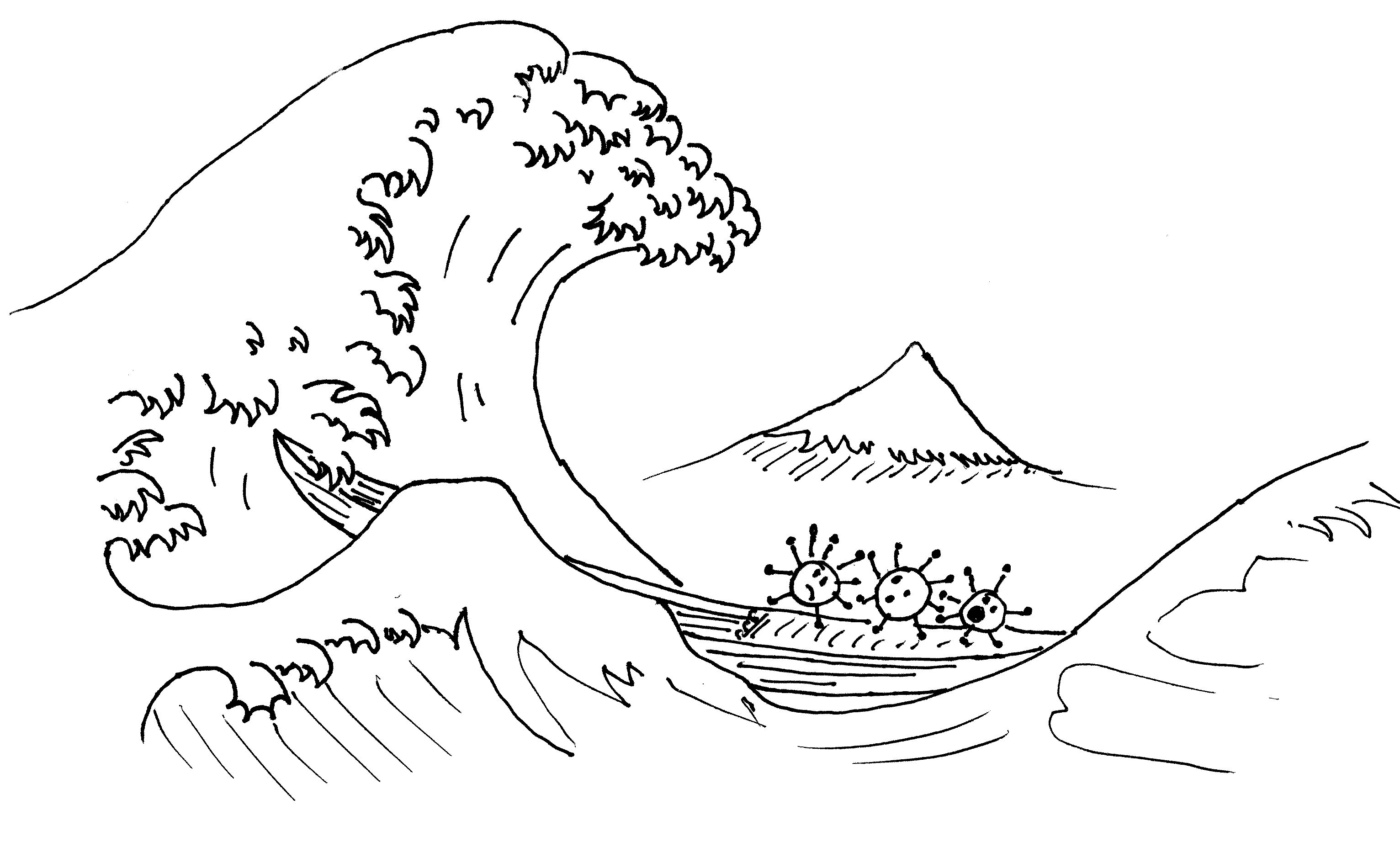

 The Covid Chronicle