Saturday 4th April 2020

Daily Diary: Big Brother, Bunny Poo and Virtual TV Panel Shows

It’s a beautiful sunny day. The breeze is warm and the common has family clusters around bicycles and pushchairs. The lockdown goes on and the police are extra vigilant, out to stop visitors at rural and coastal beauty spots.

I watch how information technology has crept into state control of the virus as I do my daily stint on the rowing machine. There are fears that the state won’t let go of its newly acquired powers easily and after the coronavirus crisis we sleepwalk into a surveillance state. It’s a particular issue with China where state control is becoming as all-consuming as any dystopian fiction.

What is going to be hard for the West is that state control will mean China comes out of the Covid-19 crisis sooner and stronger than its major competitors. It will have a head-start and their government will do what any politician will do, namely crow loudly about it from the highest rooftops.

Is this the end of the postwar ‘era of freedom?’ Freedom, unchecked, is seen to weaken, make more vulnerable, unsuitable to deal with just one viral disease. All its benefits become brushed aside in a state-centralised view of ‘the common good.’

Could what is becoming a different world view from what we imagined last forever (such a naïve thought!) and become the dominant way in which the evolution of human civilisation progresses? I feel that insecurity and I sense that it is a general insecurity the West feels in general.

On a completely different tack, I’m working on a board game as an Easter present for Emily and Tom. They like games, and although it is simple it should be fun. It’s an Easter egg hunt but with a lawn, stepping stones and bushes. If the player lands on a bush rather than a stepping stone s/he picks up a card. If it shows one or more Easter eggs the player takes that many steps forward. If it’s bunny poo the player goes back. The board is illustrated with a combination of Easter and pandemic pictures.

As I clear my relentless supply of emails the local network – Nextdoor – gives me a feel of what’s going on in the neighbourhood and unsurprisingly there are messages that paint a picture of the isolation crisis. One says:

“People are still driving to walks in my local area, even though there are many open spaces within less than a five minute walk.”

Another:

“Hi. I’m disabled and wondered if anyone locally was making and selling homemade meals. My carer is now unavailable. Looking for possibly three evenings a week when my husband is working.”

To which a reply comes:

“My wife says she will bring you 3 meals a week free of charge, if you let us know what you like.”

And finally, a plea:

“Does anyone know where I can get garden plants and soil, please?”

Home deliveries are still an impossibility as we are not needy enough, according to the inflexible criteria that don’t cover all bases by any stretch of the imagination. I receive emails from supermarket chains telling me all that they’re doing, but all I want is a delivery. Then I feel selfish, needing either to rely on our daughter or take the plunge and risk the viral consequences. That goes on to thinking that there are those who are much worse off than we are.

Tech, as all infotech is now being called, is coming into its own. Seeing panel shows like Have I Got News for You being broadcast, slightly clunkily, from both the contestants’ and host’s living rooms. The Mash Report works slightly better, although in both cases the studio audience is missed. AI is also coming to the fore. It is helping to trace contacts, it’s being looked into for triage and allowing clinicians not to be alone in making life and death decisions, and I’m sure it will really show what it’s capable of achieving with genomics.

Why genomics? Because, among other things, it will answer the mystery why some are so much more susceptible to coronavirus than others, why two nurses in their thirties die from being infected. Yet the septuagenarian Donald Trump, overweight and hardly fit, goes on regardless and you can be forgiven for thinking that some dark Faustian bargain has been struck.

However irrational the thought happens to be.

The Bigger Picture: On The Edge of Losing Control

Today, worldwide cases of Covid-19 top one million. In less than six months it will be a million deaths across the world. In Britain the number of cases of Covid-19 rises to 41,903, an increase of 3,735, in other words 9.8 per cent over the last twenty-four hours. But in fact, we don’t know, because there is no community testing. A new Covid-19 app suggests that 1.9 million Brits are infected, but it’s an estimate, an extrapolation and no one can be sure. We’re even in the dark about what constitutes being infected as we wrestle with the unknown of asymptomatic cases, or exactly what the symptoms are as loss of taste and smell are not to be added to the Covid-19 checklist at this time.

The UK death rate, at 4313 is even more alarming. There’s been an overnight increase of 708, that’s almost a twenty per cent increase over a single day. It’s a death rate steeper than Italy’s and London’s deaths exceed Wuhan’s and if a UK citizen is admitted to hospital the prospect of dying from the disease is alarmingly high.

Those in the frontline are particularly vulnerable and there are a number of stories about them being insufficiently well protected. Two nurses in their thirties die within hours of each other. Areema Nasreen, 36, died shortly after midnight on Friday at Walsall Manor hospital, where she had worked for sixteen years. Aimee O’Rourke, 38, who joined the NHS in 2017 and worked at Queen Elizabeth The Queen Mother hospital in Margate, died hours earlier, on Thursday night. Both were mothers of three children.

Two NHS healthcare assistants have also died. The family of one, Thomas Harvey, 57, who worked in north-east London, believe he would still be alive today if he had been given proper PPE.

Another healthcare assistant in north-west London, Tracy Brennan, quit her job after she was asked to remove a surgical face mask she had bought herself, despite a patient coughing into her unprotected face, because she was working on a non-covid ward. The combination of a PPE shortage, political pressures and a failure to recognise the nature of how pandemics spread meant that a hospital trust could steer away from the preventative principle of “do no harm” that has underpinned medical ethics since ancient times.

But that’s where Britain’s at on 4th April 2020.                           

In the midst of all this health secretary Matt Hancock reassures us announces that 2,000 critical care beds in the UK remain free for Covid-19 patients and there’s a commitment to by ventilators by the tens of thousands, if needs be. But it hides the live issues of the life-and-death crisis the country is lurching into. Matt Hancock also announces that wristbands or certificates could be brought in to prove that people can’t carry or catch Covid-19, even though the pattern of immunity isn’t understood, a viable antibody test is still under development and how it will be organised has barely been thought through. Say something – anything – to lead people to believe that things are in hand, like a fool setting out to conceal his folly by taking others for fools.

Boris Johnson knows he will be judged on the next four weeks. He’s sick with Covid-19 too. And the Queen is to address nation tomorrow with a television message recorded from Windsor Castle, a rare action reserved for times of crisis.

In fact, the crisis is so overwhelming it almost totally eclipses Keir Starmer’s election as Leader of the Labour Party with Angela Rayner as his deputy. In quieter times the seismic shift in left of centre politics with all its implications for the country’s future would have been major news. Instead, it is relegated to a side show.

In the United States Americans are underestimating how long coronavirus disruptions will last. Epicentre after epicentre comes into being around the country, sending out deadly ripples like the first raindrops on a millpond. The seeds of a second wave are being sown. Nearly 1,500 Americans killed in 24 hours, the worst single-day death surge in the world.

And Germany, who had made so much progress with community testing, and was the envy of neighbouring European states now reaches the upper limits of its capacity.

All that’s left is our own behaviour.

It only takes a minority to fail to change their behaviour for the virus to run freely through a population and there are plenty who are unable or unwilling to engage with that law of nature.

Australia’s Prime Minister has told all foreign visitors and students to leave the country now amid fury at backpackers for failing to follow social distancing rules. A hostel party in a Sidney hostel that needed to be broken up by the police, overcrowding on Bondi Beach despite warnings not to gather outdoors and a crass suggestion from one British backpacker that people were simply jealous that others were having fun all stoked up public outrage in a country struggling to contain the spread of Covid-19. Travelling medics aside, PM Scott Morrison said, it was past time for everyone else to ‘make their way home’.

Restrictions, arising from widespread calls for people around the world to practice social distancing, can lead to resentment. Covid-19 lockdown tensions are rising. Whether it’s shouts of, “Stay at home, idiot!” or snitching quietly online or by phone to the police, some neighbours have started to turn on each other.

Muslims in India fear they will face growing Islamophobia after hundreds of coronavirus cases were linked to a recent weeks-long event in Delhi attended by thousands of Muslims from India and abroad. As attendees made their way home from the congregation, however, states across India began to report dozens of positive coronavirus cases believed to be linked to the event, with more than 300 of the country’s roughly 2,500 cases believed to be linked to the gathering.

By contrast, Wuhan has learned, along with the rest of China, as it marks the sombre Tomb Sweeping Festival. Traditionally whole families meet and picnic around the graves of their ancestors, many of which are designed for such gatherings. This year, unable to honour the dead in person, Chinese people are turning to online alternatives.

Putting barriers in the virus’ way works. Distance works. Staying in your own home works. Open spaces work. As do masks. But in Western countries, unused to wearing masks and having wrestled recently with face coverings and identity, masks are not being taken up quite so readily.

So when the United States CDC advises to wear non-medical masks, President Trump tells Americans, “I’m choosing not to do it. It’s only a recommendation.”

There are a number of cases of senior politicians around the world dissuading people who are not directly in the frontline from wearing medical masks and people’s knowledge about masks in general, along with appropriate non-medical alternatives, is limited. I’ve now been wearing a mask since before the beginning of lockdown. My rationale is the preventative principle – the very same reason why I always wear a helmet, or carry a reserve parachute when paragliding. But I find myself on a learning curve too. A month ago, Hong Kong’s chief executive Carrie Lam said all government officials will stop wearing face masks unless it is necessary as she stressed that supplies must be given to those with greater need, admitting her government has been not quite successful in purchasing masks overseas because other governments are also accumulating supplies for the purpose of preventing Covid-19 from spreading in their own countries. The top priority had to be to ensure the supply of surgical masks for workers in healthcare settings or those in contact with patients.

It’s an understandable restraint, honestly put.

Western countries get round the same problem by saying nothing, or even in the case of Tracey Hannan, actively dissuading their use. Leaving me feeling like some kind of weirdo as I fill up at my local petrol station.

Which I don’t seem to be doing much of.

I must confess to have been pretty dismissive of the psychological consequences of isolation, the ultimately secure distancing from the virus. It’s nothing to be proud of – just my own narrowness of perspective. I used to think that the psychological impact of extended spaceflight, especially if you had fellow astronauts on board with you, was somewhat over-egged. It’s pretty clear now that I couldn’t have been more wrong. Human beings are by nature social animals and Covid-19 is already harming people’s mental health.

So when Ismail Mohamed Abdulwahab, the 13-year-old South Londoner who died from Covid-19, is buried without his family, because two siblings have tested positive and his mother has had to self-isolate, I can feel the shadows of horror and pain and begin to grasp the sheer awfulness of the situation we are all in.

It’s that, I think, that has spurred a drive for people to find creative ways to support each other. The common enemy has healed divisions. Restaurants, having lost their usual clients, prepare meals for the homeless, people volunteer for mental health phone hotlines, food banks, running errands and shopping for the house-bound, streaming entertainment online and generally looking out for each other. It might all be ‘for now’ but it’s special, and displays a set of values that drowns in pre-covid consumerism.

Life is changing.

  • A ground-breaking drone start-up in Ireland delivers medicines and groceries to vulnerable people who are self-isolating due to Covid-19.
  • The Royal Mail issues strict new rules for deliveries to tackle Covid-19.
  • Tech plays a bigger part than ever before in making isolation a little more bearable.
  • Online tours of museums and galleries are available.
  • And in the car depleted streets the bicycle makes a comeback. There is a boom in sales.

And while we are locked down in our homes advice comes from all sorts of quarters about productive ways in which we can spend our time.

Here are ten recommendations from ‘Hello’ magazine:

  • Learn a language
  • Organise your wardrobe
  • Learn to play an instrument
  • Update your CV and professional accounts
  • Write a novel
  • Start a blog
  • Get fit
  • Do some gardening
  • Upcycle your furniture
  • Learn to code

Finally, not a green shoot of the end to the coronavirus nightmare. Maybe a germinating seed as Brits are ‘to be asked’ to volunteer for Covid-19 vaccine clinical trials.

A glimmer of hope.
Friday 3rd April 2020

Daily Diary: Street Hopscotch And Other Such Things

There are bluebells out the front today. The air is a little cooler and the sky is active with racing clouds. I’m making a special point of not looking too closely at them, and my weather head that comes with fairly regular paragliding has been put well aside. It’s best not to think about what you’ve lost. The things you’ve enjoyed. The past. There is only the here and now, and that’s all that matters.

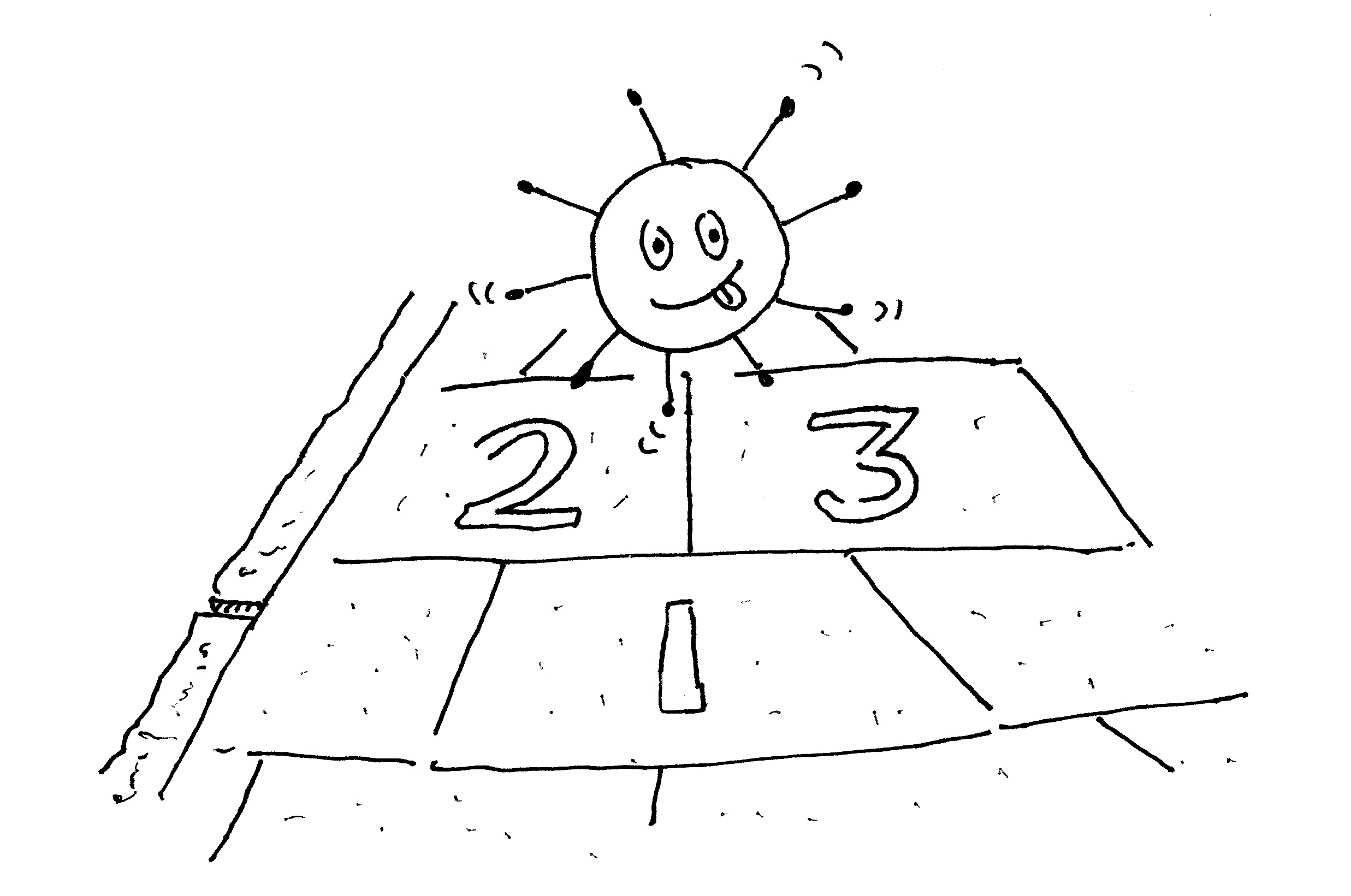
There are the little things that matter as we sail on through this period of isolation. Watching people walk across the common in ones and twos. Dogwalkers, families with small children, bats and balls. It’s like being next to a playground – a source of sanity in an otherwise claustrophobic world. Just around the corner, going down to post a letter, I can see paving slabs chalked over for hopscotch. I can’t remember that being done since childhood days and it brings back those simple pleasures that hold together human experience. Lockdown has revealed the importance of human interaction by making it a commodity in short supply.

There is the online daily reality as well. I get an email from Café Rouge with a recipe for Boeuf Bourguignon under the heading ‘Quarantine Menu.’ Big sister Corrie (she’s always been Big Sis as I’ve been Little Bro) sends me a Beatles spoof via Facebook, “I’m gonna wash my hands….”

Little Sis Judith has just joined Facebook today. We exchange a couple of messages. Em Deliveries all happens via WhatsApp and I promise myself to look into Zoom. Family connectivity almost totally virtual.

Emily did come round with the groceries at 5.20 yesterday afternoon. It’s just nice seeing our daughter, even if it is two eyes above a mask and jazz Marigold hands. Vicky and I can’t spell out too much how grateful we are for all that she’s doing for us. We have become the dependent oldies long before we ever planned to (does anyone ever plan for that?) and we’re quite conflicted both psychologically and emotionally. But coronavirus is unforgiving. We are reminded that a force of nature has no feelings, makes no judgements and does not care because it is unable to care. I’ve long been aware that there is a total indifference in the universe. I know this through paragliding and when you first come upon this stark realisation it is both daunting and frightening.

It’s humbling too.

The only thing each and every one of us is to lessen the risk until it is as near to zero as it can possibly be. Sure, there is such a thing as luck, but only a fool would count on something so arbitrary and capricious.

At eight o’clock Vicky and I go out for the Thursday Clap. It is louder this time. Claire comes out next door and Cathy and Tom next door but one. The clap becomes a conversation which lasts half an hour or so. Socially distanced, of course. We put the world to rights and talk about the bizarre consequences of being isolated. People don’t quite know how to behave towards each other in the street. There’s a slightly awkward friendliness between fellow isolates. People say hello, then avert their eyes. It’s politeness, but it’s strange. Joggers say sorry as they pass you in the street, or re-route so they pass at least two metres away. There is a joke doing the rounds that the over-60s have finally learned measure in metric.

The temperature drops as evening falls. Eventually I go in, but Vicky stays out for a conversation that lasts an hour and a half, as darkness swallows the street. Vicky loves the heat and hates the cold, and there she is in jeans, t-shirt and stockinged feet on the paving slabs. I bring her my flying jacket – a light but warm mountaineer’s jacket – and drape it over her shoulders, but I don’t have anything at hand for her feet. But she and Cathy are so absorbed in conversation she carries on when I wimp out and return to watch TV in the warmth. We were watching a film, “The Leisure Seeker,” with Donald Sutherland as an ageing retired lecturer with Alzheimers, and his wife, Helen Mirren, who’s dying of cancer. They were on a final road trip to Hemingway’s house in Key West, Florida. It’s touching and poignant, and perhaps spells out the hurdles of the next decade or two …. But I paused it while Vicky was chatting and watched a daft ‘real life’ programme about driving tests. We decided not to watch the news on TV. The coronavirus epic is so overwhelming and so all-consuming that, outside of this diary, we’re giving it a wide berth.

The weird thing is that I can detach myself while collecting stories for the diary – it’s somehow different.

That’s both strange and disconcerting.

The Bigger Picture: The Dawn of Problems With Belief

Half of humanity is now under lockdown as ninety countries call for confinement. It’s the first pandemic that can be tracked through the location information of smartphones that themselves spread like a virus through the human population a decade earlier. Google publishes location data across 130 countries to show how the coronavirus lockdowns are working.

Covid-19’s death toll appears to be higher than official figures suggest and there’s emerging evidence of countries, especially the richer ones, already looking after their own interests first. There’s a lot of virtue-signalling politicians are making to the WHO, but I’m left with a horrible feeling that for the most part it’s hypocrisy and window-dressing.        

The fight against the coronavirus has paralysed whole societies and their economies. Lockdown measures are short-term solutions, tried and tested through history, actions of last resort that threaten rapid economic destruction and the erosion of social order. There are troubling parallels with a patient severely infected with the coronavirus being killed by his own immune response.

But the principles behind the good people of Eyam, who kept the outbreak of the 1665 plague from spreading to its neighbouring Derbyshire communities apply as much today as they ever did. Eyam, was one of the few places outside London to be infected. They kept it that way.

Isolation is hard and involves sacrifices.

Politicians in the West don’t like having to ask citizens to make sacrifices. Such actions cost votes in their calculations.

So what follows is a problem with belief.                   

And that for the British government, which came to power promising an ‘oven-ready’ Brexit as its overriding priority before being overwhelmed by Covid-19, is going to prove difficult. PM Boris Johnson remains bullish on this, and for now there is little dissent. Whether it being part of the honeymoon period or the public being distracted by the pandemic is hard to tell, but beneath the surface, for those more directly involved in dealing with Brexit there are concerns.

BBC reporter, Lewis Goodall tweeted: “Have talked to officials across a number of departments in Whitehall. As I reported on Newsnight just now they are expecting an extension of the Brexit transition period. One told me, “if it doesn’t come, I don’t know what we’ll do – with coronavirus we realistically can’t do both.”

Time will test this tweet.

The public persona of Boris Johnson before his isolation with Covid-19 was a leader guided by science, appearing flanked by senior scientific and public health advisers. The reality is that the UK’s approach to dealing with coronavirus has been decided by politicians especially those in Number 10 – not scientists. It was the government that decided how many test kits would be available and how social distancing was to be implemented and enforced.

It’s a useful deceit, but for now people are believing and supporting it.

They’re even accepting the doctrine they sneered at when it came to the former leader of the opposition, Jeremy Corbyn. The outbreak shows one point at least he was right – that when there is a crisis, money can always be found.

With community testing, having abandoned testing mid-March, the UK now lags behind other countries, but Matt Hancock, the health minister has now pledged to up the ante with a new action plan for Covid-19 testing. But it’s not clear what that plan is going to be. Evidence emerges that Covid-19 is spreading too fast for traditional contact tracing, and whether a government in catch-up will be able to get things moving fast enough in the foreseeable future.

At one level it is terrifying. We don’t fully know where and when the cases – and deaths – will peak. We don’t know whether not just the NHS, but health services in other countries, are going to be overwhelmed. Visions of that beginning to happen in northern Italy haven’t faded in people’s minds.

“Absolutely Mission Impossible,” says the CEO of Drägerwerk, a world leader in the production of ventilators, really challenged to keep up with the current demand, as the coronavirus crisis accelerates. Others chip in from other engineering quarters, turning their hand to building these life-saving machines. Formula 1 comes up with a breathing machine. Racing car engineers are applying their expertise to medicine.

While on the frontline ethical systems are being developed to allocate scarce ventilators and ICU beds to avoid counting any group out. Survivability while under treatment and longer-term survivability for the over-75s are primary issues, with a year’s continuation of life as being the reference line.

The triage between treatment and palliative care, between life and death comes closer to being a reality with each passing day.

For the most part the public are spared this horror.

There is a problem with belief for the US government too. CIA hunts for virus totals in China. Dismissing Chinese government tallies, intelligence officials have told the White House for weeks that China has vastly understated the spread of the coronavirus and the damage the pandemic has done.

And there is a problem with the US government’s own credibility. The Environment Protection Agency, it’s Trump appointee chief, Andrew Wheeler, a former coal lobbyist committed to as many environmental rollbacks as he can manage, with dozens already under his belt, is allegedly using Covid-19 as an excuse to stop policing massive polluters.

But these blows to people’s beliefs are not only the act of governments. Social media is already contributing. A bizarre conspiracy theory circulates on Facebook that 5G is causing the coronavirus pandemic by lowering human immunity to it – theory about towers, Wuhan (which is not alone in China with its use of 5G) and radiation. Some people take the rumour-mongering so seriously that towers are damaged, even destroyed, the irony being that social media itself becomes harmed in the process.

It’s not the only conspiracy theory. Trump’s senior medical adviser, and advocate of sensible preventative behaviour, Dr Anthony Fauci’s personal security has been stepped up after threats to his safety. Dealing with the pandemic has become tribalised and politicised, and what should be calm and rational behaviour to protect the common good, becomes something much darker and more hysterical.

If people stop believing how will it be possible to protect society through its own collective action?

It’s a spin-off pandemic of its own kind as viral memes change the perception of human brains.

Unemployment rises. It hits 3.3 million in the United States but Rishi Sunak’s early intervention largely prevents a similar catastrophe in the UK. Food prices do too. Governments splash to keep big companies afloat, but struggle with which merit supporting and how they set about doing it. New companies, particularly technology startups are especially vulnerable, because they haven’t had time to build up the track record necessary

 In Europe, the danger of a new euro crisis is growing. Weak member states like Italy need help if they’re going to survive the coronavirus lockdown financially. But the call for Eurobonds has been met with stiff resistance, especially from the Germans.

While in Britain, March was the best month for UK supermarkets. No prizes for the top selling lines!

Finally, here are a few things that coloured our day to day reality in the newsfeeds on April 2nd:

  • Amazon tribes are at acute risk from the coronavirus. The vectors are often missionaries. Brazil’s president Jair Bolsonaro does nothing to help them.
  • And to lighten our darker moods the British entertainment industry tries out creative ideas. National Theatre’s first live showing took place on Thursday 2nd April at 7 pm. “One Man, Flu, Two Guvnors.” Have I Got News for You will return for a new series, assuming the form of an elaborate video conference, with producers building a virtual set around Ian Hislop. Paul Merton and the other show’s guests will beam in from their living rooms. Again, we will be distracted by their bookshelves.

Thursday 2nd April 2020

Daily Diary: The View From a Bubble

The forsythia bush in the back garden is bright yellow and there is a pale, lime-green haze over the trees as spring comes into being. The air is definitely warming up and I don’t feel that wintry bite in the conservatory where I make my first handwritten notes for the daily diary.

Perhaps the hardest thing is the wall to wall news coverage of the pandemic on the TV and it begins to be a strain. So we’ve decided not to watch news programmes and we’re trusting to iPlayer, Netflix and Amazon Prime to see us through.

We’re waiting for our daughter, Emily, to come through with the groceries, but still hoping for an alternative elsewhere. When it comes to pandemic logistics it’s still SNAFU and the whole country is trying to find its feet.

I sign a petition for PPE for frontline workers. I also sign up to Open Democracy Covid-19 Watch. There are concerns that the pandemic, having forced changes in government and curtailed citizens’ rights, has drawn too much power to leaders. Viktor Orban has already become de facto leader of Hungary and the EU appears toothless in doing anything about it, other than expressing concerns with the faux-ineffectualness of Willy Wonka in the chocolate factory. So how proportionate are these changes? How long lasting? History teaches us that power, once acquired, is very hard to relinquish. This is a global problem following a global pandemic.

The virus has the capacity to be really nasty. It appears to hit the muscles enabling ventilation really hard, making inhalation very difficult. With that comes fear. Will it infect anyone close? Will it affect those in our family who already have health issues? We have relatives with Alzheimers, asthma, diabetes and post-cancer throat surgery. It’s all too easy to be drawn into all this and the line between carting and worrying is a fine one.

I get an email from Toyota credit brokers. Fortunately, on a personal level we haven’t so far been financially hit hard by the crisis but we are aware that many have been, and it’s all been quite a lottery. It’s not just the rents and mortgages, but in the green new deal that’s already beginning to impact in London when it comes to motoring, we’re all being encouraged to buy newer and more environmentally friendly vehicles, there must be thousands upon thousands of unpayable debts. It’s a story that hasn’t been picked up by the press and news media yet. Maybe it will, but in these uncertain times you can’t be sure about anything.

I feel like I’m staring out of a bubble, not being sure whether the real world is inside or out.

The Bigger Picture: The Castle Keep

“You feel breathless and you understand this might be your last breath.”

So spoke a survivor as in the UK a person is dying from Covid-19 every two and a half minutes. With a 24 per cent death toll increase in the last 24 hours – some 569 souls – Britain sees its largest daily increase.

This is the castle-keep. If the coronavirus has got this far there have been a few failures.

The first is a failure of government. In Britain the obsession with Brexit has not only contributed to the delay in the Government’s response to the pandemic, but also in an attitude of insularity that meant Britain turning its back on collaborative efforts with neighbouring states, leaving  the European Centres for Disease Prevention and Control (ECDC),  the European Medicines Agency (EMA) and turning down an offer of being involved in the EU ventilator scheme.

There is still not a full grasp of the efficacy of social distancing measures, despite the fact that data from the 1918 Spanish flu pandemic shows the tighter the restrictions the better the outcomes. The use of face masks is little understood, yet recommendations that people not wear face masks unless they are sick with Covid-19 or caring for someone who is sick are being made by the World Health Organisation as recently as two days ago. Whether this is a medically held view (you would have thought there had been enough respiratory epidemics around for them to know by now) or the very practical problem of there not being enough face masks to go round, and as Dr. Maria Van Kerkhove, an infectious disease epidemiologist with the WHO, said at a briefing two days ago that it is important “we prioritize the use of masks for those who need it most,” which would be frontline health care workers, is not spelled out, but today the British government urges citizens to start wearing face masks, albeit in a somewhat muddled way about where and when.

While people around the country take up sewing masks, and some hospitals, facing dire shortage, welcome them.

There’s been a failure in testing and tracing. Such a system works well when an epidemic is in its early stages, or if the rate of transmission is relatively slow. It soon gets overwhelmed by a rapidly spreading pandemic, especially on where there are so many asymptomatic carriers. We are still learning the finer points of Covid-19’s symptoms and some research is indicating that loss of taste and smell are an early symptom of infection. There are developments, an antibody test will soon be available, although it indicates whether a person has had the disease, not whether they are infectious. Stable doors and bolting horses come to mind. Smartphone apps are appearing, although there are concerns about this is the thin end of the wedge in becoming a surveillance society.

It did not help that the UK government abandoned widespread test and trace a fortnight ago

So, to be infected the virus has had to cross those potential hurdles and at the moment, without a vaccine in sight, it does so without too much difficulty.

And reaches the castle-keep.

4,244 people test positive for Covid-19 in the United Kingdom today, but since so many of these tests are admissions to hospital the figure is not a fair indication of how widespread it is. Over twenty-two thousand casualties are already hospitalised, and of those four and a half thousand in intensive care. 574 are on mechanical ventilators and in the last twenty-four hours there have been 569 deaths.

That’s a fair bit of battling inside the keep. It’s not the derring-do of Errol Flynn but the grim, knackering slog of dedicated medics and the personal mortal struggle of hundreds of patients, many in induced comas, left to communicate their plight only by the numbers, traces and bleeps of bedside instruments. And behind the façade generated by tubes, wires and electronics the reality is that doctors are for the most part treating the disease with tech from the 1980s.

Promising possibilities are being shown by AI in triaging and information sharing, but the speed of spread by the pandemic currently outstrips that as frontline staff deal with the relentless day to day.

In many cases there’s even the inner sanctum within the keep as hospitals across Europe and the US either split into Covid-19 and non-Covid-19 zones, partition entirely, with entire hospitals dedicated to the coronavirus, while temporary hospitals are being set up for other needs, or create Covid-19 field hospitals of one sort or another, such as the Nightingale hospitals emerging in the UK.

Even so, the shortfalls are staggering. New York alone needs to contend with the coming wave: 3.3 million N95 masks, 2.1 million surgical masks, 100,000 isolation gowns and 400 additional ventilators.

To rub salt into the wound, the US does have a ventilator stockpile but thousands do not work due to expired maintenance contracts.

Some scientists in the UK say they’re confident they have reached a turning point in the battle, but it will still be a month before that translates into what most could see as things getting better. Meanwhile, the daily stress, the witnessing of continuing human tragedy and the relentlessness of it all takes its toll on healthcare workers and there are concerns about the kind of moral injury previously seen in combat veterans from Iraq and Afghanistan appearing in their ranks.

Despite that Boris Johnson’s approval rating is 72 per cent – the highest since Thatcher during the Falklands War. So far, the British public are being pretty forgiving of all the mistakes the Government have made.

It also appears to be regardless of the fact that many people’s lives have become fraught with real financial difficulties. There are a number of cases of financial institutions being less than helpful in unexpected hard times. Business minister Ashok Sharma criticises as ‘unacceptable’ banks for refusing financial help to small companies.

Too many people will also be left behind by the help for the self-employed. The flexibility within the UK job market and its lack of protections becomes really problematic during a major health crisis, particularly with a trend towards franchises and zero hours contracts.

But for now, it hasn’t eaten its way into the wider public consciousness. We like to think that we’re all in it together ….

But some are more in it than others.

Will it last?

That will depend, among other things, on how UK deaths compare to other places.

And that will take time to pan out.

As with every day, across Britain, the pandemic is characterised by many stories:

  • The COP26 climate change conference due in Glasgow this November has been postponed. It has been an aspirational landmark for PM Johnson’s ‘Green Britain.’ It now has to wait another year.
  • BA is expected to suspend 36,000 staff after coronavirus grounds flights.
  • It’s looking more and more like the coronavirus is on its way to sinking the cruise-ship business. Its PR could not be worse with nightmarish stories going back to February when outbreak on the British registered Diamond Princess claimed 700 cases and 14 deaths. Environmentally unfriendly, with a history of other non-Covid outbreaks, the industry has been losing friends. It may well be that the elderly, the core of its customer base, will shun it for good.
  • There’s some unsettlingly gothic about cemeteries becoming closed to the public. More to the point, unsettlingly tragic.
  • There’s a public outcry when Tottenham Hotspur footballers continue to be paid the full whack of £70K per week, but other workers there are now on an 80 per cent wage.
  • Some pubs adapt. Two thousand are to reopen as click and collect supermarkets during the coronavirus lockdown. Greene King, Admiral Taverns and St Austell will allow tenants and leaseholders to open grocery stores.
  • Loneliness in coronavirus lockdown is fast becoming an issue. Some, especially elderly people on their own, are frightened of contacting others for fear of being a nuisance.
  • While some approaches are distinctly unwelcome as text messages appear, telling people they have been fined for stepping outside during lockdown. With a phishing link included. Welcome to the low-life among us who see the pandemic as an opportunity for predation.

As it is abroad:

  • Belarus Football League continues to play matches as the rest of Europe locks down. With less than 100 positive cases and no deaths in Belarus, president Alexander Lukashenko has dismissed the global health crisis as a “psychosis”, and refuses to follow the example of much of the globe by imposing a lockdown, suggesting “there shouldn’t be any panic.”
  • In France fruit farmers struggle amid the coronavirus lockdown, as migrant labour from eastern Europe can no longer cross borders.
  • In France too, the homeless are having a hard time. The French Red Cross sets up shelters in car parks.
  • Portugal launches ‘Host a hero,’  where people with empty properties encouraged by an online scheme to help health workers keep their families safe.
  • In Kenya, president Uhuru Kenyatta has apologised for his heavy-handed policing of the country’s lockdown after a 13-year-old boy was repeatedly shot dead. The police’s handling of the lockdown will be investigated.
  • And in the US, president Trump announces insurance waivers on coronavirus healthcare.

He does some right things when it comes to the coronavirus crisis, but it’s too much like a stopped clock telling the right time twice a day.

Wednesday 1st April 2020

Daily Diary: Dark Odds And Stories That Don’t Have Legs

No pranks or mischievous little lies. No wind-ups and teases. Midday soon arrives and April Fool’s Day becomes like any other. It’s shopping list day and Vicky and I discuss supplies for the coming week – possibly two. Hopefully, Emily can do this again so we can remain in isolation. It seems selfish, but at the age we’re at we know we could develop severe symptoms if we become infected. It’s not fear of death, or even fear of a horrible death, when you’re too paralysed in the chest to breathe. It’s the impact each of us would have on many frontline health services and how, if one of us was hospitalised, the other would manage on their own.

Vicky worries about Emily and Tom, along with what we’re asking of them. News has come out of a twelve-year-old girl dying of the virus in Belgium and yesterday, a thirteen-year-old boy has died of Covid-19 in South East London. It’s a lottery, and even though it is weighted in favour of the young and fit, when it comes to health matters it can never be an absolute. Memories come back of Vicky believing, after the pre-op consultation with the consultant, that she’d be one of the 98 per cent who would come through an operation without complications, turning out to be one of the 2 per cent that would spend time at death’s door. Such lived experiences leave more than a belief that anyone can fall foul of medical misfortunes. They leave an understanding.

By a cruel coincidence the best estimate at present of the odds of dying from Covid-19 should you test positive is two percent. For both Vicky and I there’s a dark resonance in those odds.

The ex-Dukies, old boys from my old school, are exchanging emails about all sorts of issues, ably co-ordinated by my old friend and house captain, Chris Crowcroft. One wrote about his son:

“I’m pretty certain my son (mid-30s) in Boston has just had Covid-19. High fever. 103/39 for two days, muscle aches, cough. Self-isolated and almost back to normal now, three days later. He had dark urine, so he went to hospital to have a blood and urine test. No Covid test due to the King T policies. Elevated myoglobin indicating muscle damage, a known effect of flu and now known about Covid-19. A friend published (a paper) last week on the connection with cardiac damage – (heart being mainly muscle) and increased mortality. For those of you with cardiac issues, take note.”

I sign three petitions. The first one concerns missionaries in Brazil spreading the disease among the indigenous population. It’s a problem that preceded the Covid-19 outbreak and one that President Bolsonaro actively encourages. I put this one out on Twitter. It coincides with news that some churches are still inviting congregations. In Eyam all those years ago, in 1665 the good people weren’t as stupid as these fools are. I imagine there were such fools a-plenty in those days, only they never made it into the history books.

The second is to extend the transition period, especially so British bioscientists can work with their European partners, or that if a vaccine is developed on the continent there aren’t unanticipated barriers to importing it. Coronavirus exposes the Brexit rhetoric for what it is.

I had to wrestle with the third – a petition for partners to be present at the birth of their children during the Covid-19 outbreak. It’s a personal matter as well as one of principle, as it’s an issue within my family. I know there are PPE and public health issues. I know there have been a couple of cases worldwide, where a child dying during birth tested positive for coronavirus. It shows how inadequate our health service is that it is unable to provide sufficient protection and our society regresses to the less compassionate practices from bygone eras. I think it was that. It was a protest for the importance of our humanity that I did sign.

It’s very easy to polarise decisions. To do so simplifies. But we need to acknowledge the greyness. The ambiguity at the edges, despite the virus’s mechanical ruthlessness.

More news appears in my email inbox, especially what’s become known as the ‘Dukie-Loop’ of lost loved ones, of friends and relations dying from the virus. I know this means each and every one of us is just a couple of steps of separation away from infection. We hope, like grazing critters in the centre of the herd, it stays two steps away, but fear it could be one. Or even worse, zero.

I took a nice photo this morning from the front porch that looks out on the common. It’s of a man, seated on a bench, talking to a woman standing by a lamp post three metres away. I imagine what the backstory is, but the posture, body language and gesture describe a socially distanced friendship. Neighbours chatting? A liaison? I don’t know but I like how the pic comes out.

I’m too busy to continue my project of building a model portee two pounder anti-tank gun, used by my dad in the early years of the Western Desert campaign in the Second World War. It’s a project in memory of my father and there is no kit for it as such, which is quite a challenge. So I have shelved it to another day. I get a notice from Toyota about their much-diminished servicing arrangements, subscribe to The Economist and try to organise assistance to an older relative who appears to have slipped through the help-net. Age UK Coventry give us a list of addresses but are overloaded with respect to direct support. There are those who land on their feet and those that don’t.

It should be a story with legs. It’s a story that hardly climbs onboard.

The number of cases rises again. Two days ago, it was an increase of thirteen percent and in spite of politicians talking about “green shoots” it’s back to seventeen per cent, where it was on March 23rd. The death rate rises by an alarming thirty-one per cent, the second highest so far.

The pandemic is a force of nature.

A force that’s stress-testing us all.

The Bigger Picture: We Don’t Do Exponential Well

If there’s one thing the pandemic has taught us is that we don’t do exponential well and are fully capable of transitioning from idle complacency to total panic in hardly any time at all.

The UK’s Covid-19 death toll jumped 563 in a single day today. Yesterday, it was 381. On Monday, 180. Overall fatalities now stand at 2,352. More than 29,000 people have tested positive for the virus, mostly hospital admissions as there is no system in place to monitor on a wider basis.

Worldwide, sometime in the next twenty-four hours there will be a million cases and fifty thousand deaths. It’s projected by the White House that US deaths could possibly reach 240,000, or eighty 9/11s, and already, at over four thousand, exceed those in China. Donald Trump said the country should expect a “very, very painful two weeks”.

Spain’s number of Covid-19 cases has passed the hundred thousand mark and has reached a record daily death toll of 864.

It’s grim.

Russia too now sees itself facing the coronavirus outbreak and introduces strict covid laws after a rise of 500 including jail terms for breaking quarantine rules. President Putin self-isolates following a handshake a week ago with a doctor who tested positive.  Like so many other countries there are problems with PPE. Unlike many other countries the state makes every effort to stifle complaints from medics in the frontline.

Despite that, Russia has dispatched a cargo plane with masks and medical equipment to the US after Donald Trump accepted an offer of humanitarian aid from Vladimir Putin to fight the coronavirus outbreak. In America it is highly controversial. In Russia it’s great public relations.

Each day the statistics, grim though they are, sanitise the stories beneath the numbers. Each day the stories differ in the detail but paint a bigger picture of human suffering. Here are some:

Doctor Alfa Saadu becomes the first doctor to die from Covid-19, after returning from retirement to NHS. One former colleague writes in tribute: “He was loud, bold and loved a challenge. Enjoyed his football, family and was looking forward to retirement to spend it with his grandchildren.”

In Belgium Suzanne Hoylaerts, a ninety-year-old woman dies from coronavirus after refusing a ventilator. In a quiet act of personal courage, she asked if it could instead be used to save someone younger.

Thirteen-year-old Ismail Mohamed Abdulwahab, from Brixton in south London, died in King’s College Hospital early on Monday. He is thought to be the youngest person to have died with the virus in the UK. A statement on the fundraising webpage for his funeral said Ismail died without any family members close by due to the highly infectious nature of Covid-19.

John Carter, aged 75, A British national is among four people to have died aboard the coronavirus-stricken Zaandam, a Holland America Line cruise ship departed from Buenos Aires on March 7, a day before the US State Department advised against cruise travel and before any substantial restrictions were in place in Florida. It had been scheduled to stop in San Antonio, Chile, then complete another 20-day cruise to arrive in Fort Lauderdale, Florida, on April 7. But fear of coronavirus and the media publicity across Latin America, portraying the Zaandam as a plague ship resulted in her being denied permission to dock at port after port. Passing through the Panama Canal passengers were asked to keep their rooms dark and leave their curtains closed.

To reach Florida and find the state governor Ron DeSantis, often called ‘Florida’s Trump’ is reluctant to allow disembarkation for the more than 1,000 people on board the Zaandam.

“Just to drop people off at the place where we’re having the highest number of cases right now just doesn’t make a whole lot of sense,” he told a news conference.

The matter went to the White House.

President Trump shows an uncharacteristic moment of compassion.

“They’re dying on the ship,” Mr Trump said at a coronavirus press briefing. “I’m going to do what’s right. Not only for us, but for humanity.”

A cat in Belgium fell ill with coronavirus after her owner suffered symptoms of the deadly virus following a trip to northern Italy. The cat had diarrhoea, vomited and suffered breathing problems. It illustrated how coronavirus can jump species and the cat family appear particularly susceptible. That black and white feline from two doors away that likes to sunbathe on our garden furniture seems just a little more sinister, even though she likes having her tummy tickled.

It’s becoming apparent that the principles behind dealing with the virus are straightforward. So long as it can be detected, treated and prevented from spreading through the population. The Chinese are now approaching the other side of their Covid-19 outbreak and are now moving on to asymptomatic cases: China reported 36 new Covid-19 cases and 130 new asymptomatic cases, bringing the total number of such cases under observation to 1,367.

This is a draconian society and visions of citizens being manhandled into ambulances and doctors being silenced are fresh in people’s memories. Such behaviour would be unacceptable in western democracies and the struggle to turn principles into practices in democracies is a central theme in the story of the pandemic.

Without detecting the virus, managing it becomes close to impossible. The UK government abandoned testing and tracing in the wider community in mid-March, limiting its use to hospital staff and admitted casualties. Reports suggest that the reason behind the struggle to increase the amount of testing to 25,000 per day is due to a shortage of equipment. The current level of testing is 8,200 a day, way behind the Germans who are at 500,000 every week. Germany tested early and tested a lot. It saved lives.

Health secretary Matthew Hancock has ordered all spare coronavirus tests to be used for NHS workers, as it emerged only a small proportion of those in isolation appear to really be ill with the virus.

Other than that, Britain is blind.

Treatment is limited to the general expertise of ICU medics, learning from each other’s practices, successes and experiences, for example that severe Covid-19 patients are more likely to recover lying on their fronts and that intubation is not always the best intervention. Coronavirus-specific interventions are still in their early stages and medications are on a hit and miss basis.

So, all we’re left with is preventing the virus from spreading, and Biosciences are far away from producing a vaccine, although the global race has begun.

Which means we are almost entirely dependent on people’s behaviour and fickle as it is, unless constrained in a straitjacket (sent mail-order from China?) that’s a tough call. Former president Barack Obama compares the White House’s response to climate change denial. 

When we don’t factor in the possible existence of the virus that’s when it does its worst. So a religious gathering at a New Delhi mosque becomes a superspreader event. Dozens test positive, some die and a thousand are isolated.

The capacity of society to cope is related to the scale of the pandemic. India isn’t coping too well and there is anger at how the country treats its poor, who are beaten up in the streets for breaking Covid-19 restrictions by police with batons and even hosed down with chemicals in the name of public health. Hundreds of thousands of day wage workers have been left without money, food and shelter across India’s cities.

Doctors call out for the public to exercise social distancing. It’s ignored by sun, sea and surf-seekers on Sidney’s Bondi Beach during much of March and this results in a spike in coronavirus cases. So Bondi Beach closes, as there are too many who are prepared to be careless about social distancing. The only visitors are to the Covid-19 testing centre which has been set up. Japan closes its schools until early May, and Brazil closes its border with Venezuela for health reasons, although many are still arriving in the country from abroad.

Italy’s lockdown measures are to be extended until April 13th. The health minister Roberto Speranza has the foresight to warn that Italians must not confuse the first positive signals with an ‘all clear’ signal.

Someone else who has shown foresight is Republican Ohio Governor Mike DeWine, who imposed sweeping measures days before a single case had been reported in his state. On 5th March Mr DeWine got a court order to shut down much of the Arnold Sports Festival – an annual event featuring 20,000 athletes from 80 countries, around 60,000 spectators each day, and an expected $53m for Columbus, the state’s largest city.

It was much criticised.

“This is a balancing test,” Mr DeWine responded.

Over the next three weeks spectators were excluded from major sporting events, well before US sports organisations cancelled their seasons. He was first in the nation to declare a state-wide school shutdown and invoked an emergency public health order to postpone Ohio’s presidential primary the night before it was scheduled on 17 March.

In short, Mr DeWine was one of few American leaders who acted pre-emptively and prevented his state being on catch-up.

Hi critics dismissed Ohio’s strict regulations as overblown and out of step with neighbouring states, let alone fellow Republican Donald Trump, who until later in March downplayed the threat of the virus, saying it would “go away”.

Mr DeWine selected Dr Amy Acton as Director of Ohio’s Department of Health, which was a smart move when it came to controlling the pandemic.

“Mistakes that I have made throughout my career have generally been because I didn’t have enough facts, I didn’t dig deep enough,” Mr DeWine said. “So, I made up my mind I was going to have the best information, the best data available.”

At a recent briefing Dr Acton said, “On the front end of a pandemic you look a little bit alarmist, you look a little bit like a Chicken Little, the sky is falling.”

Then added, “At the end of a pandemic, you didn’t do enough.”

Still, while Ohio’s infection numbers are rising, with 2,199 cases, 55 deaths and 585 hospitalisations, it has so far avoided the surges seen in states like New York, Washington, and Louisiana, ranking 15th nationwide in terms of reported cases.

“It has to be the type of response you take in war time because we have been invaded, literally.

“We’ve got to stay at it.”

Last week, Ohio reported 187,780 jobless claims – the second highest nationwide and almost half the total claims from all of last year. But the economic fallout is a consequence of doing what needs to be done. The two are neither ‘either-or’ in a zero-sum game way, nor are they mutually exclusive, tempting though both positions are being taken by some policymakers. There are broad patterns:

  • Firms dealing with personal services and hospitality, such as restaurants, hairdressers, clothing stores and cinemas are shutting down.
  • Elsewhere there are firms in demand: supermarkets (Tesco recruited 35,000 in 10 days in March), farming – 9,000 workers needed; transport and logistics – Morrisons extra 2,500 drivers and pickers and 1,000 more in distribution centres, food production, care workers, call workers, pharmacies.
  • Changes in people’s daily behaviour changes their energy needs. So the price of oil slumps, despite Saudi Arabia flooding the market and America trying to pump up prices. In the end the rules of supply and demand are so much stronger than individual countries’ tinkering.
  • All this leads to stock markets around the world, the first quarter was one of the worst in history. The start of the second isn’t looking any better, with Asian and European markets opening lower and US futures implying they will follow suit.

Both widespread lockdowns and the volatility of both national and global economies all have a bearing on our everyday lives. Here are some examples:

  • Art galleries and museums go online, but some of the ‘real thing’ is hard to replicate.
  • Covid-19 is creating a short-term boom to streaming services.
  • Petitions appear for PPE for frontline workers.
  • A family’s lockdown adaptation of Les Misérables song goes viral
  • Staff shortages could mean power blackouts
  • Disney’s multiplayer online game, Club Penguin is back and 6 million users have already signed up
  • Leslie Jordan, a sixty-five-year-old actor goes viral with live video feeds about enduring the day to day of lockdown. Looks like a lot less work than me writing all this, but I don’t think I’ll swap somehow. Makes me feel old too!
  • Postman delivers in fancy dress to cheer people up during lockdown
  • A puzzle company is selling a jigsaw that Is completely see-through
  • Corona fraud. To date Interpol have dealt with 30 Covid-19 scams and frozen more than 661,000 euros in bank accounts.

But there is one silver lining and its appearance is almost magical. The sudden halt of economic activity has led to a visible decrease in air pollution across Europe and beyond. The skies, especially in urban areas, become bluer and clearer. It holds promise, even if the changes are likely to be too short-lived to have any effect on climate change. Maybe the hardships of the pandemic itself will focus the public’s mind on the even greater threat in our future. Maybe humans are simply too fickle.

In truth, nobody knows.

But pandemic greening is a reality as nature starts to reassert itself. Goats invade Llandudno in Wales as empty streets give wildlife a chance to flourish during the coronavirus lockdown. A large herd of Kashmiri goats have been feasting on flowers and hedgerows and giving us all a feelgood story that’s brought us all out in a smile.

Excluding those who planted the flowerbeds, I guess.

But it’s not all roses – more likely tulips.

When nursing home workers were asked about their fear of catching and spreading the virus, one of them asked:

“Who else is going to take care of them?”

Back to reality…..

It’s raw and uncompromising.

Tuesday 31st March 2020

Daily Diary: Everyday Messing With Our Heads

We’ve been socially isolated for over a week. Life feels very restricted. I think about all those who are having much more difficulties than we are, whether in the UK or further afield. The least advantaged in society are now enduring a living hell. There are car parks marked out in squares in Nevada, so the homeless can sleep socially distanced. The tall towers of Las Vegas hotels mark the skyline in the background. Migrant labourers are being evicted in New Delhi and other Indian cities. Scenes of them being fire-hosed with disinfectant as if they are livestock are truly alarming. We thought this kind of dehumanisation was a symptom of war. Not so. This is a vision that resonates with the Holocaust.

Mental health stories are already emerging. In its own way it is a struggle as many of us are having our heads messed up with both uncertainty and visions of our own mortality. There are stories of women in particular trapped as prisoners of domestic abuse across the world. It’s not just your own mortality but the consequences of being infected on your own nearest and dearest. For the NHS – for the person whose space you have effectively taken as one of a rising curve.

Out on the common people are in ones and twos. A middle-aged couple returning home from a walk. Two mums in different parts of the green with pushchairs, giving the little ones some fresh air. There’s a dad playing kickabout with his young child, maybe a four year old, and a young couple just sitting pensively overlooking the ravine we call The Slade. There is a breeze and what I call a mixed sky, where different clouds are layered.

Small stuff gets bigger when the easy means of dealing with it gets more difficult. Vicky and I are both in our late sixties. We are pretty sure we might not get a ventilator if we go down badly and we have no means of checking out our fears, so our only option is to do everything possible not to go down at all. Vicky has a bad pain in her left shoulder and it’s becoming chronic. She doesn’t want to go to the doctor because of an increased risk of being infected. Yet it is painful and could probably be alleviated by the right anti-inflammatory. It’s those secondary consequences that are of concern. How many people will miss out on treatment? How far will people push the envelope of tolerating discomfort and how many conditions will get worse?

How long will the NHS be in catch up and it’s inevitable diseases such as cancer will in some cases progress to more troubling and harder to treat stages.

With all of this comes stress and anxiety and neither Vicky nor I are immune from it.

I believe it’s called self-preservation.

The Bigger Picture: Day Turning To Night

Like day turning to night, it’s a simple change with profound consequences when an infinitesimally small pathogen infects a population.

And as with the dark the nightmares come.

In Britain 381 people have died from coronavirus in twenty-four hours. The day to day figures are a bit erratic, dogged by delays in recording and reporting, but the seven-day average is much more reliable – and ominous. It’s rising exponentially. Saturday 28th March the seven-day average is 123, but with each passing day it’s rising exponentially – 135, 153, and today 195. It looks like the nightmare has begun.

In Belgium the coronavirus kills a 12-year old girl in Belgium, leaving doctors, nurses and family utterly devastated. It’s another ghastly face of the nightmare. Children are much safer from the ravages of Covid-19 but no-one is totally safe.

In Albany, Georgia, the nightmare becomes ghoulish as a funeral on February 29th turns out to have become a superspreading event in the weeks that followed, as if the dead were trying to recruit mourners into their sombre cohort.

For healthcare workers in many lands the nightmare is real as insufficient PPE sows dread and fear into those whose safety depends on it. Single-use N95 masks end up being worn over and over again, sometimes for several days on end. Hope and desperation, rather than design becomes the purpose of wearing them. In England there are now calls for PPE provision from asbestos firms and car workshops. Air ambulance workers are pleading for PPE donations and PPE is being diverted from vital social care service providers because the Government has failed to adequately provide those on the frontline.

And to the point of being a horror cliché, the virus picks on the most vulnerable first as it’s confirmed that people with underlying health conditions, including diabetes and heart disease are likely to get more severe symptoms from Covid-19 and have worse outcomes.

Another horror cliché is a deserted world. Drones flying over Paris, Rome, Athens, Prague, Trafalgar Square in London, the Ponte Vecchio in Florence and countless other tourist hotspots capture panoramic footage of the emptiness in a way that would have been barely possible a decade ago. Quietly apocalyptic

The darkness has its denizens too. Corona criminals creep out of the shadows to do their worst. Corona-spitting becomes a new, disgusting and deadly form of assault, while organised crime groups have adapted their activities to benefit from the global health crisis. Common practices are fraudulent calls from health officials and counterfeited protective equipment.

While leaders around the world invoke executive powers and extend their authority. For the most part citizens are compliant in these early stages of the lockdown, but critics say some governments are using the crisis to seize powers that have little to do with the coronavirus. Watching how China has appeared to be successful in dealing with the virus some begin to fear that moves like mass surveillance will take place.

Hungary’s parliament has voted to give prime minister Victor Orban the power to rule by decree, punish journalists whose reporting it deems inaccurate and suspend all elections indefinitely in response to the Covid-19 pandemic. A number of politicians in Brussels protest that it’s unacceptable and against the core democratic values of the EU, but the EU does nothing. Europe is, to use the words of the Italian foreign minister, Luigi Di Mauro, at war with Covid-19.

Despite that, and the longstanding discord between himself and Victor Orban, George billionaire Soros donates a million to the capital city, Budapest, where he was born.

Concerned about the pandemic’s effect of citizens coming out to polling stations, Poland’s ruling Law and Justice party drafted a new law to turn the up and coming election into a postal only vote.

Where there are alliances it matters more than ever that there is common purpose. And never more so than when it’s a life and death struggle with the same invisible and stealthy enemy. As in so many other cases where Covid-19 has stress-tested human beings at every level in the first quarter of the twenty first century it finds weaknesses, not just personal, but systemic too. The fabric of the European Union begins to tear.

The European Union is largely untested when it comes to public health emergencies. Ebola happened at the very fringes, AIDS less so, but it never became centre stage. It shared with Britain the history-derived complacency that it was a faraway problem. So such matters lay beyond the EU’s competence and as a result, despite the early all too visible traumatic scenes from Northern Italy, it was slow to react.

The virus continues to affect different countries at different rates. For years a number of member states had fine-tuned passing the buck with mass migration. They had learned how to duck and dive responsibility and where the boundaries of Brussels’ authority lay. Now coronavirus challenges any unified response. Without anything approaching intelligence or strategy it succeeds in dividing its human opposition.

In a glimmer of hope, in Spain, despite coronavirus deaths peaking at over nine hundred a day, the number of patients recovering far outnumbers the casualties, more than 16,000 people have already been discharged from Spanish hospitals. But it all looks like one country at a time on its own Covid journey.

It’s becoming clear in Trump’s America is struggling with achieving a unified approach. It’s hardly surprising that twenty-seven different countries could succeed in achieving solidarity either.

Across the Channel there are Brexiteers who relish the schadenfreude. They have little to crow about as the virus begins to drive a wedge between the nations of the Union too. 

So as different countries take wildly different approaches, Belgium lashes out at the Netherlands over its initially lax measures, Denmark disapproves Sweden’s approach, Italy is fuming about being left high and dry about the economic consequences

And it looks like everyone is seriously pissed off with Hungary!

There’s a frustration in the West. Countries in the Far East are seen to have managed the virus. South Korea has kept Covid-19 at bay without a total lockdown and after months of a shutdown economy, China’s factories are ramping back up.

Test and trace comes across as being a kind of magic bullet, and there is a feeling abroad that ‘if they can do it, why can’t we?’

It’s a bit like watching a virtuoso violinist play, picking up a fiddle and believing you can knock out Bruch’s Violin Concerto Number One first go.

The British government tells its citizens it’s going to increase testing to 25,000 a day, but reports suggest there is a shortage of equipment. Michael Gove tells a variation of the story that the UK needs to move faster with testing but there was a shortage in a key chemical needed for them to work.

Not splitting hairs on the detail – just that the UK at present is unprepared.

The same is the case in America, compounded by a toxic combination of the president’s lack of receptiveness to the problem and political tribalism. When the Democrat governor of Montana told Trump that his state was on the verge of running out of tests, Trump replied that he had not “heard about testing being a problem.”

The vaccine remains a hope but seems a long way off. Some scientists are testing an old and controversial tuberculosis vaccine to see if it could protect against coronavirus. Spurring on a theory of general immunity – that if you are immune to one disease some of that capacity can be carried over to others. There is a little substance to the hundred-year-old idea – but only a little.

One way or another we will need twenty first century science to tackle this virus and that ultimately means the power and resources of big pharma. Johnson & Johnson is already ramping up production on its $1 billion coronavirus vaccine.

They are not alone.

Despite their being instruments of last resort in this war propaganda plays an important part. The ventilator becomes the tank being transported to the battlefront. Cabinet minister Michael Gove announced that the “first of thousands” of newly manufactured ventilators would “roll off the production line” this weekend and be distributed to the NHS frontline next week.

Hooray, as ventilator after ventilator rattles past our eyes into action!

Well, that’s what it feels like, anyway!

In the United States things are even worse. Ventilators are up on online auction, it’s state against state, with the federal government in the bidding as well. I don’t know how many comedy sketches have been written about the stereotypical fool inadvertently outbidding himself, but this is no joke. New York State governor Andrew Cuomo says ventilators are going for $50,000. That’s up from $20,000.

What chance winning the war when you’re battling with madness?

While all this craziness is going on the number of Covid-19 cases is continuing to accelerate. The US recorded 500 coronavirus deaths in the past 24 hours. New York, the state that’s hardest hit to date, sees its highest number of hospitalisations in a single day. Governor Andrew Cuomo, whose brother just got diagnosed with Covid-19, says the peak of the outbreak in that state could be anywhere between one and three weeks from now.

On Sunday, President Trump heeded the warning of public health officials and walked back his plan to lift social distancing guidelines by Easter. Instead, makes a public announcement of “a very, very painful two weeks” ahead.

Roughly three quarters of American people are, or soon will be, under instructions to stay indoors as states try to check the spread of the coronavirus before hospitals are overwhelmed.

Top government scientists battling the coronavirus have estimated that the deadly pathogen could kill between 100,000 and 240,000 Americans, in spite of the disruptive social distancing measures that have closed schools, banned large gatherings, limited travel and forced people to stay in their homes. Time will prove this to be an underestimate, despite how shocking the numbers seem at this time.

Many of those who are still working are in fear of the virus stalking their place of work. A number of grocery store workers are getting hazard pay but it’s by no means all. A sickout is planned today by Whole Foods Market employees in protest at what they see as inadequate safety measures and insufficient pay for the risks they are confronting. The worker who led a similar walkout from an Amazon warehouse in Staten Island on Monday has been fired.

Farm workers aren’t receiving the protections and hazard pay of those dealing with groceries. They want to know why. Yet another example of coronavirus divisiveness.

Mexico and the United States shut their border, while the Trump administration has sped up construction of a wall on the southern border, arguing it will help to limit the spread of the virus from Mexico. It’s Alice in Wonderland stuff as outbreaks are occurring in every state, something recognised by health insurance companies as UnitedHealthcare is the latest large member of their fold to waive out of pocket expenses for Covid-19 treatment.

It’s not so much healthcare insurance companies showing a newly discovered compassion, but an increasing number of customers who won’t be able to pay. Wall Street had its worst month since 2008 as the coronavirus decimated the global economy. Political promises of “whatever it takes” to save the local economy don’t convince the markets and although passed by Congress it will take weeks for payments from the US Coronavirus Relief Fund to arrive in people’s letterboxes. In Europe there are some who see ‘coronabonds’ as a means of steering away from a deep recession there have been a million job losses in just two weeks – but the Germans in particular are not keen on the idea, seeing German money yet again underwriting other countries’ debts.

In Britain, Covid-19 makes social inequality worse by the day as prime minister Boris Johnson is held hostage to fortune as he is constantly reminded about his promise to “level up” Britain. It requires a leap of imagination, or faith, to now see that happen.

Boris Johnson chairs the first ever digital-only Cabinet meeting for ministers, with just cabinet secretary Sir Mark Sedwill present in the Cabinet room itself. Following the national pastime of looking at various ministers’ Zoom backdrops; their bookshelves and their Union Jack flags Liz Truss wins the prize.

Number 10 said it expected the PM to end his self-isolation this Friday, while health secretary Matt Hancock told BBC Radio Suffolk: “I’m on the mend.”

But cynics among the great British public, after all the bodge and fudge about the Government’s response to the pandemic barely care.

Nor do they much about minister for the cabinet office’s words in his boss’s absence, even though they read as being statesmanlike.

“Now is absolutely not the time for people to imagine there can be any relaxation or slackening …. People’s sacrifices are worth it, if they are making a difference, but we must not let up.”

The Home Office announces that NHS doctors, nurses and paramedics with UK work visas due to expire before 1st October will have them automatically extended for a year so they can ‘focus on fighting coronavirus.’

It’s a relief, but it masks a deeper and troubling problem. Britain has not invested in training sufficient healthcare workers, recruiting from countries that may soon have equally pressing healthcare problems. For example, Bulgaria and Romania have seen thousands of healthcare workers go West in search of new opportunities. But this has left the system back home with a shortage of doctors and nurses, particularly those specialising in intensive care.

The Government is to spend £75 million on charter flights and airline tickets in order to repatriate up to 300,000 Britons stranded abroad as many civil airports around the world shut up shop to curb the pandemic.  

Derbyshire Police will be given new guidance warning them not to exceed their powers to enforce social distancing and lockdown rules, amidst concerns that overzealous policing could risk Britain becoming a “police state” if officers continued to attempt to bar people from driving to exercise in the countryside.

And, surreal as it sounds, the UK takes this moment to announce an ‘ambitious plan’ to become a hub for green transport.

But then these are surreal times.

  • Alan Jope, CEO of consumer goods giant Unilever, is running the whole show from home.
  • Amid Covid-19 fears, some mothers are now being separated from their babies immediately after birth. Partners are not allowed to be there. It’s harsh – as if we’ve been catapulted back to the 1950s. The terms ‘covid birth’ and ‘covid baby’ come into use.
  • March was a month of panic-buying at unprecedented levels. Between 24th February and 21st March UK shoppers spent an extra two billion pounds extra in stockpiling groceries. Toilet paper and spaghetti feature strongly in the madness and Britons made 80m extra grocery shops in less than a month.
  • Not only are supermarket staff run-off their feet, but they are among the workers who are right in the frontline. We need to see them also as heroes and we should clap them as well as the NHS medics. We’re beginning to see those who sustain our everyday lives clearer than ever before – delivery drivers, post office workers and front of counter in pharmacies. 
  • Zoom, the videoconferencing app whose traffic has surged, and which has been the means for many to continue social cohesion with family and friends, is under scrutiny for its data, privacy and security practices.
  • Now that theatre fans aren’t able to visit, the National Theatre establishes ‘National Theatre at Home’. A range of plays will be made available to stream via YouTube in April and May, starting with One Man, Two Guvnors by Richard Bean and starring James Corden.
  • “Some homeless will stay on the streets if hotels won’t accommodate their dogs.” Jade Statt, founder of StreetVet, urged hotels to make an exception to their ‘no dogs’ policies during the Covid-19 outbreak.
  • The loss of overseas students as a result of the pandemic’s effect on travel, and the risk of more prestigious institutions flooding their courses with UK students at the expense of smaller colleges results in universities having their admissions capped for the first time since 2015.
  • Despite many sources of employment being under threat there are British companies and sectors urgently looking for workers during the Covid-19 outbreak. Delivery drivers and agricultural workers are in particular short supply.

While my local messages tell various lockdown stories:

A request for someone to collect a new laptop:

“Hi guys. We are self-isolated, my child and I for the next 12 weeks because of my child’s condition. My child (8 years old) is gonna have to do online lessons. I bought a laptop and I need someone who can pick it up from Argos, Bexleyheath to Plumstead Common. (I will pay for it). Thank you.”

A call for face-mask fabric:

“Face masks for carers: Hi all. My parents are at an extra care sheltered accommodation at Richard Neve House in Plumstead. The carers are doing a great job but have a very low supply of masks. I made some and I liked them so I have offered to make one for each (26) of them – but here is where you come in. I need thick cotton fabric, like chinos, overalls or even aprons (it needs to be so thick you can’t see through it). I also need a cotton lining material, thin (knicker) elastic, lots of it and Singer sewing machine needles. 90 is the size I use but any would be a godsend! I am down to my last needle. I live in Welling, XX XXXXX Road, if anyone could drop off any spares please. I will put my old paper bin near my front door. If anyone could help then we can all do our bit to help them. A BIG THANK YOU FOR READING THIS.”

Gratitude to NHS health workers:

“Thank you, NHS, for all you do. Last night I was feeling a bit unwell, my daughter was worried she called the ambulance service, however we had to cancel as I felt better …. To my surprise the medics showed up at my door at 7 am, saying they knew I cancelled and was doing a follow-up …. They took a good half hour checked all my vital signs, including blood pressure etc. etc. I am most grateful to the NHS and to the two young medics. Please give them a like for me, a thumbs-up and a thank you. They have families at home too but are putting themselves out there to keep us safe …. Thanks ever so much.”

Frustration in getting healthcare:

“Medical attention. Has anyone any suggestions as to how to get to speak to someone at the local health centres, Gallions or Heronsgate. All I need to somehow get my regular 3 monthly injections of B12 vitamin, usually done by the practice nurse. I have tried repeatedly to get someone to use these centres but always get a recorded message of no use and when I get told to ‘press 1’ for reception the line just goes dead. Peter Burgess.”

Feeling let down:

“What’s the point!! I am usually not a judgemental person here; however, I go out due to the guidelines despite I don’t want (to) and keep(ing) my 2m distance as much as I can. I am on the bus going to Queen Elizabeth Hospital to find five nurses all grouped together very closely. Well, what’s the point of lockdown if they can’t even respect the two metres distance at the very least. Might as well infect the entire population and start again. I despair. I respect them but, my goodness, they need to think about this. They could be carriers with no symptoms and infecting everyone else. I wonder at times am sorry am having a bad day but this virus will stay for a long time if people now don’t follow the rules.”

And a second prayer in two days:

“Dear friends, please turn to God in this period of Lockdown. We need God’s help to deal with this terrible disease.”

Monday 30th March 2020

Daily Diary: The New Reality is Weird – And Not In a Nice Way

It’s grey and overcast, but I’m writing in the conservatory, the back doors are open and it’s not cold. The coronastory is now huge, epic and global. Beyond my own small island that ends at the garden fence there’s a whole world going about its business, largely from countless other islands, some I guess ending with garden fences too. There was a big fundraiser on Fox TV – a huge global music event, all from people’s living rooms. When I was younger this would have been science fiction, with the virtual and real worlds beginning to overlap, so it’s possible to be in isolation and be in a community all at the same time.

Yesterday Vicky rang Midge, who we’d taken to her daughter in Rainham for the lockdown. She has heard that John, Claire next door’s partner, had gone down with the coronavirus. It sounds as if it’s not the worst of attacks and he is now at the other side of it. The previous evening, he had gone for a walk outside. That’s put Claire into quarantine. Vicky then rang Claire to see if she was okay for things. Because she’s recovering from cancer, she’s a priority case for Sainsbury’s deliveries. Her fridge and larder are bursting! She’s better off than we are. Claire gives Vicky the contact number for Sainsbury’s. Vicky still has a ‘rattle’ on her chest ever since the surgical disaster she endured at King’s about five years ago. It may be that being over 65 with a post-traumatic condition she might be a priority too and we might be included on Sainsbury’s delivery list.

But it’s not to be. There’s an NHS letter, a code, and if you don’t fit the bureaucratic criteria, go whistle.

Claire is short of toilet roll and soap, so we pass some on to her. There’s the rigmarole of social distancing – parking a shopping bag of goods, ringing the doorbell then staying well clear.

A bit like when we were kids, although we didn’t park shopping when we played knock-down-ginger.

Worrying times. The world feels more hostile, more alien, than it did even a fortnight ago. Most of it might be in the mind, but it doesn’t make it unreal.

The Bigger Picture: A Matter of Us and Them

It’s getting serious.

As the UK hospital death toll rises to 1,408 and prime minister Boris Johnson is afflicted by Covid-19, he has his Damascene Moment.

“One thing I think that the coronavirus has already proved is that there really is such a thing as society,” he says.

The PM is one of 29 MPs who are self-isolating due to Covid-19 symptoms, prompting calls for a ‘virtual Parliament’ to be introduced after Easter. Some are saying that in-person Parliament could be shut for months.

Linked to Boris Johnson’s self-solation is, according to a news bulleting, his chief adviser, Dominic Cummings, the PM’s chief adviser, is self-isolating at home after suffering coronavirus symptoms. We’re led to believe he has gone back to his £1.6 million home in Islington, having scarpered out of Downing Street, satchel over his shoulder, like a naughty truant bunking off school, half an hour after his boss’s announcement he was self-isolating. If he isn’t en-route to County Durham, breaking a number of the rules he was instrumental in making for the rest of us, he soon will be.  

It’s that instinct at the core this government that it’s one rule for them and another for everyone else. It’s one that will in the weeks ahead corrode public good will and influence the course of the pandemic in Britain.

Us and them.

Tory MP Bob Stewart has been accused of fuelling xenophobia after a Facebook post in which he called coronavirus a ‘foul Chinese illness.’

Us and them.

With June 2021 set as the date that EU citizens without Settled Status becoming illegal in the UK, disruption caused by Covid-19 means that people who require face-to-face support with their applications won’t be able to access it in time, and are in danger of becoming undocumented migrants overnight. Windrush, that combination of callousness and incompetence, casts a long shadow. Many of the very same migrants who are now playing a vital role in keeping the country running could soon lose their basic rights. Children in care, victims of domestic violence, elderly people with insufficient language or digital skills who struggle with their applications are particularly at risk.

By contrast – and at last – Foreign secretary Dominic Raab announces £75 million to fund charter flights to repatriate stranded Britons from ‘priority countries’ overseas. Some would turn out to have been safer from the virus had they stayed at their destination, but life presents other pressing priorities and anyway, there is no place quite like home.

Especially if you become ill.

The severity and inexorable spread of the novel coronavirus is beginning to come home. As cases continue to rise, political leaders are taking ever more drastic steps to try and limit the virus’s spread. It even affects the political leadership of countries. The Hungarian parliament passed a bill to give prime minister Viktor Orbán sweeping new powers without any time limit, including the suspension of all elections. It gives the government virtually unlimited authority to enforce social distancing and other related rules but with liberal democracy under threat from quarters like Islamism and the alt-right some are worried.

That too is a problem. There has been a growing distrust of government throughout the west. This is not particularly that government has become significantly less trustworthy, although here and there it might be so, but because of the way in which issues become readily amplified through social media. Communication technology has rapidly outpaced people’s capacity to come to terms with it. Education has become increasingly utilitarian and critical thinking has been low on the agenda. In America and Britain especially, opinions are even permitted to hold the same weight as scientific facts. This alone will turn out costing countless lives.

In America on Sunday, National Institutes of Allergy and Infectious disease (NIAID) director Anthony Fauci predicted that the US could see millions of coronavirus cases and 200,000 deaths. At the time it sounds shocking, but it turns out to be conservative. For the country with the most powerful defence forces in the world its biological security is woefully and alarmingly inadequate. It’s also where the N95 facemask was invented. Outsourcing abroad means there are virtually none manufactured in the US. This is true for other PPE and testing equipment too. America is like a sleeping giant woken up by a swarm of invisible angry hornets, thrashing about, making lots of noise but ultimately vulnerable. Hospitals around the country are running short of PPE and healthcare workers are having to re-use masks. There are some cases of masks being made to last a week, many more where face coverings are improvised.

President Trump, on a call with governors, suggested a shortage of test kits had been resolved. It’s simply untrue.

New York is fast becoming the world’s next coronavirus hotspot. It’s locked down. There are $500 fines for congregating in public. The wealthy depart for second homes, as they will from cities across the developed world. It is one of the contributory factors for class and ultimately race tensions come to surface. It’s not the only one.

The FDA’s US Public Health Service Commissioned Corps (USPHS) is still not yet fully mobilised to fight Covid-19. USPHS officers are highly-trained public health professionals who work nationally and internationally in careers such as medicine, veterinary sciences, dentistry, nursing, epidemiology and biomedical research to serve underserved and vulnerable communities. It’s an indicator of the slowness of response.

Trump relents the Easter deadline, after hearing Dr Fauci’s prediction that 200,000 Americans could die during the outbreak and extends social distancing guidelines to April 30th. Everyone in the United States must avoid non-essential travel or gathering in groups of more than ten for at least another month, and perhaps until June, the president said on Sunday. He had earlier expressed a desire to relax the coronavirus guidelines and get the country back to work by Easter, April 12th

He also favours a business approach to dealing with the pandemic over a public health agency one as his administration spends nearly half a billion dollars on one company in the race to find a coronavirus vaccine. Forbes found a $456 million order with Johnson & Johnson’s pharmaceuticals arm Janssen – even though the pharma giant hasn’t yet started any clinical trials as other firms have.

Mr Trump’s hefty black signature is barely dry of the $2.2 trillion Coronavirus Aid, Relief, and Economic Security (CARES) Act and scammers are already coming up with schemes to defraud already cash-strapped citizens, using confusion over the stimulus cheques to convince potential victims to turn over personal identifying information.

These are not the only shysters. There are many fake cures and treatments available. Some, like heavy doses of Vitamin C, with a history of anecdotal claims of being an immunity booster, don’t protect against the novel coronavirus. Others are simply downright dangerous, yet still available to buy online on Facebook Marketplace.

Where there’s an opportunity there always seems to be someone ready to take it, and it never takes long to happen.

The coronavirus does turn out to have a knack of exposing human weakness. Name any one of the seven deadly sins and it wouldn’t be too challenging to find a coronastory to go along with it. The ones that come to the fore are greed, pride and sloth. Sloth is its original meaning of acedia, which includes not being bothered to make the effort to face up to scientific realities and to act rationally in response. So that the tiresomeness of social distancing doesn’t register that economic losses would be even worse if efforts to control the pandemic are relaxed too soon.

It’s lazy thinking that creates the binary world we’re in and politicians on the right have done their best to stoke the tribalism that results from it, so following a political movement becomes little more than supporting a football team. So already there is this adversarial set of opposites – to take measures to control the virus or to get the economy moving – the blind-spot being that both are co-dependent.

It’s the failure of people to observe that basic rule of co-dependency that’s starting to turn economics on its head. It’s hard to make sense of it, like seeing symptoms but not being able to figure the underlying illness or how to treat it. For example:

  • It’s not just the UK but countries all over Europe that abandon fiscal disciplines and control deficits to spend, spend, spend their way out of a crisis. How Northern European countries frowned upon what they saw as profligate spending by countries such as Italy and Greece, now find themselves needing to behave in much the same way. No-one seems to know where all this will end up and everyone who has hit the buffers with a credit card spree knows it might not be pretty.
  • There are some of the most powerful companies on the planet becoming even mightier. Not only that but they are changing the whole ecosystem in which they are doing business and we don’t know where it leads, only on a personal level where everything I’ve purchased barring a car and a paraglider wing (both red, by the way) have been delivered to my door.
  • Even so, the big guys can still be hit by the perverse pandemic. Hundreds of Amazon workers in a Staten Island warehouse are planning to walk off the job because the warehouse stayed open after a confirmed positive test result.
  • Weird things are happening with energy. The price of oil plummets. Saudi Arabia floods the oil market. America tries to prop up prices. But for supply to match demand, they may have to fall even further.
  • Macy’s, which owns Bloomingdale’s, plans to furlough most of its 125,000 workers as stores remain closed as a result of the coronavirus outbreak.
  • EasyJet, one of Europe’s biggest airlines grounds all flights due to the coronavirus pandemic.
  • Health insurance giants Cigna and Humana will waive out-of-pocket costs for coronavirus treatments.
  • It’s estimated by the St Louis Fed says that the pandemic could lead to 47 million jobs lost. America is in steep decline.

It’s getting serious and there’s no easy way out. We’re trapped in vagaries when it comes to even a notion of systematic testing and months away to see the light of the end of the tunnel when it comes to the quest for a vaccine. Clutching to be seen to be doing something both the British and US governments make a big deal about ventilators. Stories like how a Formula 1 team built a breathing aid for coronavirus patients in just ten days hit headlines, but the underlying reality is one of disarray. The CEO of Germany’s Drägerwerk, one of the world’s largest ventilator manufacturers expresses his scepticism of non-specialists’ ability to ramp up production of these highly specialised machines. He also worries about a shortage of supplies as demand soars around the world.

The four thousand bed NHS Nightingale hospital created in Docklands’ Excel Centre makes headlines too. As does the number of former NHS staff who have returned to help reaching 20,000, as Boris Johnson is all too ready to reveal in an online video.

They are significant achievements but all three are about dealing with the last-ditch defences, not keeping the virus at bay where we’re on the back foot. Buildings don’t break apart and dark waters don’t come rolling in but this is as much of a disaster as anything the elements can throw at humanity.

When it comes to scaling natural disasters in the US “Waffle House Index” has been used by FEMA (Federal Emergency Management Agency) since 2011. It uses the time it takes for Waffle House’s 2,000 no-frills diners in 25 states to reopen after calamity strikes and is based on the reputation of Waffle House for having good disaster preparedness and staying open during extreme weather, or reopening quickly afterwards.

“If you get there and the Waffle House is closed? That’s really bad,” Craig Fugate, former Head of FEMA and coiner of the index explained.

In two and a half weeks’ time 99 per cent of Waffle Houses will be closed.

 “We’ve never seen anything like this,” says chair Joe Rogers, JR, a co-founder’s son.

It’s like we’ve entered a world where everyone has gone home. It becomes the centre of our lives and all our activities, whether watching streamed content on Netflix, turning to jigsaw puzzles – there is a rush for jigsaws from online stores, engaging in arts and crafts, or making the most of outdoor spaces, from gardens to windowsills. Those with kids find the extra challenge of keeping others occupied, home-teaching and DIY games.

“I survived a week of home teaching with a seven-year-old and a toddler,” a triumphant mum declares, adding, “Just 11 more weeks of lockdown to go.”

Home becomes the backdrop to all our lives. The previously strange sight of media personalities backed by bookshelves, living room posters and paintings.

“I’m sure it never occurred to me that Krishnan Guru-Murthy had a living room,” observed Eleanor Margolis in iNews. “I guess I thought he lived in the news.”

Home becomes the base for pretty much everything. Even home abortions in England, Scotland and Wales are to be made easier during the coronavirus outbreak, the Department of Health has confirmed.

For some home becomes a sanctuary, especially when going to a very different kind of isolation in hospital. Many simply put off the day, not even waiting for the letter of a postponed appointment. Others have no choice.

“I’m 34 weeks pregnant with my second daughter,” writes Emma. “I was recently admitted to a maternity ward due to a suspected pulmonary embolism. I had to attend some tests and I was told that due to the Covid-19 outbreak I’d have to go alone and not be permitted visitors during my stay.”

For others it imprisons innocents from the lives they wish to lead.

“Postponing our wedding because of coronavirus means we can’t live together yet.”

Sticking to love, lust and relationships yesterday was Tinder’s busiest day ever. A record in smartphone screenswipes. Read into that what you will.

Yet maybe home is not that safe as a cat is confirmed to be infected with Covid-19 by its owner.

There are times the coronavirus just appears downright sneaky.

Before you realise that’s a sneaky anthropomorphic notion.

I get a notice from Greenwich Police on Nextdoor.

Safety First

Please follow government guidelines to only make essential journeys, if/when going out for your necessities continue the social distancing rule of staying 2m (6 ft) apart and respect others’ space. In these difficult times we all need to work together.

For any further information please see http://www.Gov.uk . We continue to be out on patrol so should you need us, please email or call.

Thank you

Further afield:

  • In Italy, football club Juventus reached a pay cut agreement with its players and coaches to control costs while sports are shut down, saving $100 million through June. European media outlets are reporting superstar Cristiano Ronaldo sacrificed some $4 million, despite being still on track to become the first $1 billion footballer this season.
  • In India millions struggle. Prime minister Navendra Modi has asked the nation for forgiveness over the strict lockdown measures, but said there is no other way, while thousands of poor urban labourers are returning to their rural birthplaces on foot after facing catastrophic loss of income and potential loss of housing.
  • In the Caribbean a number of islands, including  Anguilla, Antigua and Barbuda, St Barts, and St Lucia manage to control the virus by the most pro-active and decisive disease containment strategies in the hemisphere.
  • While Brazil’s president is in fateful and fatal denial. It’s just a sniffle, he claims.

A simple message comes to me via Nextdoor.

Pray for everybody, it says.

Sunday 29th March 2020

Daily Diary: How Quickly We All Get Overtaken By Events

The windy spring continues outdoors. The sun is shining but the air is cold. Last night the clocks went forward but doesn’t seem to matter much. Normally there is a sense of celebration. It features strongly in the news – summertime is here. But not today as a nation enters its seventh day in lockdown. We can go out to exercise or to go to buy essentials from the corner shop or pharmacy. Travelling further afield is strongly frowned upon. What seemed pro-active in choosing not to fly ten days ago, needing events to prompt me, or closing our club’s sites has been quickly overtaken by events.

One of the fascinations of history is being able to grasp how people become overtaken by events. How, all of a sudden, we come to be at war in 1914, or 1939. How paradigm shifts happen. How readily we come to accept authoritarian changes, like the police fining us for not observing the self-isolation rules. Things only a fortnight ago that would have been seen as undesirable, even deplorable, enter the realm of acceptability as we come to realise how fragile our bubble of western comfort truly is. I always suspected that democracy was a luxury that comes with being in a wealthy state. Now it’s pretty plain to see that that’s the case.

The first rain for days comes down. The outside world on the first day of British summertime has a forbidding air about it.

It turns to hail just as I’m unblocking the kitchen’s outside drain.

I get peppered by it.

The Bigger Picture: The Especially Vulnerable Migrant

It’s been a few years now since I re-entered the fold of former ex-pupils of the Duke of York’s Royal Military School, where I spent most of my teenage years. Not fully. I get hugely uncomfortable at large gatherings and I avoid formal reunions like the plague, but pre-covid informal get-togethers of a dozen or so and the occasional engagement with an email forum bring their own rewards.

Like this great email from a real old timer from the days when Dukies had been evacuated from their school premises in the shadow of a number of Luftwaffe targets around the port of Dover and relocated in the beach resort of Saunton in Devon.

“Me, 90 in Sept! At present apart from having a nose procedure, wearing a great big dressing, doing OK. Not a complete lockdown as I can still visit supermarkets, and most importantly booze outlets. Most of small businesses closed down. Am in the process of turning garage into home gym. Better still, plenty of rain after long hot summer. No ANZAC Parade this year. I usually march with ANZAC Vietnam vets. No Malaya vets in this area. No ex-Dukies either. Cheers Jim – p.s, I was not exactly the best maths/science student at Saunton.”

It got me thinking about the diaspora of so many of my schoolmates to all over the globe. I’d go as far as to say that with so many of us coming from well-travelled army families it doesn’t seem odd at all.

So it takes a particular kind of special exceptionalism to think that there’s nothing wrong about Brits travelling far and wide. You might even extend that to most of the developed world. But somehow it’s not right for others to do the same thing. To follow their fortune, to escape persecution or to set up a new life for all the reasons people set up new lives.

But there are challenges to overcome when travelling, and certainly when relocating, and the more socially disadvantaged you are the greater those challenges become and as the novel coronavirus spreads, it’s the least advantaged, such as refugees, who are being left out in the cold.

It’s a tough journey. Tough beyond our wildest imaginings. Surrounded by unsympathetic indigenous locals and regional administrations at every step along the way. Haunted by fear, both within and without, the latter often expressed as hostility and xenophobia. It’s nothing new. If you’re in New York, do make a point of visiting Ellis Island’s Museum of Immigration, which holds testimony to the movement of people into America from the days of the first European settlers to recent times.

You can’t escape what it’s like to be on the move to somewhere you believe to be better than where you are at the moment.

There, but for the grace of God…..

Driven on by hope of a better future in a better place. Some sell body organs to pay for the rest of their passage. Others, some of whom describe themselves as slaves, become caught up in forced labour by unscrupulous criminals along the way. What little help there has been, such as humanitarian operations are being suspended by UN agencies and NGOs, disrupted by Covid-19.

Losing critical documents along the way becomes easy, often to the traffickers who claim to be helping them. It makes the better future in a better place all the more difficult. With the British government’s current hostile approach to undocumented migrants, the pandemic poses a particular danger to victims of modern slavery. They face the direst consequences of a faltering economy, being ‘last in line’ to benefit from anything. As for sickness – for many the only option is to suffer stoically, fearing that if they seek medical attention they’ll be deported.

It’s neither good for them nor for the whole of society.

There’s a hypocrisy too. Governments that claim their hostility to migrants is in their interests – not to be trafficked, exploited and abused – turn out to be turning a blind eye to PPE items such as nitrile gloves being manufactured by forced labour in Malaysia and other parts of South East Asia. The US Customs and Border Protection (CBP) even went so far as to lift its ban on imports of such gloves on the basis that, magically, labour conditions had changed. They hadn’t.

 It’s all part of a growing awareness that’s being exposed by the coronavirus that there are deep inequalities in society. The first NHS consultant, Amged El-Hawrani to die from Covid-19 passes away at Leicester Royal Infirmary. Medics that follow are disproportionately from the BAME (Black, Asian and minority ethnicity) community.

At first, it’s a curious observation, but when there’s a call for the second emergency hospital at the NEC in Birmingham to be called NHS Seacole, the first at the Excel conference centre in Docklands in East London being named NHS Nightingale it is declined. Mary Seacole is a Jamaican-British war hero who supported British troops as a nurse during the Crimean War. She applied to work with Florence Nightingale but was turned down.

The parallel is not missed by many, nor is the growing sense of inequality during the pandemic.

But for now, the headlines are about the shock of the rapidly increasing presence of the virus. Seventeen American states are reporting at least a thousand cases. It’s a widespread struggle to bring about the most basic of contingencies such as urgently issuing guidelines to citizens and doing whatever is necessary to manage a dearth of equipment in clinics and hospitals.

The New York City area may suffer a worse outbreak than Wuhan or Lombardy. It is less successful in flattening the curve to the same extent that either of those other areas and no one is clear about where it will end up. Other American cities appear to be on the same path.

An early lack of screening has allowed the coronavirus outbreak to spread largely undetected for weeks. Technical flaws, regulatory hurdles, and a lack of organised leadership would cost the US a month of testing that could have slowed the virus.

Dr Anthony Fauci is a veteran of disease control, having been director of the National Institute of Allergy and Infectious Diseases (NIAID) and a key figure in the Trump administration’s White House Coronavirus Task Force, can see both the alarming situation and the need for an emergency response. He told members of Congress that the early inability to test was “a failing” of the administration’s response to the deadly outbreak.

But American politics is so tribal he’s become a target of claims that he is mobilising to undermine the president.

President Trump, on the other hand, finds himself substantial pressure from state officials to do more to quell the crisis. In response he makes concessions by extending Federal guidelines for social distancing to remain in place until April 30th, backing away from his plan to end them by Easter on April 12th.

He also considered imposing a quarantine on the New York area but said he would issue a travel advisory instead.

On Friday, the president finally signed a $2 trillion economic relief plan to offer assistance to tens of millions of American households affected by the pandemic. But much of the money promised in the stimulus package still weeks away, so where the US economy is heading will rest largely on how many payments go unmade, which bills are put ahead of others and the terms on which they are settled. Millions of Americans have lost their jobs in recent weeks, an economic catastrophe many are struggling to absorb. The layoffs and furloughs across the country happened abruptly and in many cases pitilessly, overturning lives in an instant.

Many turn back to the land. There are feed stores reporting they’re selling out of baby chicks almost as fast as they can get new ones in. There’s a similar run on seeds, even from those who have no previous gardening experience, and You Tube videos on such things as how to build a raised bed have a rapid increase in hits.

Seeds must.

Meanwhile, the presidential race continues,

But online only.

And with a range of issues that no-one could have foreseen when the New Year came in.

An infected, self-isolated Boris Johnson starts to take things more seriously. He realises that this is much more than a bad bug that can be blagged away. Out of control, this virus could result in doctors choosing who we have to save and who we have to ‘let go.’ It creates profound ethical choices and fears, exposing with savage brutality who we really value in society.

He writes a letter to the nation warning that the worst is yet to come and he will ‘go further’ than existing lockdown measures if needed.

While communities secretary Robert Jenrick says millions of pieces of personal protective equipment (PPE) has been sent to NHS trusts across the UK.

At last.

It should have been stockpiled at the outset.

750,000 volunteers respond to the ‘biggest call-out since the Second World War.’

The World’s oldest man is from Hampshire, and having turned 112 has had to cancel his birthday party.

The coronavirus doesn’t play fair.

It just does what it does.

Saturday 28th March 2020

Daily Diary: As If I’m Hit By A Freight Train

It’s getting windier and a cold front is coming in. We’ve gone from blue skies to angry grey rollers in a couple of hours. Paragliding has turned me into a weather obsessive, but I’m finding because of not being able to go out flying my attention to weather is waning. The details don’t seem to matter as much, so I’m becoming like most other people, looking at the big picture and not much more. But hey, I’m indoors now and the nearest I’m getting to clouds at the moment is when one gathers under the kitchen ceiling when I forget about a pan of boiling eggs.

Listening to LBC I hear that there are already concerns about domestic abuse and other frustrations with people cooped up together. It helps being retired. Vicky and I have shared this space intensively since I retired in 2012. We know how not just to live with each other, but around each other. We’re practised, which makes being isolated together a lot easier. We talk about how long all this will go on for. In truth it’s impossible to say. My thoughts go out to those who have to spend much of their lives outside their homes and the work part, with all its daily rituals, of the work-life balance is so important psychologically. It was to me before I retired. Those who use home simply as a place to eat, unwind and sleep before returning to the regimen of employment are likely to find it hard.

It’s funny how the day gets filled with the routine. It’s beginning to dawn on me how huge the coronavirus pandemic story truly is. At one level I knew all along. That’s why I began this diary in the first place, but engaging with it brings me closer, and being closer makes it seem so much larger and time-consuming. It’s easy to get swept away by it and I remind myself to be careful to avoid that. I guess that’s where the likes of Netflix and Amazon come into their own. Throw in a conversation or two with friends and family and the day is full.

My old school friends, along with other old boys from the Duke of York’s, where I went in the sixties, are having an online group chat about the pandemic – several emails daily, circulating ideas, theories, criticisms and jokes. Covid seems to have triggered something as it’s all at a level I haven’t seen before. I don’t want to get too drawn in, but sling in my two ha’penny’s worth every now and then to let folks know that I’m still alive and kicking.

The I switch to my Twitter account and come across:

“I’m going to make myself unpopular.

I wish I wasn’t a doctor.

I wish I wasn’t terrified of what I might be asked to do.

I wish I could self-isolate.

Sorry.”

For a moment I feel as if I’m hit by a freight train.

Then I collect myself and realise how fortunate I am, and how I have a responsibility to keep both Vicky and I away from the firing line.

The Bigger Picture: Shock and Confusion

If you’ve ever had an accident, as I had when I once fell from the sky, you can probably remember that the very first experience you have of it is one of shock and confusion. Often you don’t even know whether you’ve been injured, and if you have, the extent of damage has been caused. So much so that the horror of the experience can take days to fully sink in,

The other thing about an accident is that events accelerate in the last moments before crunch time happens,

So it is when Covid-19 arrives. It doesn’t make its presence felt in a gently linear fashion. Its growth is exponential, as are the consequences and its psychological impact on us all. We are shocked. We reel from the confusion of it all and it affects the way we see the world around us. So, whatever your politics – whether you subscribe to the liberal ideals of western democracies, the simplistic world view of populism or the secure instincts that breed authoritarianism – they’re all hit for six, and all contending views are momentarily stunned.

It’s as if the fragile composite is broken like a dropped Lego model and how it will be reassembled, or even what it will be reassembled into is uncertain.

What we do know is that it will be reassembled into something different. The coronavirus crisis will change politics forever. Even if, as Stephen Bush of the New Statesman puts it, the right choices are made and the economy is successfully preserved, different ways of living and organising will have to be found.

In the meantime, as attempts are made to reassemble the scattered bricks of belief, so we enter a topsy-turvy, Alice in Wonderland world. One in which the president of the United States can utter:

“The government intervention is not a government takeover. Its purpose is not to weaken the free market. It is to preserve the free market.”

And it’s actually one of the least contested remarks he’s made. It’s a bit like saying the state needs to be small until it needs to be big.

Although President Trump is enjoying a level of public approval signs of his erratic behaviour are concerning. As America tries to catch up with the rest of the world the president tries to undercut experts. He weighs in on a New York area quarantine but offers no details about how his administration would enforce a travel ban. He adds to a widespread mood of fear and anxiety, which in turn plays to his blowhard leadership style as borders close and normal life breaks down.

As a hospital in Illinois reports the first known Covid-19 death of an American infant.

In Britain, the Government reveals its shock by a lack of an adequate public information campaign. That was topsy-turvy too. It has excelled at promoting Brexit. It has Got Brexit Done, and if you said “Got?” to any member of the public and asked for a response it would have been “Brexit Done!”

It had wanted Brexit.

It had prepared for that eventuality.

It had not wanted Covid-19.

It had not prepared.

So it was totally blindsided.

In the shock of being blindsided it did something that we can all find ourselves doing. It acts irrationally and against its own self-interest. It abandons developing systematic testing and tracing for the virus. The system had been there at the outset when Brits in China were expatriated, but when the workload expanded the Government abandoned it. Tests become limited primarily to hospital admissions and there are rising concerns about the absence of testing in social care settings.

Most of us aren’t fully familiarised with Covid-19 testing. Even some journalists don’t register that there is a massive difference between the Polymerase Chain Reaction, or PCR, test for viral genetic material and the Antibody test, which is for human antibodies produced in response to the virus. The PCR test is to see if a patient is infected and is therefore almost certain to be infectious. The antibody test simply that a patient has been infected. It’s useful, but it does not indicate whether they are infectious or not and no one’s clear about how long immunity lasts.

Some are suffering shock because business giants suddenly find themselves out of sync with a sudden change in human behaviour. Like palaeolithic behemoths that woke up to find that the ecosystem has changed while they were sleeping. Airlines are fighting for survival. As the virus spread, borders closed and flight routes dried up.

You can Google it. Simply enter ‘covid air traffic map gif’ and you can see animations based on aircraft transponders. Collectively they look like the workings of a single celled organism and you can watch the planet’s metabolism being infected. It’s chillingly intriguing.

Richard Branson stepped up, pledging $250 million to save jobs at Virgin Atlantic from his own personal cash pile and Virgin Group. His initial reluctance triggered a Twitter storm, many tweets inviting him to sell Necker Island if he was that strapped for cash. It turned out he wasn’t.

Some businesses rise in people’s awareness. Takeaways have become ‘essential’. Previously underpaid and undervalued, the drivers that deliver your meals are now at the top of the pile as we question what’s important today.

Some businesses have a golden opportunity. Dyson will make 10,000 ventilators at a British historic airforce base. The race is on to build the ‘CoVent’, which was designed in ten days. It could reach hospitals in the UK and beyond in just weeks.

Some change people’s tastes: award-winning chef and writer Zoe Adjonyoh provides hot meals and wellbeing kits to vulnerable people nearby and in the process helps start an African food revolution in London.

And many leave people at home, struggling to get started, to concentrate without all the immediate distractions at hand, while at the same time knowing how not to become overloaded with information. Defining work-life balance when all happens within the same four walls is the new big challenge facing so many, where partners and families all become part of the mix. Increasingly downtime become important. Socialising apps like Houseparty become the thing of the moment, with caveats, of course, about privacy pitfalls and the need to be savvy about your settings.

Also, online, Greta Thunberg’s climate activism continues. In locked-down countries there are no schools to not attend, but, if anything, the Covid-19 is an experience of how easily a world humans have taken for granted can turn on lax custodians. Climate change has not gone away and the world will not cease its warming trend because human activity has a respite of a few months, maybe a year or two. We are reminded of our vulnerability.

The medical and scientific communities do not need reminding. The World Health Organisation crowdfunds clinical and research experiences, what has worked and what hasn’t and connectivity through countless servers makes it possible for the whole of humanity to learn from failures and share successes almost overnight. If the transponders of airliners can give us an impression of how we collectively sicken as a planet, then the sharing of information via Zoom, emails and other wonders of tech surely shows humanity’s immune response.

Unlike a vaccine or wonder-drug this phenomenal development goes largely unsung, but innumerable lives will be saved by it in the months ahead.

And while the medical profession in dozens of countries pore over the triumphs and tribulations of the early days of Covid-19, the people of Wuhan start going back to work.

Friday 27th March 2020

Daily Diary: Calculating The Odds and Counting The Blessings

Covid-19 finally gets to the prime minister and health secretary. Earlier this month Boris Johnson was blithely talking about going around a hospital where there were patients suffering from coronavirus and shaking hands with everyone he met. Perhaps, ticking away in that brain beneath the haystack was some perverse and lazily thought through calculation that if it worked wonders for Princess Diana with HIV/AIDS patients it would work wonders for him too. Who knows? Twenty-four days later he’s in quarantine, having had a cough and a temperature.

There are echoes of Prince Prospero in Edgar Allen Poe’s ‘Masque of the Red Death.’

Yesterday our daughter Emily came round at five in the afternoon, wearing the mask we’d mailed to her, along with a bright yellow pair of Marigold gloves. Bless her! She has shopped for us at the Tunbridge Wells Sainsbury’s and made the hour’s drive to deliver. She’s calling herself ‘Em Deliveries’ and messages us as if she’s an up-market delivery company. We put a big ‘X’ on the front door with masking tape. Traditionalists would say that it should have been whitewash with ‘LORD HAVE MERCY’ daubed underneath, but we’ve moved with the times and the whitewash would have been a bugger to remove. We keep a healthy distance and she leaves the shopping on the front garden wall. There’s an element of fun to the occasion and passers-by in the street are mildly and politely amused. Emily has sprayed everything with a gentle bleach solution, which takes a little adjusting to, but it keeps us safe and that is what the whole exercise is about when all’s said and done.

Anyone who has studied biology, especially ecology and evolution, knows that everything is driven by probability. Stack the odds in your favour and you survive. But there is the caveat that it is random and only partly determinate. The weak link, and what stops Em Deliveries being a certainty is that her husband Tom has to go up to Westminster a couple of times a week. They try to stack the odds by Tom travelling on an almost-empty early train and returning on an almost-empty late one, but he’s in Westminster during the day, where the odds of being infected are high. Emily tries to compensate for that by insisting Tom leaves all his outdoor clothes at the front door and has to go upstairs immediately and wash his hands before he can unwind and relax. But it’s all about odds. Odds like where the fish is located in the shoal at any one time when the predators are circling. We’ll see! We’ll hope!

Emily told us that when she was packing the car, she had parked it outside in the narrow street where she lives. The woman car driver she blocked was patient, understanding, polite and friendly. They ended sorting their cars out by a kind of motorised urban ballet, with manoeuvres I won’t even try to describe. Once sorted, Emily finished loading up and before she set off looked up the street to the sheltered accommodation. There was a woman sitting on a bench, talking to her elderly mother, who was looking out of her upstairs window. All a bit Romeo and Juliet, or to be more exact Juliet and her mum. Emily found the scene touching.

Lockdown is made up of moments like this.

At 8 pm Vicky and I go to the front door and clap for our NHS, carers and all those on the front line. Cathy two doors down is out, as is Mercedes, our Spanish neighbour, two doors up, clapping with much energy. There are few others along the street, but across the common there’s a lot more noise and good cheer – even a firework or two. Then, chilled by the spring night air, we go back inside, hearing as we do so a couple of kids shouting, “Hooray for the NHS! Hooray for the NHS!”

Back indoors, to lives intertwined by social media. The whole world is changing!

Today there is more sun, but a cold wind blows. I have to confess that as a paraglider pilot I have become obsessed by weather, and in the British Isles that’s a fine line away from addiction. Now I’m beginning to notice that day by day the weather is becoming less central to my life as I continue to be indefinitely grounded.

You’ve got to consider there may be a few days when you are fully cut off. It encourages frugality. Some mistakes are hard to remedy, so the frozen chillies and garlic carelessly left outside the fridge for too long become ‘lost forever’ as their replacements would almost certainly not survive the time-lag of a delivery. Recyclable rubbish went out in clear plastic bags. Now, for the most part it is tipped straight into the blue-lidded wheelie bin. It’s feeling increasingly wrong to be wasteful. I also appreciate how fortunate Vicky and I are to be retired and, for now at least in reasonable economic circumstances. There are many stories of people really struggling and I can only thank good fortune and remind myself of ‘there but for the grace of God go I.’

We get two deliveries – a pretty little decanter I bought on eBay for £2.80 that I deep-clean before filling with whisky and some stationery I need to continue this diary. They’re left behind the bins as I don’t hear the delivery person.

Raymond Briggs’ “Where the Wind Blows” comes to mind, as I contrast my somewhat banal day to day existence with something terrible and epic taking place in a dangerous wider world.

Collecting the parcels, a couple of health workers pass by. We enter into a brief, socially distanced, conversation. I mistakenly think they are our neighbour Peggy’s carers because I mistake their identities behind the masks. They tell me they aren’t.

“God bless her,” one of them says.

“You are carers?” I ask.

“Yes we are.”

“God bless you too.” I put my hands together, Namaste-style.

“God bless,” they reply.

The Bigger Picture: If a Nation Wants to Beat Covid-19 It Needs to Figure Out How It’s Going to Adapt.

If a nation wants to beat Covid-19 it needs to figure out how it’s going to adapt.

First, all its citizens need to be singing from the same song-sheet. It sounds pretty straightforward but it does depend on the relationship between the majority of citizens and those in government.

In an authoritarian regime, such as China, citizens will be singing from the same sheet. No ifs or buts and make sure you stay in tune.

In a society that has recently experienced another epidemic, such as MERS or SARS in Vietnam or Taiwan, there’s a memory of what can go wrong and there’s nothing quite like having had the bejasus scared out of you already in living memory to make you take your government seriously.

Then you’ve got a precious few democracies where there is enough trust established between citizens and leaders for there to be a widespread willingness to pick up the same sheet and make the music that keeps Corona at bay. New Zealand comes to mind.

But it doesn’t sit easily with libertarians who believe that prosperity and personal freedoms are totally interdependent. Locking down is seen as the antithesis of that and where leaders like Trump and Johnson are predisposed to libertarianism, that cognitive dissonance paralyses both society and the economy. Lockdown measures are fine for the short term, but they threaten to rapidly destroy the economy and erode a fragile social order that’s been held together by the repeated endorphin fixes consumerism brings.

If libertarianism could once be defended as principled individualism, in the face of Covid-19 it has mutated into a species of malignant selfishness.

That great libertarian wave that Boris Johnson was riding, crashed abruptly on the spiky rocks of Covid-19.

Just four days ago, journalist Ian Dunt summed up the PM’s cavalier attitude:

“Johnson already looks bored of the coronavirus. Suddenly we need seriousness and professionalism. But it’s too late. We elected an after-dinner speaker.“

Today Boris Johnson tweets:

“Over the last 24 hours I have developed mild symptoms and tested positive for coronavirus.

I am now self-isolating, but I will continue to lead the government’s response via video-conference as we fight this virus.

Together we will beat this. #StayHomeSaveLives”

Health Secretary Matt Hancock also tests positive for Covid-19 and many wonder who else in Government has been infected.

In New York that paralysis arising from the conflict between the ill-conceived intentions of libertarianism and the hard-spiked dictats of Covid-19 appears in the desperate day to day life of emergency medics. The US now leads the world in the number of confirmed coronavirus cases, with at least 85,000 known infections. New York City is at America’s epicentre with more than 23,000 confirmed infections, with a current death toll of 365. A Navy hospital ship, the USS Comfort, is expected to arrive in Manhattan on Monday, three weeks earlier than previously thought. It will stay a month and only treat 186 patients. It’s easy to define this as a token gesture – showboating, if you will – but in the context of the time, seeing cases and deaths rising exponentially, the existence of a backup is reassuring, even if it might have been more psychological than practical. The same is true for England’s Nightingale hospitals.

A Rhode Island doctor writes:

“I feel abandoned by U.S. leaders who appear to be bungling through a national catastrophe with unearned bravado.”

And:

“Abandoned by US leaders, the only Covid-19 protection I can count on in my emergency department is trust.”

There is a scramble for the personal protective equipment, or PPE, that can help keep Covid infections from spreading. It’s not just at a hospital level – there is a global explosion of demand that far exceeds supply.

Brigham and Women’s Hospital in Boston is burning through an unprecedented 9,000 procedure masks,1,600 surgical masks and 800 N95s a day. Best estimates give two weeks’ supplies of PPE left and the pandemic is reckoned to get exponentially worse.

It’s now not a case of being able to eliminate Covid-19, or even a matter of controlling it. Test and trace is still far from developed, not just in the States but in many other countries too. Test and trace talk is all too often about possibilities rather than actualities, like the new antigen tests that can help pinpoint people who have recovered from undetected cases of Covid-19 and might be immune, even though no one is sure about whether immunity is a natural consequence of surviving the disease.

In the absence of an effective, safe and reliable vaccine or medication, ventilators hit the headlines. Drägerwerk, a world leader in the production of ventilators, finds it challenging to keep up with the current demand. There is a dash by scientists and industry to fill that gap. The Edison of our era, Elon Musk, promises to produce ventilators, as does James Dyson, who receives an order for ten thousand from the British government. There are even some new designs that can be assembled by DIY enthusiasts. While the White House haggles with the private sector for 80,000 ventilators with an accompanying $1 billion price tag.

The race for ventilators epitomises where we’re at in the closing week of March 2020. The mortality rate of Covid-19 patients on ventilators is 88 per cent, 97 per cent for the over-65s. We’re making a big deal over an action of last resort. 

Day by day the public are becoming increasingly aware that the threat of Covid-19 is growing. It’s alarming. We can’t eliminate the coronavirus and we’re barely able to control it. And how will it compound, and be compounded by other disasters in the near future, like wildfires, floods and hurricanes? Countries like America and many in Europe are left with mitigation and containment. That means social distancing. It’s not smart, like the Taiwanese approach, but it has provenance going back to the Middle Ages. Social distancing, from quarantining to staying a distance away, stops bugs from having an easy ride from person A to person B.

Because if the coronavirus gets too much of an easy ride it’s going to sink health care.

In America, President Trump succeeded in looking as though he was doing something about it. He said he planned to label different areas as “high risk,” “medium risk,” or “low risk,” to help states determine quarantine and distancing measures. He was taking charge and America would start reopening up parts of the country soon. Despite the growing number of cases, people still feel confident in government leadership. In fact, President Trump’s approval ratings have recently increased, helped along by repeated China-bashing.

It turns out that souring Sino-American relationships is another symptom of Covid-19. Like losing taste.

It’s been a volatile week on the markets as stocks struggle to climb back from the massive Coronavirus Crash two and a half weeks ago, the biggest in history. Like the aftershocks of a major earthquake there are falls followed by rallies, followed by further falls. A $2 trillion economic stabilisation package in response to the coronavirus pandemic, already unanimously approved by the Senate gets through Congress. Real estate tycoons, sunscreen makers and student lenders are among the many industries in line to benefit. Central banks all over the world bail out struggling economies. There is some optimism and big banks put off planned job cuts, to cover staffing shortages and to prepare for a potential burst of activity when the pandemic subsides.

Within the markets countless unexpected small stories emerge. On the upside, orange juice futures are soaring as demand rises among health-conscious consumers. On the downside New York’s laundry industry, servicing a stricken hospitality sector, worries about its own survival. Some companies switch over to dealing with the pandemic, so clothing manufacturers are retooling to make masks and other protective garments, engineering firms such as car manufacturers move to respirators and ventilators, tech companies are offering their huge computing capabilities to crunch epic amounts of data and distilleries and brewers switch from drinks and perfume to hand sanitiser. During World War II my father-in-law was an engineer, building Wellington bombers in a commandeered shoe factory in Peterborough. It’s the same needs must when the devil drives.

It’s called adaptation.

Yesterday the Westminster Government did the right thing and adapted to a public outcry by announcing it would scrap parking costs across all hospitals in England.

They also did the wrong thing in immigration detention centres as stories emerge of vulnerable asylum seekers being put at risk because of a lack of measures to safeguard them in those establishments.

They did a puzzling thing. Communities secretary Robert Jenrick explained why he included custard creams in 1.5 million food boxes for vulnerable people shielding from the coronavirus:

“I have always been partial to a biscuit, particularly when I’m in the house on my own, raiding the cupboards.”

They did a spurious thing in passing the Coronavirus Bill, when it comes to adult care. Under Schedule 11, ministers can free councils of their duties under the Care Act 2014, the legislation governing much of the adult care system.   If the measures are enacted, councils will no longer have to assess and meet the care needs of elderly or disabled people unless they are required to by the European Convention on Human Rights and will not have to provide adult care when children receiving social care turn 18. It’s emergency legislation, we’ve been reassured.

It’s like they’re asking us to trust them to do the right thing.

Bearing that in mind, it looks like they’ve done an untrustworthy thing. The EU has cast doubt on claims that an email mix-up was to blame for the UK failing to take part in a Europe-wide scheme for buying ventilators and medical supplies to tackle coronavirus.

Europe too has faced similar problems to the UK. Spain has suffered more Covid-19 deaths than any country, save Italy. The country is both stricken and shuttered. European governments have declared food supplies a matter of national security, but border lockdowns have cut off seasonal harvest workers. The crisis has forced a rapid reassessment of how to supply labour to farms.

The danger of a new euro crisis is growing. Weak member states like Italy need help if they’re going to survive the coronavirus lockdown financially. But the call for Eurobonds has been met with stiff resistance – especially from the Germans.

There are those who start talking about the coronavirus creating an existential crisis in the EU. But a history of working to harness 27 countries to common goals has developed cat-herding skills in the organisation and after a fumbling start it begins to cope better with the outbreak.

There are differences in the ways that countries tackle Covid-19. Most are moving to restrict public life, but there are outliers like Sweden and now Holland opting for less drastic measures, hoping for herd immunity and relying on the common sense of its people.

Further afield Moscow is implementing restrictions and will close all non-food shops until at least 5th April while hotels, resorts and spas will close for an indefinite period.

Elsewhere, other countries wait. In Africa there are concerns that many countries are woefully ill-equipped to cope with the pandemic. Underdeveloped health systems and governments lacking the resources to provide financial support on a par with the wealthier countries in the developed world. The bottom line is, people cannot stay away from work if they have no money.

It’s possibly an even deadlier threat to the indigenous peoples of the Amazonian rainforest as Brazilian President Jair Bolsonaro does nothing to protect them, according to the former head of the government authority responsible for their protection.

One of the realisations arising from the pandemic is the degree to which the developed world has become complacent in a kind of nurtured superiority over lands beyond their borders.

Shraddha Chakradhar reporter for STAT writes:

“In fact, during a recent 11-day trip to see family in India, I found it striking that the country of more than 1 billion people, which has not yet seen the scale of Covid-19 that the U.S. is experiencing, seemed to be doing far more to monitor its citizens and educate people about the risk of the virus and ways to protect against it.”

That a whole country can skip several steps, so that its citizens can go from a standing start to full interconnectedness via smartphones in a handful of years seems barely observed in the west. That a government can then harness that technological leap to communicate pandemic alerts to over a billion citizens hardly registers.

Similarly, there is something hard to swallow that China, a society whose values we more than struggle to come to terms with,  has succeeded in controlling the first wave of the pandemic and is moving on to preventing the onslaught of a second, and worried that international travellers might trigger it, China announced that it was suspending practically all entry by foreigners.

It’s easy to get drawn into historical memes about China being closed to the outside world, as if we’re still in the era of Marco Polo, but the fact is, like it or not, they’ve pulled ahead of us in a game where we not so long ago believed we were laying down the rules and handing out the cards.

There’s also a failure to identify that there is nuance within an autocratic regime that we would neither want nor be able to abide. That there may be cultural differences but the underlying experience of being human is the same. So it should come as no surprise that Chinese people struggled under their lockdown, that they too found themselves mentally and emotionally challenged, that there should have been a mental health hotline helped residents of Wuhan living under lockdown as night after night, Dr Du Mingjun would be waiting by her phone receiving their calls and providing support.

But we cannot simply take China as the template about how to sort out our problems. It would be naïve to do so. Would we want a society unapologetic about its level of autocracy, surveillance and control? We already have the consumer goods that the Chinese people sold their freedom for and we still have most of the freedoms too.

Even though we might wonder about the degree to which we surrender ourselves to apps and data networks to keep tabs on the pandemic. And, in the process, ourselves. The Economist magazine coins the term ‘coronopticon’ and, somewhat tongue in cheek, warns about Big Brother is contact tracing us.

Nevertheless, it turns out, despite Orwell being part of our literary heritage, Brits are willing to give up their privacy to get help and to assist those responding to the coronavirus emergency. The Covid symptom tracker becomes the hottest coronavirus app in Apple’s App Store. So far, this app, product of the Kings College London and Guy’s and St Thomas’ hospitals alongside the health data company ZOE, has had 1.2 million downloads in the UK alone. Users in the UK have been downloading the app and inputting their symptoms, which are then anonymised and given to a team of epidemiologists faster than the government is handing over data. It gets a £2 million government grant.

In the absence of a comprehensive PCR test for the virus it’s probably the best we can do.

We are adapting.

Stig Abell writes in the Times:

“Britain is coping with the coronavirus crisis because of the quiet heroism of its citizens.”

I suppose it’s the case with many other countries too, as we all face the inevitable with an inescapable stoicism, lightened from time to time with coronavirus jokes, memes and funny videos, along with musical performances on balconies and applause for the medical workers putting their lives on the line to care for the sick.

The quiet heroism is an apt description of the hundreds of thousands of volunteers who take a step forward to help and I’m proud of our daughter for being among them. Just a few days ago the Government called out for 250 thousand. To date, seven hundred thousand have come forward.

Some volunteers are supporting the NHS directly, others helping the isolated and vulnerable, including many elderly, others yet again setting up home industry, getting sewing machines a-whirring to make masks or getting their 3D printers to produce face shields for doctors and nurses on the front line. In some universities, medical students volunteered to graduate early so they could start internships at city hospitals sooner.

In many ways this is lockdown’s finest hour, when we saw ourselves at our best. At our most altruistic.

And quiet exceptional behaviour was the norm.

We are adapting.

  • We’re learning to share our life experiences online. For some older folk it has been a rapid learning experience.
  • Cultural institutions – museums, galleries and zoos – have opened their doors digitally.
  • Humanist pastoral carers in hospitals, hospices and prisons, along with funeral celebrants are recognised as ‘key workers’ delivering round the clock services during coronavirus.
  • Leading restaurant chains combine for a £1 million campaign to feed NHS staff, working with actors Damien Lewis, Helen McCrory and Matt Lucas to launch FeedNHS.
  • In the United States, delivery app GoPuff is now bringing groceries to doctors and nurses on the coronavirus frontlines. It’s a thoughtful move by this unicorn firm, based on what a chore visiting a grocery store is at the end of a long shift on the Covid frontline.
  • Birmingham Airport is being adapted to erect a temporary mortuary, able to hold 1,500 bodies as a minimum.

On the upside:

  • Mike Ashley, the billionaire owner of Sports Direct, has issued a public apology after drawing criticism for lobbying the British government to keep his stores open.
  • Pollution has fallen dramatically in major urban areas as people have stayed home.

On the downside:

  • Abortion services are ‘at risk of collapse’ because of coronavirus outbreak. A quarter of BPAS abortion clinics were forced to close on Tuesday, due to staff sickness and isolation.
  • WeWork tenants are on the verge of rebelling as the company continues to demand rent payments.

Travelling some distance simply to go for a walk in the Peak District, strikes up a conversation on social media. There are views on both sides, about small-minded police officers using drones to catch Ethel and Bernie taking Bonzo for a walk on the moors, and about Ethel and Bernie (Bonzo didn’t know any better) being so bloody selfish, contributing to traffic jams in rural beauty spots when we should all be showing a lot more restraint.

It struck a chord with me, being involved in a particular outdoor activity and I would like to share my response:

I had to deal with a similar problem. I’m chairman of a hang gliding and paragliding club and we suspended all our activities before social distancing came into effect because we had a number of concerns. The first was, as a non-essential activity any incident that required intervention by paramedics or accident and emergency departments, however minor, would be an avoidable demand on our emergency services. You can be sure that there are many more call-outs in the Peaks for walkers than for paraglider pilots, because there are so many more of them, and pilots are trained and licensed, including hazard awareness, risk assessment and first aid.

The second issue was we really didn’t want the sport we loved to be seen by the wider public as cavalier risk-taking. We depend upon the goodwill of the public at all times and being considerate is central to that. The landowners of the places we fly from would soon ban us from launching. At these times, setting a good example of public spiritedness and responsibility is really important whatever we do.

Thirdly, we would be inadvertently acting as vectors of Covid-19 through our movements. For example, if we fill up with petrol, the pump we use has been handled by many others. At the checkout we are less than two metres away from the staff member the other side of the counter. We come into contact with the pay machine if we are spending more than £30 and so many other things. We must act as if we are all potentially infectious or have the infection to be infected.

Risk assessment involves multiplying the chance of something happening by the worst-case consequence, should it occur. Walking your dog in the Peaks has a fairly low risk of breaking your ankle but the risk exists and the consequence of that risk, especially to the vulnerable is unthinkable.

At the time we did have a slightly exaggerated idea about risk. But I have to say I always carry a working reserve parachute when I go paragliding. It cost a few hundred pounds to buy and needs periodic checking and maintenance. I’ve never had to throw it. I never want to. But it is part of the precautionary principle any sane person needs to have when facing hazardous situations.

This pandemic is a highly hazardous situation and I’ve often wondered whether in a world made so safe so many of us have lost the mindset of mitigating risks.

I also received this notice from a charity that means much to Vicky and myself, having witnessed the harrowing reality this incurable disease brings:

We have created advice and practical tips for people living with dementia and those supporting them – either in the same household or from a distance, to help during the coronavirus pandemic. These include.

  1. Helping prevent the virus from spreading by washing your hands often with soap and water (or if this isn’t possible, a hand sanitiser).
  2. And cleaning things you handle a lot, such as remote controls and taps.
  3. Arranging getting essentials like medicine and food, by speaking to your GP or local pharmacy, using online deliveries, or asking a friend, family member, or local volunteer for help.
  4. Making a plan of what to do if you or the person you care for becomes unwell, such as leaving the number(s) to call prominently displayed.
  5. Staying active with gentle exercises and activities, like reading, jigsaw puzzles, listening to music, knotting, watching TV or listening to the radio.
  6. Keeping connected with family and friends by phone, post, email or Skype. This is a challenging time for everyone, but a phone call can make all the difference.

Every day I’m thankful this isn’t Vicky or I.

As every day I dread the possibility.

There are many more things to be disturbed by than just Covid-19.

Thursday 26th March 2020

Daily Diary: A Virus That Haunts Before it Strikes

It’s another beautiful spring day, although the wind has picked up a little. There are people out on the common walking in ones and twos and making an effort to socially distance themselves. The news channels are swamped with coronavirus as if they’ve all been dunked in a virological culture and got badly dosed up. There’s a hapless character from Birmingham who got himself arrested, having climbed Tryfan in Snowdonia, only to need rescuing on the way down. The publicity really stinks when outdoor pursuits gone wrong catch media attention. I’m glad we shut our sites, but my guess is that any flying would be sure to attract police attention and an on the spot fine. Events have moved on and are doing so at helter-skelter speed.

Last night Kath rang. She’s pretty much isolated in her flat up in Coventry. She had gone there to be near her son Paul and grand-daughter Summer. Now Paul and Summer are in lockdown. They are separated by the virus and he’s trying to work online. Kath talks of still visiting the shops and that worries Vicky and I. She’s 74, and although with a positive outlook on life to be admired, is not in the best of health, dealing as she does with both diabetes and asthma. There’s always that fear. I’ve already lost two followers on Twitter through coronavirus, each time following a comment about suffering from what are becoming increasingly familiar symptoms.

It seems that all too often the virus haunts before it strikes.

Back at home life is settling into a routine – get up, emails then Twitter, rowing machine, a coffee and something light for breakfast, catch up on some TV or LBC on the radio, diary time. Then have an afternoon cup of tea or coffee with Vicky and sort out stuff like food and other essentials, including plans to get out into the garden to do some weeding soon.

We plan to be out for the Big Clap at eight.

More of that tomorrow.

The Bigger Picture: We’re trying to fly the plane while we’re building it.

“We’re trying to fly the plane while we’re building it.”

So it is that Richard Hunt from the US department of health describes caring for patients seriously ill with Covid-19 in a training session.

Were there such a metric as the Ethelred Scale of Unreadiness and ten was the maximum I reckon we’d be on an eight.

In many western countries, including our own, it’s like the answer lies in a jigsaw puzzle where we’re receiving the pieces through the mail, one at a time. At this stage of the pandemic’s ever-changing history we know the following: First, as a respiratory virus there’s a good chance it can be stopped, or at least slowed down. Second, although older populations are disproportionately affected and are likely to experience the most severe symptoms, the virus does not exclusively single out the elderly. Third, death rates differ by location. Fourth, in a darkly parallel way to how, on a nano-level, coronavirus messes up the human immune response, so on a macro-level it sends a wrecking ball through the supply chains that keep the human world turning, including the logistics necessary for public health systems to deal with it. Fifth, coronavirus is tricksy, its transmission depending catching people out on every careless act and casual oversight.

But we don’t know some highly pivotal facts, like how many people are being infected, why some people have such a severe disease and others barely become ill, whether infection confers immunity, and how long that immunity is likely to last.

The unreadiness leads to thousands dying alone in Italy, unable to say farewell to loved ones. Some 7,500 people have died, now more than China. They are desperate. Desperate enough to accept a medical relief package from Moscow, earning itself the slogan “From Russia with Love,” and following follows a phone conversation on Saturday between Russian President Vladimir Putin and Italy’s Prime Minister Giuseppe Conte. 600 ventilators, disinfectants, masks, protective equipment and testing kits. Supplies were transported in military planes. Military medics were among the team of specialists that landed at a military air base near Rome.

But whether it’s a genuine goodwill gesture, or the exercising of Russian PR and soft power when the EU has been so obviously slow to support is uneasily unclear. The Italian paper La Stampa reported that unnamed Italian officials had claimed that 80 per cent of the supplies sent over are useless and the story dies quickly.

The unreadiness leads to a struggling health system in Spain, where despite being locked down since 14th March, Spain, with more than 4,000 COVID-19 deaths, is still struggling to stop the spread of the disease.

It leaves New York’s hospitals under siege as they start to confront the sort of increases in coronavirus cases that have overwhelmed health care systems elsewhere. Already in America, with over eighty thousand cases and a thousand deaths so far, the pandemic is becoming politicised, so much so that a CDC veteran openly wonders how the CDC has come to be sitting on the sidelines in this fight against the coronavirus.

The US now has the most reported coronavirus cases with 81, 321, according to New York Times data. Over 1,000 deaths have been linked to the virus.

And people working for the NHS is feeling more insecure than ever after ten years of underinvestment. 17,000 NHS beds have been cut since 2010 while private hospitals get 30 per cent of their income from NHS patients on waiting lists. There are real fears about intensive care beds in particular. There is insufficient Covid-19 testing and a shortage of personal protective equipment (PPE) is presenting a real and present danger to those in the front line.

If it’s bad enough with the NHS the care sector feels even more abandoned, with much justification.

Adding to Britain’s unreadiness is the now-obsessive tunnel vision over leaving the EU. It has to be total. It has to be complete. It has to be Canada, or Australia, or anywhere that sounds half-decent, especially to those who don’t know what it means. After all, an Australia deal is no different from an Outer Mongolian deal, but we wouldn’t want one of those, would we now? So, in accordance with that emergent group-think is ‘Britain good, EU bad.’

Which in turn means that the Government wants as little as possible to do with the EU when it comes to all sorts of matters of mutual interest and co-operation, including public health. Boris Johnson has already decided to pull Britain out of the EU’s Early Warning and Response System (EWRS) after Brexit EU’s pandemic warning system, despite the Coronavirus outbreak and despite the fact that it was a well-established online platform to let health chiefs exchange rapid information about “serious cross-border threats to health”. Despite the fact that the NHS Confederation, which represents hospitals and NHS bodies, warned a month ago that quitting the EWRS could heighten the risk from a pandemic in February. Seemingly it was blocked because the Government didn’t want to be accused by ardent pro-Brexit faction, upon which it sees its power base lying, of seeking more than the basic Canada deal in trade talks.

Likewise, Britain has not joined an EU-wide scheme for buying life-saving ventilators even though they were invited.  Number 10 claimed the Government did not receive an email invitation in time. It was the thinnest of excuses, not credible to anyone. Lib-Dem MP Layla Moran crisply described this needless wooden-headedness when she accused the PM of putting “Brexit over breathing.”

The Government has muddied its initial response to the virus with political game-playing. It creates ambiguities, each one a loophole for the virus.

The need for focused leadership is already becoming clear with two new studies showing the aggressive social distancing measures taken by China at the outset of the Covid-19 epidemic significantly helped to curb the outbreak and lower the number of cases. But there is an anxiety elsewhere in a world that has moved away from authoritarian government, or where it hasn’t, cloaked it with populism and libertarianism. There is already amongst some a brooding resentment that this time the pandemic originated in China, adding to a refusal to acknowledge reality at face value that strict lockdowns work.

Propagandists for China are already claiming the pandemic will boost China’s standing in the world, and there is an uncomfortable feeling among all but the staunchest deniers they might, on this occasion be right.

The coronavirus could devastate poor countries. It is in the rich world’s self-interest to help. But many of the rich countries have been made too inward-looking by the pandemic to even see themselves in a position to do so. A China emerging early from the pandemic might well be able to, creating a new, wider hegemony. A loose parallel to America in 1945.

A western backlash is almost certain. A new fault line appearing between east and west in a world about to face a global challenge that will dwarf Covid-19, namely climate change.

It’s worrying.

In America the markets are volatile. The promise of a $2.2 trillion stimulus package gives the Standard and Poor S&P 500 its best three-day run since 1933. Investors look past 3.3 million American workers on to the dole in a week. They seemingly fail to notice the skew towards the phenomenal success of Tech companies such as Amazon and Zoom is highly localised in a wider faltering economy. They sleepwalk into the weird world of negative interest rates, which in essence means giving someone money and paying them for the privilege of holding it.

Covid-19 is bringing about economic unreadiness too.

Which in some way or other means a political unreadiness as well. The political implications could reverberate far longer than the health and economic ones.  All anyone has to do is look back over the last five years or so to see that. One thing’s for sure is that political activists will be looking for opportunities and in the world of social media who knows what volatility that will create. Big government is needed to fight the pandemic.

What matters is how it shrinks back again afterwards, or whether it even can.

And there are unexpected consequences. Some good, like Trump acting pragmatically to halt collection of student loan debt, a move affecting nine million student loan borrowers currently in default. Some perverse, like closures of nonessential businesses prompting a new abortion debate, a bizarre fusion of an obsession with privatised health, Roe versus Wade and what’s really meant by focusing on the most vulnerable. Some simply missed opportunities for necessary change, such as US airlines getting what they wanted in the coronavirus bailout bill, without environmental restrictions.

In Britain, Rishi Sunak takes the opportunity to announce almost all self-employed will receive 80% of their income. The support may not be available until early June, more than two months from now.

It’s well received.

Well enough for the new coronavirus police powers to be announced without controversy. The Home Office has published details of the new regulations which allow police to take people off the streets, ‘instruct’ people to go home from outdoor areas and can use ‘reasonable force’ to do so. Those who breach the lockdown rules face a fixed penalty of £60, which will be lowered to £30 if paid within 14 days. But repeat offenders face a maximum of £960 in fines. Anyone found guilty of ‘coronavirus coughing’ at emergency workers could be imprisoned for up to two years.

So far it has to be said that the police have been highly restrained.

While in Westminster there are the beginnings of a rift between MPs in Parliament and Number 10 and there’s a call from Tory MP, defence committee chairman Tobias Ellwood for Boris Johnson to take online questions from a group of select committee chairs twice a week while Parliament is shut.

It’s a while before he does this at all.

For most of us there is a continuing change to our lives – the New Reality.

People are increasingly using the video chat service Zoom to do business, contact health professionals and stay in touch with loved ones and friends. There are caveats about privacy, but overall it’s a great enabler and has been software that almost seems to have sprung out of nowhere. However, it does require new thinking. I personally find it fine for meetings but I still get spooked about using it socially with all but family and the closest of friends. There is even a telemedicine comparison site in the States. 

While the potential for videoconferencing is great in education. I remember remote-teaching twenty years ago, but it required a lot of setting up and in my case was used with a small A-level group in a minority subject where staffing had become an issue.

Things have changed but still have a long way to go.

In one case in Hong Kong, children are expected to be “dressed appropriately” and sit at a table, not a couch, when they log on to Google Classroom each morning. Her school has been using the free service to share assignments, monitor progress, and let students and teachers chat. They’re also doing interactive lessons via Google Hangouts Meet, a virtual-meeting software made free in the wake of the coronavirus. “I actually think she’s more focused with this approach,” a Polish mother living in Hong Kong says about her daughter. “She’s not distracted by other kids. Her class sizes are normally about 30, so I imagine a typical teacher spends a good portion of the time on behaviour management. Here the teacher can mute anyone!”

Hybrid learning, actually successful since the introduction of the Open University in the 1970s, is beginning to come into its own.

Stripping away the need for human contact has revealed its potential.

Perhaps it’s been that primal need for in-person communication that’s masked its potential for decades. Some of the countless stories are highly personal.

Like the Michelin-star chef who moves family into restaurant to cook for NHS staff full time. The British couple stuck in a motel amid New Zealand’s lockdown, needing vital medication, and fearing they won’t be able to get home. It turns out that New Zealand is among the best places in the world to be stuck during a pandemic, but at this point in time it’s an unknown and doesn’t diminish the experience. The loving couple so desperate to be together that they brought forward the big day, even if it meant a more modest celebration. The empty theatres – movie and live performance – forced to close, their staff furloughed by the thousands,

Labour MP Jess Phillips brings to light one of the darkest emerging stories. The paradox that isolating people brings some whose relationships are at risk of foundering dangerously close together and exposing the dangerously fragile sides to their personal psyches. Jess calls that hotels will be needed to house domestic violence victims during lockdown, providing sanctuary at a time these women and children most need it.

In 2016 Shelter and YouGov carried out a poll and found that 37% of households were on paycheque from destitution. A quarter would not be able to cover their housing costs at all if they lost their job. Even before the pandemic things had not moved on over the following years, with the political toing-and-froing of Brexit being a huge distraction away from the country’s deep structural problems (none of which were obviously solvable by leaving the EU). Renters in particular are fearful, and much of this huge demographic are renting from private landlords in an inadequately regulated sector compared with our neighbours such as Germany.  One story about ‘distraught’ supply teachers fearing for homes after being laid off by schools sums up the frightening personal reality.

“They’ve nothing to fall back on. They’re going to lose their homes.”

Even the more comfortably off at home are not safe in a world so interconnected by its laptops, tablets and smartphones.

Fake texts, scam calls and emails are on the rise. I’ve even had a few myself. One comes out warning people that they’re on a ‘final warning’ for breaking government rules and a fraudster was recently arrested after claiming his pills could prevent coronavirus. On an online marketplace, of course.

But it’s not all dark. Some genuinely want to bring light. Global Citizen creates a series called ‘Together at Home’ to support the World Health Organisation’s efforts. to bring us all together to feel less lonely by bringing major artists into our living room. In being entertained it’s also possible to feel that you are taking action to slow the spread of the coronavirus.

We all need feelgood at the moment.

There’s an upside too environmentally. As more people stay at home, demand for oil, including gasoline and jet fuel is plummeting. It might be a temporary illusion but people can see the possibility of ending our addiction to carbon-based fuels. It’s important psychologically.

Elsewhere:

  • A luxury hotel in Switzerland is offering a Covid-19 Service, that includes a $500 coronavirus test, a bid to earn revenue as global demand for hospitality services plummets.
  • Thousands of Olympians face not only the disappointment of not competing in Tokyo this year, but the worry that there’s a chance they may not qualify to participate as part of their national teams for the 2021 Games.
  • In a cruel irony, China still prevents Taiwan, a champion in the fight against Covid-19, being admitted into the World Health Organisation whose first priority is the pandemic.
  • All returning Canadians will have to enter a mandatory 14-day quarantine, regardless of whether they have the symptoms or not.
  • The first diagnosed case of Covid-19 has appeared in war-torn Libya.

Closer to home I receive three notices. The first is a stern one from energy provider British Gas:

“So for now, we can only help with prepay issues or emergencies (e.g. no heating or hot water). Please don’t contact us about anything else.”

The second is from the trades site Rated People:

“Tradespeople can carry out work in people’s homes as long as the tradesperson is well and has no symptoms, and can stand two metres apart from anyone else in the house. They shouldn’t carry out work in houses that are self-isolating or if an individual is classed as vulnerable and being protected, unless the work is to sort out a problem which is a direct risk to the safety of the household, like emergency plumbing or repairs, and where the tradesperson is willing to do so.”

The third, on my local Nextdoor

“At 8pm tonight do not forget to stand at your front door and even hang out of your windows to give the NHS a massive clap to say thank you for all their hard work!

Outside your door, balcony or windows scream, shout, clap, whatever you feel most comfortable with for essential key workers needed to support everyone, which includes:

  • Supermarket workers
  • Delivery people for food, gas and oil
  • Engineers for gas and electric
  • Thames Water people
  • Transport for London staff
  • Ambulance crews
  • Nurses and doctors
  • Police

Anyone I’ve forgotten I apologise now, but seriously run out of ideas. You heroes keep Britain rocking.”

Vicky and I’ll be out there. You betcha!